
Permanent magnets, which contain the critical elements neodymium, praseodymium, terbium, and dysprosium, are widely used in electric vehicle motors and wind turbine power generators. As the use of rare earth elements in these magnetic applications becomes more established, end-of-life magnets will become a key alternative source of critical rare earth materials to primary mineral sources. IDTechEx predicts that by 2045, $1.2 billion worth of critical rare earth elements will be recovered from secondary sources such as permanent magnet motors.
Why are rare earth magnets important?
In 2023, magnetic applications accounted for 29% of global rare earth demand by weight. Rare earth permanent magnets, specifically neodymium (NdFeB) and samarium-cobalt magnets, are used to interconvert electrical and kinetic energy. As such, rare earth magnets are commonly employed in electric vehicle motors and wind turbine power generators. Other common applications include hard disk drive actuators, medical equipment such as MRI scanners, and audio speaker equipment.
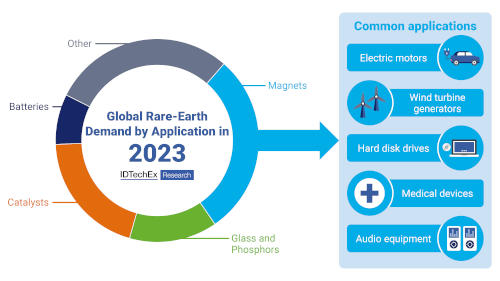
Global demand for rare earth elements for common magnet applications and uses. Source: IDTechEx
The imminent international climate targets, which depend on the decarbonization of energy and transport technology, are driving demand for rare-earth permanent magnets. Rare-earth permanent magnet motors used in electric vehicles typically provide the highest power, torque density, and efficiency, with associated low manufacturing costs, compared to competing motor technologies. As a result, rare-earth magnet motors have maintained over 77% of the electric vehicle motor market for the past nine years. IDTechEx predicts that the number of electric motors deployed will double by 2035.
The impact of rare earth supply challenges on magnets
The high regional concentration of rare earth supply and refining capacity poses a persistent risk to the magnet market. China processes over 90% of the world's rare earth elements annually; for heavy rare earth elements, such as dysprosium and terbium, this figure is nearly 100%. This regional concentration of supply also extends to downstream stages, where 92% of the production of higher value-added magnetic alloys (e.g., NdPr and NdFeB) and magnet manufacturing takes place in China.
The price of major magnetic materials has been volatile in recent years due to rare earth supply issues. In 2011, export restrictions on rare earths imposed by China increased the price of neodymium more than sevenfold, while the price of dysprosium rose by approximately 2,000%. More recently, rare earth prices peaked in 2022 at approximately four times their eight-year average. The potential for further price volatility continues to pose a significant risk to rare earth magnet markets amid growing demand.
China’s recent ban on the export of rare earth extraction and separation technologies has increased market interest in alternative sources of magnet precursors. In September 2024, New Zealand became the latest nation to identify rare earths as critical materials, joining the EU, US, UK, Japan, and others. The emergence of critical materials lists worldwide underscores the growing demand for developing domestic supply and processing capacity for rare earth critical materials.
How can rare earth elements be recovered from magnets at the end of their useful life?
The limited availability of primary rare-earth minerals in many regions makes end-of-life magnets a key alternative source of critical rare-earth elements. Permanent magnets can contain more rare earths than many primary mineral sources. For example, an NdFeB magnet contains approximately 33% by weight of rare earths, including up to 31% neodymium. In contrast, the low-rare-earth minerals that are typically mined contain around 1% by weight.
Startups are taking different approaches to recovering neodymium, praseodymium, terbium, and dysprosium from magnets at the end of their useful life.
Long-cycle recovery processes extract, separate, and recover critical rare earth elements from magnets as isolated rare earth oxides. Companies such as Ionic Technologies, Carester, and Shin-Etsu Chemical are developing conventional solvent extraction technologies, while ReElement uses a chromatographic separation process to recover rare earth elements from magnets with reduced solvent usage.
One advantage of long-cycle rare earth recovery is that the processes can be supplemented with primary mineral feedstocks if needed. Furthermore, the ability to sell isolated rare earth oxides in various application markets (beyond magnets) helps sustain the business models in the early stages while magnet recycling streams are being established.
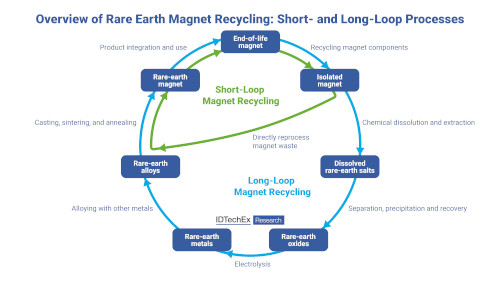
Critical recovery of rare earth elements in the short and long term from end-of-life magnets. Source: IDTechEx
Short-loop recovery directly processes rare-earth magnets to convert them into recycled pure magnetic material. Noveon Magnetics uses powder metallurgy, a high-temperature sintering process, to recycle end-of-life magnets and convert them into new magnets that retain 84% of their original magnetic strength. HyProMag, on the other hand, employs a hydrogen decrepitation process (reaction with hydrogen gas) to extract pure NdFeB alloy from end-of-life rare-earth magnets.
IDTechEx estimates that 195 tons of rare-earth magnets will be recycled in 2024 using short-loop processes. As the use of rare-earth elements becomes more established in magnet applications, short-loop processes are expected to become increasingly compelling recovery strategies due to their greater energy and chemical efficiency compared to long-loop solutions.
Market conclusions and outlook
The electrification of vehicle fleets worldwide continues to drive demand for rare-earth magnets. This demand is unlikely to decline—with China being the largest electric vehicle market, rare-earth permanent magnet motors are expected to maintain the majority of the electric motor market share. While critical rare-earth refining and magnet processing capacity will remain consolidated in China for the foreseeable future, this presents a clear opportunity for the development of alternative rare-earth sources, particularly the recovery of the magnets themselves.
IDTechEx forecasts that by 2045, $1.2 billion worth of critical rare earth elements can be recovered annually from secondary sources, and the value of recoverable rare earth elements is expected to grow at a CAGR of 14.9%. Whether long-cycle or short-cycle recovery strategies are more suitable has not yet been determined. One of the current goals of rare earth recycling startups is to develop sustainable business models until significant volumes of end-of-life material are available for recovery. In this regard, long-cycle processors are well-positioned, as major players currently supplement raw materials with mining waste and other primary minerals from junior mines in North America, Australia, and Central Africa.
Author: Dr. Jack Howley, Technology Analyst at IDTechEx