However, although efforts are underway to begin producing LFP outside of China, almost all of the active material in LFP battery cathodes and cells is currently manufactured in China, raising concerns about supply chain security and geopolitical risks for manufacturers that rely on LFP, particularly in the US.
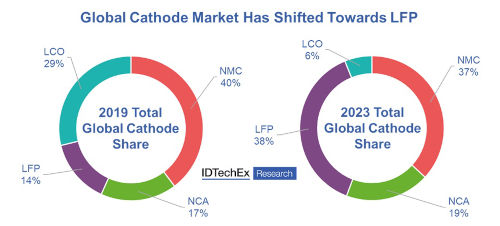
The global market share for lithium-ion cathodes has shifted from LCO to LFP. Source: IDTechEx
LMFP as a response to the energy density limitations of the LFP
Although LFP offers significant cost advantages and benefits related to cycle life and thermal stability, it has one notable drawback: its energy density is lower than that of NMC or NCA chemistries. Despite improvements in battery design, this limits the range of electric vehicles using LFP batteries, a key consideration for both automakers and consumers. Lithium manganese iron phosphate (LMFP) has emerged as a potential solution. LMFP maintains the cost advantages of LFP while improving energy density by incorporating manganese into the cathode composition. This development could help reduce the performance gap between LFP-based and NMC-based batteries, while maintaining the low-cost structure of LFP. Major cathode manufacturers, such as Dynanonic and Ronbay, and newer entrants like Lithium Australia/VSPC and Mitra Chem, plan to develop and expand their LMFP production capacity. The IDTechEx report "Li-ion Battery Market 2025-2035: Technologies, Players, Applications, Outlooks and Forecasts" offers production prospects for active material for cathodes and forecasts battery demand in GWh per cathode until 2035.
Artificial graphite is gaining market share over natural graphite
Another notable shift in battery material trends is occurring in the anode market, where engineered graphite is gaining ground on natural graphite. IDTechEx estimates that engineered graphite will account for approximately 73% of the graphite anode market for lithium-ion batteries in 2023, up from approximately 60% in 2020. The primary driver of this shift is cost. Historically, engineered graphite has been more expensive than natural graphite due to the energy requirements of graphitization, but it offered greater reliability in material production and some performance advantages related to capacity and cycle life. However, low energy prices in China and intense competition have driven down the price of engineered graphite, which has reached as low as $6 per kilogram for high-quality anodes. This has made artificial graphite a more attractive option for battery manufacturers seeking to optimize cost and performance, leading to its increased use. Importantly, this also creates a barrier to the adoption of alternative anode materials for cost-sensitive applications, such as silicon-based materials, which can be an order of magnitude higher in US$/kg.
Cost drives the battery market
Current trends in the selection of anode and cathode materials share a common factor: cost. The use of LFP and the development of other low-cost cathodes, such as LMFP, are prime examples of the increasing focus the Li-ion industry is placing on costs and prices. The recent shift towards synthetic graphite from natural graphite has also been driven by falling prices. Intense competition and excess capacity across the battery value chain are driving prices down even further. This will be highly beneficial for battery buyers and consumers, but it creates considerable obstacles for new entrants, particularly in Europe and North America, where less developed supply chains and industries present an additional barrier to competing with established Asian players and manufacturers.
A wide range of materials and technologies are emerging to meet the demands of a rapidly growing lithium-ion battery industry, but the key to the successful adoption of any material and technology will be cost, as demonstrated by the recent shift towards lithium-phosphate (LFP) and engineered graphite. Innovations and developments that can boost performance, safety, and environmental benefits while maintaining low and competitive prices will be crucial for the continued growth of the battery industry and the decarbonization projects that depend on it.
Author: Dr. Alex Holland, Director of Research at IDTechEx