
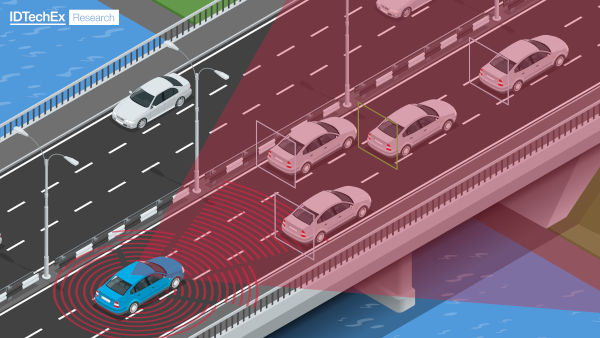
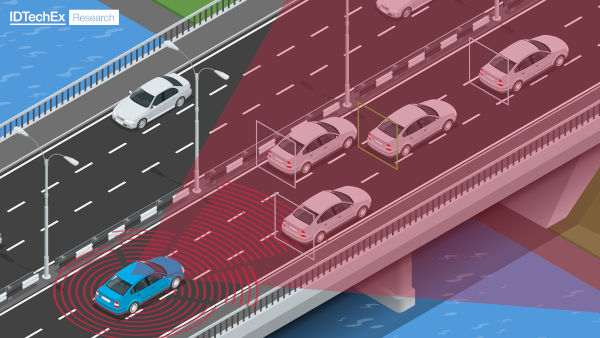
Front radar used in an adaptive cruise control application: Source: IDTechEx
Tesla and Radar:
Tesla is at the forefront of both electric vehicles and automated driving technologies. It's also a pioneer, being one of the only original equipment manufacturers attempting to build a fully autonomous vehicle using only a camera. However, the tide seems to be turning; since May 2023, the Model S and Model X have had radar reinstated with the HW4.0 update.
In 2016, when Tesla first claimed to have all the hardware in its vehicles to create a fully autonomous car, it used eight cameras and radar. Since then, its relationship with radar has deteriorated, and in 2021, Tesla decided it would be better off without radar and abandoned the sensor. It was first removed from production in the Model 3 and Model Y, followed by the Model S and Model X in 2022. Older models had the radar functionality disabled via over-the-air software updates. In 2023, Tesla technicians even began disabling the radar in some Model S vehicles.
The functionality of the radar-less vehicles remained unchanged. They still possessed the same ADAS features of adaptive cruise control and lane-keeping assist. Initially, there were some reports of reduced functionality under certain conditions, such as a lower maximum speed for adaptive cruise control in heavy rain. However, Tesla claims that modern versions of the "Tesla Vision" system have maintained and even improved safety ratings compared to the previous radar-based system.
In 2022, the FCC released certification documents showing that Tesla had been working on a radar system. Some speculation arose that the new radar would use Arbe's chipset. Arbe has one of the leading technologies for automotive radars and would represent a generational upgrade over the radar Tesla chose in 2016. This speculation stems from an image posted by X user "greentheonly," showing a list of vehicle configuration details and highlighting the name Phoenix below the radar section. Phoenix is also what Arbe calls its demonstration radar, which, combined with the companies' prior testing history, strongly suggests that Tesla's radar might be using Arbe's chipset.
Alternatively, IDTechEx believes that, based on available radar images, Tesla could have developed the radar in-house using off-the-shelf chipsets from companies like NXP, Texas Instruments, Infineon, or another leading Tier 2 vendor. This also aligns with Tesla's aggressive vertical integration approach.
The HW4 was first launched in the Model S and Model X in early 2023, followed soon after by the Model Y. Key changes, in addition to the radar, include a new set of front-facing cameras with wider fields of view and higher resolutions, new B- and C-pillar cameras, and a new, more powerful ADAS computer with 144 TOP of processing power and a redundant SoC.
Performance of modern radar
Radar is a powerful sensor that provides highly accurate information about distance and relative speed. This makes it essential for most manufacturers to enable systems such as adaptive cruise control and automatic emergency braking. Its drawback is that its image quality is much worse than that of a camera, and most systems will merge camera and radar data to understand what is being detected. However, the IDTechEx report "Automotive Radar 2024-2044: Forecasts, Technologies, Applications" shows that new technologies available for radar offer significant performance potential.
Tesla wouldn't have realized these new performance benefits with the outdated unit it was using until 2020. The weaker performance of Tesla's older unit meant its system was susceptible to phantom break-up phenomena. This occurs when the radar detects a harmless object, such as a manhole cover, and mistakenly classifies it as a hazard, such as a pedestrian in the road. The result of this misclassification is that the automatic emergency braking system will activate for no apparent reason. This creates an unsettling experience for the driver and passengers, and while it rarely happens, it can decrease user confidence.
Author: Dr. James Jeffs, Senior Technology Analyst at IDTechEx