The complex will house five such lines; another one is planned for 30 GWh/year, and more batteries will be manufactured under license.
Numerous competitors, including CATL, Svolt, Farasis, Lifun, DFD, Transimage, and others, are currently working on their own sodium-ion batteries, which are slated for mass production this year. Market analysis conducted by IDTechEx in November 2023 projects a minimum of approximately 40 GWh of SIB (Sodium-Ion Battery) growth by 2030, with up to an additional 100 GWh of manufacturing capacity anticipated by 2025 if the market is successful. The stage is set for another major shift in the battery industry in the coming years, similar to the large-scale emergence of LFPs (Liquid Power Factors) in 2020.
IDTechEx anticipates that sodium-ion batteries will first penetrate the A00 vehicle segment (small, low-speed electric vehicles) in China, as these are primarily used for urban commuting and do not require long ranges. The energy density of A00 class vehicles currently in production is mainly concentrated between 140 and 160 Wh/kg (pack level), and their cruising range is typically less than 250 km, according to IDTechEx research. Existing sodium-ion batteries can largely meet these requirements, as shown in IDTechEx's report, "Sodium-ion Batteries 2024-2034: Technology, Players, Markets, and Forecasts," which compares cells from various market players.
Recently, a race has emerged in China to be the first to use sodium-ion batteries in high-volume electric microcars, with Farasis, HiNa, and CATL announcing plans to supply sodium-ion batteries to JMEV, Sehol, and Chery for use in their respective A00-class models. A00 electric vehicle manufacturers are very cost-sensitive, and sodium-ion batteries offer certain advantages. In the long term, when sodium-ion batteries can be manufactured at scale, they are expected to have a 20-30% price advantage over lithium-ion batteries.
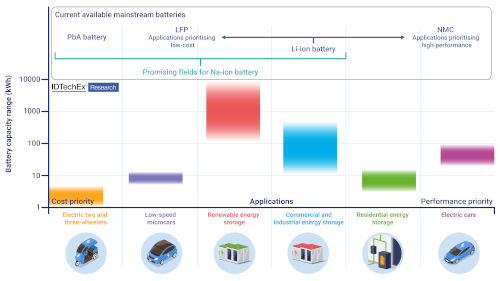
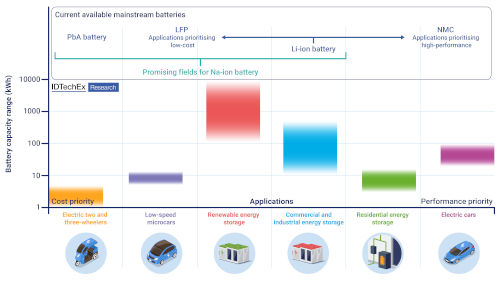
Sodium-ion batteries have characteristics comparable to lithium iron phosphate (LFP) batteries, suggesting potential applications for low-speed micro EVs. Source: IDTechEx
Although LFP batteries have improved since 2015, battery pack engineering has improved even more. The Sehol E10X's battery pack is air-cooled and uses cylindrical cells, giving it an energy density of 120 Wh/kg. In terms of weight, this is 96% of the 125 Wh/kg energy density of the 54 kWh LFP pack in the standard Tesla Model 3, first announced in 2020. But in terms of volume, this air-cooled pack wouldn't be competitive. Nor do HiNa's prismatic cells, with their volumetric energy density of 263-283 Wh/L, appear at first glance to be a viable replacement for LFP cells with 380-450 Wh/L. However, the engineering of cell-to-pack (CTP) battery packs has improved enormously even in the few years since they were first discussed in 2019.
CATL announced its sodium-ion batteries in 2021, along with a projected integration efficiency of over 80%. Such packs make even first-generation sodium-ion batteries viable as a direct replacement for older generations of cars with LFP battery packs from the early 2020s. Even from a performance standpoint, sodium batteries would be preferable to older cars with LFP batteries. They can be rapidly charged from 10% to 80% in 15 to 20 minutes and lose only 10% of their capacity at -20°C. Sodium-ion batteries can also be fully discharged without risk of catastrophic failure upon recharging, as would occur with lithium-ion batteries due to the copper current collectors in the anode.
CATL expects to sell its Prussian blue cathode batteries for as little as $30/kWh to $45/kWh in mass production due to the lower material cost of the iron-based cathode and the synthesis without the need for high-temperature calcination. More advanced stratified oxide cathode cells are expected to reach 200-220 Wh/kg and 400-500 Wh/l in the coming years, before the end of the decade. This will allow electric vehicles to exceed 500 km of range without the need for lithium. This will radically change the battery market. However, the energy density of high-nickel NMC cathodes is 20-40% higher than that of any known commercially available sodium-based cathode.
But this won't make sodium-ion batteries redundant. Cost matters more than energy density. It's important to remember that, even today, there's a 400 GWh/year lead-acid battery industry despite its low energy density of only 35 Wh/kg. Sodium-ion batteries, based solely on abundant materials like sodium, iron, manganese, carbon, aluminum, and the like, are sufficient for electric vehicles with a practical range of around 300 km, even in their current primitive form. Without critical resource constraints, this should help alleviate many of the geopolitical tensions currently building around access to battery materials like lithium, nickel, cobalt, and graphite. The IDTechEx report "Sodium-ion Batteries 2024-2034: Technology, Players, Markets, and Forecasts" takes an in-depth look at this emerging industry.
Author: Shazan Siddiqi, Senior Technology Analyst at IDTechEx