
where they are widely used as the backbone of server-to-server communication for training the most advanced machine learning models.
Currently, most PICs are based on silicon or silica, as the manufacturing techniques for these materials are the most mature. However, silicon and silica have properties that make them suboptimal or even unusable for some emerging quantum technology applications. As a result, this field has become a major driver of interest in new material platforms for PICs. This article delves into the data from the IDTechEx report, Materials for Quantum Technologies, which forecasts that PICs for quantum applications will reach a market of $12.6 billion by 2046.
Why is photonics so closely linked to quantum technology?
Photonics is the technological field dedicated to the generation and manipulation of light, and its study has historically been tied to advanced experimental physics: lasers, microscopes, and optical systems that can occupy entire laboratories.
Quantum technologies—which include quantum computing, sensors, and communications—largely originate from research centers and universities. However, as they evolve toward commercial applications, they can no longer rely on bulky and delicate optical systems. This is where PICs (Pictured Control Panels) add value: they allow these complex systems to be miniaturized into robust, mass-manufactureable chips.
Computing with Light:
Many of the most advanced approaches to quantum computing rely on photonic systems, including those based on neutral atoms, trapped ions, or photonic qubits. These systems use lasers, waveguides, and cameras to manipulate and measure individual particles.
The development of suitable PICs (Picture Controlled Premises) is key to scaling up these technologies. Therefore, in recent years there have been numerous acquisitions of photonic companies by quantum computing companies, with the aim of integrating manufacturing capabilities and specialized knowledge.
Beyond Silicon:
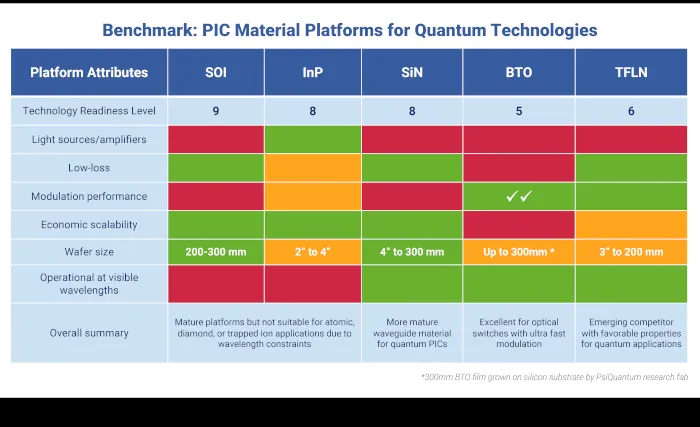
Although silicon is the dominant material, it has significant limitations, such as its lack of transparency in the visible spectrum, crucial for many quantum applications. Furthermore, these technologies require low interference and high stability, rather than speed or power.
Therefore, new materials such as silicon nitride (SiN), thin-film lithium niobate (TFLN), and barium titanate (BTO) are being explored, although they still present challenges in terms of cost and manufacturing.
Market Outlook:
PICs are already fundamental in telecommunications, data communications, and LiDAR, but quantum technologies are pushing their capabilities to the limit. The development of new supply chains and materials will be key to their growth, including applications in quantum computing, quantum networks, and cybersecurity.
The Materials for Quantum Technologies 2026-2046 report analyzes the factors that will drive this multi-billion dollar market, providing detailed forecasts and case studies based on industry insights.
Author: Noah El Alami, Technology Analyst