




IDTechEx has been covering the printed electronics and conductive inks market for over ten years, independently assessing the industry's technological and commercial developments. IDTechEx has published a new report, "Conductive Inks Market 2024-2034: Technologies, Applications, Players," which includes granular ten-year market forecasts, profiles of more than 30 key players, and provides comprehensive in-depth coverage of numerous end-use markets for conductive inks.
Conductive inks are a platform technology that enables a wide range of applications, from established ones (photovoltaics) to emerging ones (smart packaging). As printed/flexible/hybrid electronics gain traction, opportunities will arise for differentiated conductive inks to meet the needs of emerging applications such as in-mold electronics and wearable technologies. Many different types of conductive inks exist, each encompassing a distinct range of parameters, such as conductivity, print performance, and curing time. In this article, IDTechEx provides an overview of some considerations taken into account when evaluating ink technologies and key application areas.
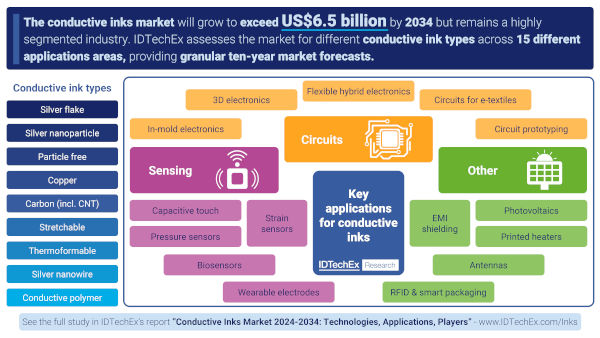
Overview of the conductive inks market segmentation provided in the IDTechEx market report "Conductive Inks Market 2024-2034: Technologies, Applications, Players". Source: IDTechEx
Ink technology
The conductive ink technologies in the IDTechEx report are segmented into the main categories used to market the inks, minimizing duplication as much as possible. Silver flake is currently the dominant conductive ink material, estimated to account for around 97% of the market by weight. Large companies, such as Henkel, DuPont, and Sun Chemical, are the leading producers. Therefore, while it might not be considered an "emerging technology" per se, the emergence of high-volume applications for printed/flexible electronics, such as smart packaging or electronic skin patches, is expected to drive increased sales. Nanoparticle-based inks are typically produced by smaller suppliers, whose main selling point is higher conductivity. However, a substantial shift away from conventional flake-based inks has not yet occurred for most applications. Particle-free conductive inks are produced by a number of early-stage companies and offer clear advantages for electromagnetic interference (EMI) shielding and printed antennas.
Beyond silver, copper inks have long been desirable due to the much lower cost of the raw material, and after years of unsuccessfully battling oxidation during sintering, they are finally gaining commercial traction. Carbon-based inks fall into two categories: low-cost carbon-based inks (typically carbon black) and those based on more expensive conductive/semiconductive nanocarbons, such as graphene and carbon nanotubes (CNTs). Stretchable and/or thermoformable conductive inks can be produced using multiple formulations, the most common being flake-based inks with an elastomeric binder. This class of conductive inks is likely to grow rapidly with the adoption of wearable electronics/electronic textiles and in-mold electronics (IME). Further down the list of ink types are also silver nanowires and conductive polymers, both suited to specific applications.
Key applications
Conductive inks are arguably the leading platform technology for printed/flexible electronics, used in all types of devices and components. As such, these materials have a broad and diverse application space, ranging from photovoltaic panels to electronic skin patches and from transparent antennas to pressure sensors. IDTechEx aims to structure this complex application space by segmenting the market into three distinct categories. In circuit fabrication, conductive inks are used to connect components, and the required properties are determined by the fabrication methodology rather than the device's functionality. Conductive inks can also be used to enable a specific type of sensing, which determines the required properties. Furthermore, conductive inks are used to provide non-sensor functionalities beyond simply connecting components.
The current market for conductive inks is dominated by the use of silver flake-based ink as a charge collector in photovoltaics. However, increasing efficiency and the transition to the next iteration of solar cell technology will lead to extremely modest growth in demand for silver flake-based ink in photovoltaics over the next decade. In fact, the vast majority of demand growth for this dominant ink type will come from emerging opportunities in applications such as 3D electronics, printed heaters, RFID, and smart packaging.
The greatest growth opportunity for conductive inks lies in non-silver inks, with IDTechEx forecasting a 24% CAGR in market revenue. Stretch/thermoformable inks and copper inks will capture the largest share of this expanding market, driven by applications such as in-mold and wearable electronics. For silver flake inks, RFID and smart packaging will also be key application areas for growth over the next decade.
Author: Dr Conor O'Brien, Senior Technology Analyst at IDTechEx













