According to IDTechEx's market report, "Redox Flow Batteries Market 2024-2034: Forecasts, Technologies, Markets," as demand for these technologies increases, so will revenue-generating opportunities for stakeholders across the value chain. In the earlier stages of the value chain, stakeholders will focus on manufacturing materials and components and supplying them to RFB developers.
Electrolyte
A complete RFB system consists of three main components: the electrolyte, the cell stack, and the balance of plant (BOP). The most widespread RFB system, VRFB, uses an expensive vanadium electrolyte. In 2021, miners supplied 120,000 tons of vanadium worldwide, 92% of which went to steel production, while the VRFB market accounted for 2%. Key companies such as Glencore, Largo, and Bushveld are responsible for vanadium mining and will be key players in this part of the supply chain. The vanadium electrolyte represents approximately 30–50% of the unit cost of a VRFB and will be influenced by the overall system size as well as the required storage duration.
Stack of cells
The cell assembly also accounts for a significant portion of the unit cost of VRFBs and comprises several key components. These include the membrane, bipolar plates, electrodes, gaskets, and sealants. Arguably, the two most expensive components of a VRFB stack are the membrane and the bipolar plates. As the number of VRFB installations increases, so will the demand for components and materials for these systems.
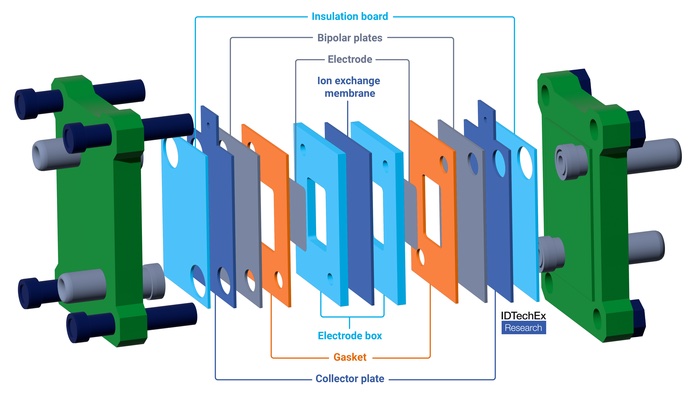
RFB cell stack exploded view. Source: IDTechEx
Membranes
The function of membranes is to prevent the two electrolytes in a bioreactor (BR) from mixing and the two electrodes from touching, while simultaneously allowing the flow of opposite ions (such as H+). Membranes typically balance ionic conductivity with species selectivity. Commercial membranes range in thickness from 50 to 200 microns. In a BR, the ideal membrane should have good ion exchange capacity and ionic conductivity, low permeability to active species to prevent self-discharge, and be chemically resistant to aggressive species.
The most commonly used membranes in RFBs are cationic ion-exchange membranes (CEMs). Cationic CEMs can be fluorinated or non-fluorinated. The standard material for fluorinated cationic CEMs is perfluorosulfonic acid (PFSA), with Nafion, originally manufactured by DuPont, being the prime example. They offer good ionic conductivity and resistance to acidic environments, although they exhibit non-negligible vanadium species cross-linking rates in VRFBs. Some RFB developers, in interviews with IDTechEx, commented that they have focused their R&D efforts on mitigating this issue and claim it is no longer a drawback for their technology. However, these materials have remained confidential, as they are likely to offer a commercial advantage. Therefore, cationic CEMs are expected to remain the most popular membrane choice for RFB systems, given their comprehensive properties. However, as highlighted in the IDTechEx study, it is an expensive component of the cell stack, representing approximately 50% of the stack's cost.
Bipolar plates
The bipolar plate increases the structural stability of the cell stack and allows electrons to flow from the positive electrode of one half-cell to the negative electrode of the next. Materials typically used for bipolar plates include graphite, graphite-filled polymers, titanium, or steel. Binders, usually thermoplastics or thermosetting polymers such as fluoropolymers, polyethylene, and polypropylene, may be used in the manufacture of composite bipolar plates. These binders typically make up 10–20% of the bipolar plate's material composition. Examples of bipolar plate manufacturers include Hycco and Schunk. Ultimately, bipolar plates constitute a significant portion of the cell stack's cost.
Perspectives
In the next decade, it will be important for RFB manufacturers to have established their supply chains to meet the growing demand for long-life energy storage technologies. There will be increasing opportunities for value chain players to supply materials and components to RFB developers. These may include electrolytes, membranes, bipolar plates, or the materials that make them up, such as PFSA, graphite, graphite-filled polymers, titanium, steel, thermoplastics, thermoset polymers, and so on. While the electrolyte represents between 30% and 50% of the unit cost of VRFBs, the membrane and bipolar plates account for between 30% and 50% of the unit cost of VRFBs.
Author: Conrad Nichols, technology analyst at IDTechEx