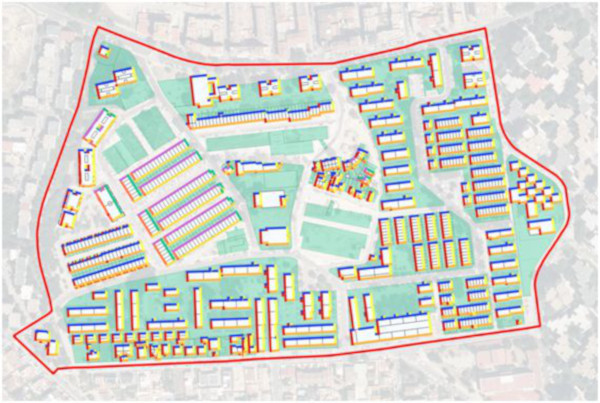
The work of the European Union's Standing Committee on Cadastre to promote transparency of data held in public registers has led to the recent open publication of cadastral databases. The availability of this information has significantly expanded the possibilities for using data on existing buildings in urban studies. Processing cadastral databases allows for new levels of detail that were previously impossible, surpassing analyses based on samples of representative buildings carried out to date.
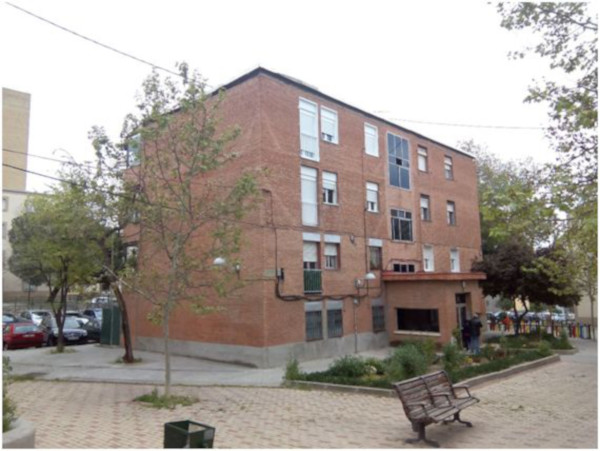
The cadastral data used in this study pertains to Canillas, a Madrid neighborhood classified as a disadvantaged urban area with a very low energy efficiency rating. As a result of this work, the researchers have proposed a method that uses programming techniques for the analysis of complex systems (big data), applying urban data science to automate data processing and enabling the inclusion of broad areas of analysis. As Fernando Martín-Consuegra states, “having data for each building, obtained from cadastral records, provides us with a useful tool for designing energy rehabilitation strategies and allows for the quantification of, among other things, heat transfer through the building envelope.”.
 The study has successfully defined a passive energy efficiency indicator for an urban area or neighborhood, encompassing urban planning and building aspects (dimensions, orientation, building shape and layout) and construction aspects (such as the quality of the building envelope). This indicator is useful for identifying priority areas for the renovation of inefficient buildings, allowing for the identification of the most affected buildings. One of the most unique results obtained in the study, according to the lead researcher, is that "we have found that, in addition to construction quality, which has been the focus of attention until now, the geometric aspects of the urban fabric have a significant influence on energy losses.".
Comparing the energy losses of the original building with different improved scenarios allows for estimating the potential for reducing energy demand. By inputting unit cost data for the improvements, the total investment needed to improve the building envelope in energy rehabilitation projects for neighborhoods can be approximated. This method—which is useful for determining aspects of energy demand in the regulatory definition of the "Nearly Zero Energy Neighborhood" concept—also provides valuable information for designing energy supply infrastructure and district heating systems.
This work is part of the research developed within the context of the doctoral thesis of architect Fernando Martín-Consuegra Ávila, supervised by Dr. Agustín Hernández Aja, tenured professor at the UPM (Technical University of Madrid) and principal investigator of the Research Group on Architecture, Urbanism and Sustainability (GIAU S), and co-supervised by Dr. Ignacio Oteiza Sanjosé, researcher at the Eduardo Torroja Institute of Construction Sciences (IETCC) of the CSIC (Spanish National Research Council). It has benefited from the essential participation of Fernando Frutos García, an urban planner specializing in big data and a doctoral student in the Complex Systems Group (GSC) at the UPM. It has also benefited from the collaboration of the HABITAres Project “New integrated assessment tool for vulnerable urban areas. Towards energy self-sufficiency and in favor of a bio-healthy habitability model”, REF BIA 2017-83231-C2-1-R, directed by Ignacio Oteiza.
Martin-Consuegra, Fernando; de Frutos, Fernando; Oteiza, Ignacio; Hernández-Aja, Agustín. Use of cadastral data to assess urban scale building energy loss. Application to a deprived quarter in Madrid. ENERGY AND BUILDINGS 171: 50-63. DOI: 10.1016/j.enbuild.2018.04.007. JUL 2018.