Now, MIT engineers have developed a spring-like device that could be used as a basic skeletal module for almost any robot with muscles. The new spring, or "flexor," is designed to get the most out of any attached muscle tissue. Like a leg press with just the right weight, the device maximizes the amount of movement a muscle can naturally produce.
The researchers discovered that when they attached a ring of muscle tissue to the device, similar to a rubber band stretched around two poles, the muscle reliably and repeatedly pulled on the spring, stretching it five times further compared to previous device designs.
The team views the flex design as a new building block that can be combined with other flexes to construct any configuration of artificial skeletons. Engineers can then equip these skeletons with muscle tissue to power their movements.
"These push-ups are like a skeleton that can now be used to convert muscle drive into multiple degrees of freedom of movement in a very predictable way," says Ritu Raman, the Brit and Alex d'Arbeloff Professional Development Professor of Engineering Design at MIT. "We're giving roboticists a new set of rules for building powerful, precise, muscle-driven robots that do interesting things.".
Raman and his colleagues report the details of the new bending design in an article appearing in the journal Advanced Intelligent Systems. Co-authors of the study at MIT include Naomi Lynch (12), SM (23), undergraduate student Tara Sheehan, graduate students Nicolas Castro, Laura Rosado, and Brandon Rios, and mechanical engineering professor Martin Culpepper.
Muscle strain
When left alone in a Petri dish under favorable conditions, muscle tissue contracts on its own, but in directions that are neither entirely predictable nor very useful.
"If the muscle is not subject to anything, it will move a lot, but with enormous variability, so it will only agitate in the liquid," Raman explains.
To make a muscle function as a mechanical actuator, engineers typically fix a band of muscle tissue between two small, flexible poles. When the muscle band contracts naturally, it can bend the poles and pull them together, producing a movement that would ideally power part of a robotic skeleton. But in these designs, the muscles have produced limited movement, mainly because the tissues vary greatly in their contact with the poles. Depending on where the muscles are positioned on the poles and what part of the muscle surface touches the pole, the muscles may succeed in pulling the poles together, but at other times they can wobble uncontrollably.
Raman's group sought to design a skeleton that would concentrate and maximize the contractions of a muscle regardless of exactly where and how it was placed on the skeleton, in order to generate maximum movement in a predictable and reliable manner.
"The question is: how do we design a skeleton that most efficiently utilizes the force generated by muscle?" Raman states.
The researchers first considered the multiple directions in which a muscle can naturally move. They reasoned that if a muscle has to pull two posts in a certain direction, the posts must be connected to a spring that only allows them to move in that direction when pulled.
"We need a device that is very soft and flexible in one direction and very rigid in all others, so that when a muscle contracts, all that force is efficiently converted into movement in one direction," Raman explains.
Gentle flexion
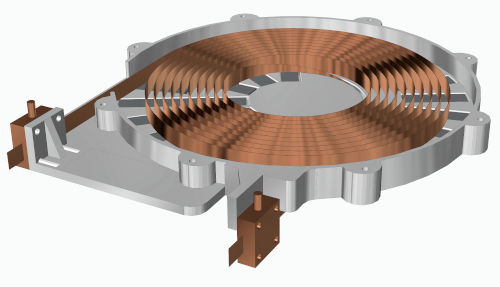
Raman found many of these devices in Professor Martin Culpepper's lab. Culpepper's group at MIT specializes in designing and fabricating machine elements, such as miniature actuators, bearings, and other mechanisms, that can be incorporated into machines and systems to enable ultra-precise movements, measurements, and controls in a wide variety of applications. Among the group's precision-machined elements are flexures, spring-like devices, often fabricated from parallel beams, that can flex and stretch with nanometer precision.
"Depending on how thin and separated the beams are, the stiffness of the spring can be changed," Raman explains.
Ella and Culpepper teamed up to design a specially tailored push-up bar with a configuration and stiffness that would allow muscle tissue to contract naturally and fully stretch the spring. The team designed the device's configuration and dimensions based on numerous calculations they performed to relate a muscle's natural forces to the stiffness and range of motion of a push-up bar.
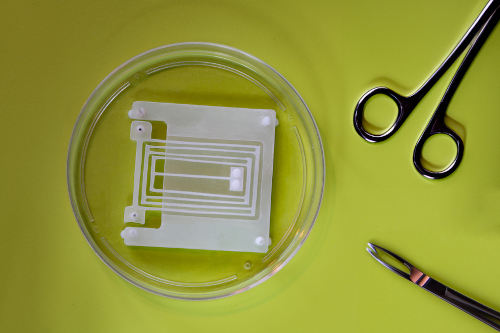
The flex they ultimately designed is 1/100th the stiffness of the muscle tissue itself. The device resembles a miniature accordion-like structure, its corners attached to an underlying base by a small post, which sits close to a neighboring post that fits directly into the base. Raman then wound a band of muscle around the two corner posts (the team fashioned the bands from live muscle fibers grown from mouse cells) and measured how close the posts moved when the muscle band contracted.
The team discovered that the flex configuration allowed the muscle band to contract primarily in the direction between the two posts. This concentrated contraction enabled the muscle to bring the posts much closer together—five times closer—than previous muscle actuator designs.
"The flexor skeleton is designed to be very soft and flexible in one direction and very rigid in the others," Raman explains. "When the muscle contracts, all the force is converted into movement in that direction. It's a huge boost.".
The team discovered they could use the device to accurately measure muscle performance and endurance. When they varied the frequency of muscle contractions (for example, by stimulating the bands to contract once versus four times per second), they observed that the muscles "tired" at higher frequencies and did not generate as much traction.
"Observing how quickly our muscles tire and how we can train them to have high-resistance responses is what we can discover with this platform," Raman says.
Researchers are adapting and combining flexes to build precise, articulated, and reliable robots powered by natural muscles.
"One example of a robot we're trying to build in the future is a surgical robot that can perform minimally invasive procedures inside the body," says Raman. "Technically, muscles can propel robots of any size, but we're particularly excited about building small robots, as this is where biological actuators excel in terms of strength, efficiency, and adaptability."
###
Written by Jennifer Chu, MIT News