




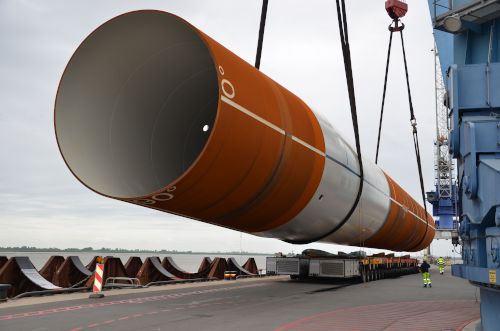
To ensure that these steels can withstand storms, waves, and the harshness of saltwater for many years, while remaining economically viable to produce, materials researchers at Saarland University and mechanical engineers at RWTH Aachen University are collaborating with steel specialist Dillinger and other companies to develop new, customized steel grades. The research project is supported by a €1.2 million grant from the German Federal Ministry for Economic Affairs and Energy.
The production of the enormous steel tubes for offshore wind farms requires heavy plates like those produced by the steel company Dillinger in Saarland. The plates, with a wall thickness of about ten centimeters, are welded together to form pipe sections with diameters of up to ten meters. These are then joined piece by piece with additional weld seams to reach lengths of more than 80 meters. "The main problem with this process is the intense heat briefly applied to the steel during welding, which alters the material's internal structure. The thicker the heavy plates and the faster they are welded under production conditions, the more drastic the structural deviations around the weld seams can be," explains Frank Mücklich, professor of functional materials at Saarland University.
The materials researcher and his team have developed special analytical techniques that can be used to quantitatively represent all the changes in the internal structure of materials. To do this, the researcher uses high-resolution electron and ion microscopes, including nanotomography and atomic probe tomography. The information and image sequences acquired at different scales in this process are combined on a computer to form a precise spatial image of the steel's structure, down to the individual atom. "This allows us to see at the micro and nano levels, as well as at the atomic scale, what fine adjustments need to be made to modify a material so that it has the desired properties," said Frank Mücklich, who also heads the Steinbeis Research Center for Materials Engineering on the Saarbrücken university campus.
The project partners are now collaborating with monopile manufacturers EEW Special Pipe Constructions, the Sif Group, and welding consumables and power supply manufacturer Lincoln Electric to further optimize the heavy plate steel for the welding processes used in offshore wind turbine construction. “Dillinger has made forward-thinking investments and driven innovation in recent years to develop an advanced plate for the demanding monopile market,” said Sebastian Scholl, PhD in materials science and a welding engineer at Dillinger. “As a result, Dillinger has already been able to significantly increase productivity and contribute to reducing the construction costs of offshore wind turbines.”.
Scholl added that it is also important to continue increasing the efficiency of heavy manufacturing processes, for example, by increasing the maximum welding speed achievable with Dillinger steel grades. Modern welding processes for heavy plate, such as multi-wire submerged arc welding or electron beam welding, play a significant role in this regard. "The next important step will be to reduce production time. This can be achieved with high-performance welding methods. That is why we want to collaborate with our partners on this research project to develop a steel that meets these high requirements," Scholl said.
Professor Uwe Reisgen, Director of the Welding and Joining Technology Institute at RWTH A&M University, agrees: “Huge steel structures like these are absolutely inconceivable without welding technology. For the enormous quantities required, we need both highly efficient welding processes and tailored materials. They have to be easy to process using high-performance welding methods, without losing their mechanical and technological properties. I am very pleased that such a competent steel company as Dillinger wants to pursue this path with us.”.
The German Federal Ministry for Economic Affairs and Energy is funding the joint project with €1.2 million under the energy research program "Innovations for the Energy Transition." The research project has a total budget of over €1.9 million. "With this project, we want to contribute not only to the further development of renewable energy but also to securing production facilities in Germany and Europe," said materials researcher Frank Mücklich.













