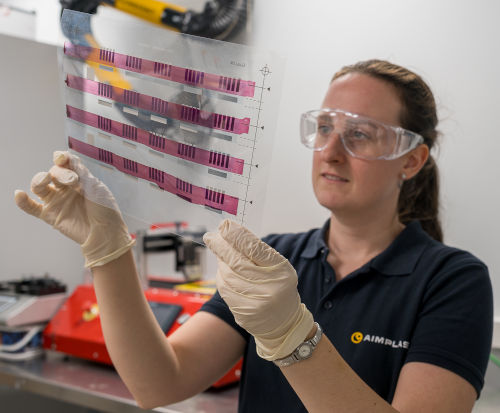
As explained by Susana Otero, lead researcher in Engineering at AIMPLAS, “flexible solar cells based on perovskites are more economical, versatile, and environmentally friendly than silicon cells. With the PEROVSOL project, funded by IVACE, we aim to advance the manufacturing of cells with this material using conventional printing technologies, such as screen printing and slot-die printing. This would significantly reduce production costs and pave the way for large-scale commercialization.”
Furthermore, the researcher continued, “perovskite production is a good alternative to silicon and consumes much less energy, which is an advantage when it comes to bringing this product to market, both in terms of sustainability and cost, as well as industrialization.”
The work developed by AIMPLAS in the previous SOLARFLEX project, focused on polymer solar cells, gives rise to a new line of research in flexible solar cells that materializes in the PEROVSOL project, in which the leap is made to working the active layer using perovskites, much more efficient, but also more reactive than polymer cells to oxygen and humidity, which requires working in an inert atmosphere to avoid their oxidation.
Photovoltaic Solar Cells for Renewable Energy Generation.
Regarding environmental sustainability, the PEROVSOL project contributes to the development of technology for the production of photovoltaic solar cells for renewable energy generation. Furthermore, the use of printing as a manufacturing technique allows for the controlled deposition of the exact amount of material required, which will reduce the volume of waste generated in the manufacture of solar panels compared to more conventional technologies.
The PEROVSOL project benefits from the cooperation of leading companies in the various materials that will be used in the layered structure of the perovskite-based solar cell, such as INTENANOMAT for the electron transport and hole transport layers (HIL), Omar Coatings for resins for device encapsulation, and ClearPet for the use of recycled PET material. All these companies are interested in new materials for the development of flexible solar panels that can be integrated into complex geometries, and in the most efficient use of resources, both in terms of materials used and energy consumed in their processing.
In addition, AIMPLAS is also collaborating with the Advanced Semiconductors Group of the Institute of Advanced Materials (INAM) at the Universitat Jaume I in Castellón, and with the UMDO+ group of the University Institute of Materials Science at the University of Valencia (ICMUV), who will contribute their expertise in the formulation and characterization of perovskite active layers and the solar cell.
The PEROVSOL project is included in the Valencian Institute of Business Competitiveness (IVACE) grant program for technology centers in the Valencian Community for non-economic R&D projects carried out in collaboration with companies for the 2023 fiscal year, funded by the European Regional Development Fund (ERDF) of the European Union within the framework of the 2021-2027 Operational Program.