





This report constructs a detailed quantitative model to forecast the addressable market size for dies and substrate attachment materials in various power electronics functions across all forms of electric vehicles. It also develops ten-year market forecasts, both in value and volume, segmenting the market by material type. The materials considered in this document include nano-silver sintering, micro-silver sintering, copper sintering, SAC and other solders, and transient liquid-phase bonding materials.
The report provides a comprehensive view of industry trends, observing the trends driving the adoption of higher-performance die attachment materials; studying how encapsulation solutions, including die attachment, interconnection, and cooling mechanisms, are evolving to meet increasingly stringent industry requirements; and examining the various existing and past implementations of power modules in leading electric vehicles. The report also provides a comprehensive review of all companies offering metal sintering solutions worldwide.
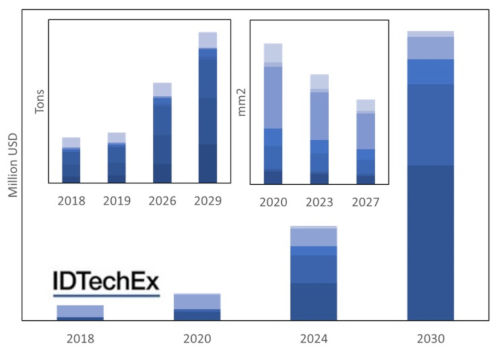 Main chart: Market forecast for various pellet bonding materials used for both die and substrate bonding. The materials included here are, but not limited to, SAC and other solders, copper sintering, TLB, and micron- and nano-Ag sintering.
The change in the material mix will affect market value due to price differences. Left box: addressable market forecast for die bonding in pitches segmented by electric vehicle category, e.g., mild hybrid, plug-in hybrid, forklift, bus, motorcycle, etc. Right box: forecast for the aggregate die area segmented by power electronics function, e.g., charger, DC/DC converter, inverter, etc.
Background:
The electric vehicle market is expanding. As a consequence, the market for power modules in all types of electric vehicles is also expanding. This, in turn, will lead to a growing demand for materials, including die-fixing materials, used in power electronics packages and modules.
Our team has been researching the electric vehicle market for the past 15 years. This ongoing internal research uniquely examines a wide range of electric vehicles, including 48V hybrid, plug-in hybrid, hybrid, and fully electric vehicles, as well as electric forklifts, buses, motorcycles, scooters, drones, and more. Much of this data supports our forecasting models.
Power electronics technology itself is also evolving. This report provides an overview and benchmarking of various semiconductor technologies (Si, SiC, GaN). Here, we consider the advantages of each material technology at both the material and device levels. We then describe their key target applications in terms of voltage and power requirements. We will highlight some of the challenges facing broadband semiconductors.
More specifically, we will argue that these new technologies are not a direct replacement for Si MOSFETs or Si IGBTs. Many package designs, drive schemes, and circuits will need to be adapted to enable the optimal use of these technologies. We will then consider the commercial rationale for deploying SiC in inverters for all-electric, high-range vehicles, despite SiC being, and likely to remain, more expensive than Si, even if, as is underway, its production shifts to larger wafer sizes.
Of particular interest to this study is the trend toward increasing power-area densities, which translates into higher operating temperatures. In fact, the temperature has already risen to 170°C from around 70°C in the early 2000s, and the industry is keen to push it further toward 250°C.
This trend is partly aided by the transition to broadband materials such as SiC and GaN, which can tolerate high operating temperatures. These materials will shift the temperature bottleneck away from the device junction temperature and towards the package materials. These materials will also allow smaller dies to handle large power levels, thereby increasing power-area densities. The combination of trends towards high power density and more efficient high-frequency operation (which reduces passive component size) will result in smaller, embedded power electronic packages. To accommodate this and other trends, package technology will have to adapt and is adapting. In fact, this trend will push many materials, including most solders, beyond their performance limits, thus opening the door to alternatives.
The report examines how interconnect technology is moving away from classic aluminum wire bonding, which (a) suffers from low thermal conductivity, (b) is not suitable for double-sided cooling, and (c) is a common point of failure. Many alternative approaches are reviewed, including (1) bonding copper wires to copper-metallized dies; (2) Soldered/sintered copper wires/clips/pins with/without spacers; (3) bonding Cu wire to sintered buffer boards; (4) bonding metallized flexible film with adhesives; and (5) metal sintered flexible PCB fitting. Note that this topic relates to materials because in some implementations, for example, a sintered metal or solder is used.
The limitations of solder technology as a pellet bonding material are examined in another section. We consider the maximum operating temperature of various solder chemistries and show how the homologous temperature of the solder technology, especially lead- and gold-free solders, is low, leading to a high probability of failure as operating temperatures approach 175–200°C. We then compare metal sintering against various solder technologies, demonstrating that metal sintering can offer similar volume melting temperatures, high thermal conductivity, and a relatively low CTE mismatch with copper. The price levels of various options are also compared.
A review is conducted of how several companies, including ABB, ST Micro, Semikron, Infineon, StarPower, Danfoss, Continental, Siemens, Microsemi, CRRC, Fuji Electronic, and Hitachi, have used or demonstrated metal sintering. In fact, it is clear that most manufacturers today have the capability to work with metal sintering technology.
An overview of the inverter power modules used in various hybrid and fully electric vehicles is provided. The power modules deployed by various vehicle manufacturers, either directly or indirectly, are examined. These overviews will include inverters used by General Motors, Hyundai, Volkswagen, Daimler, Nissan, Honda, BMW, Tesla, and others. The module manufacturer is also highlighted. This section emphasizes the diverse design and material choices made by each player in terms of substrate, cooling technology and design, die and substrate fixation, etc. Trends will become clear despite the fact that multiple designs exist and have proven to meet current requirements. As previously stated, these designs will evolve to keep pace with future requirements and emerging semiconductor technologies.
Materials, processes, and suppliers of metal sintering pellet bonding pastes are discussed. First, the key characteristics of pressure metal sintering pastes are examined, considering sintering process conditions, joint shear strength, and the relationship between sintering pressure and sintered layer porosity. Some equipment used in pressure sintering is also highlighted. Further discussion follows on how the product form factor is evolving beyond the previous pastes toward preforms and dry transfer films to make metal sintering as replaceable as possible. Finally, pressureless sintering is considered. Typical challenges, including the conventionally long sintering time and the difficulty of sintering large-area pellets without creating excessive drying channels, are discussed.
Suppliers of Ag and Cu sintering pastes are also covered. Here, a comprehensive overview of companies including Heraeus, Alpha Assembly, Namics, Kyocera, Bando Chemical, NBE Tech, Mitsubishi Materials, Indium, Henkel, Nihon Superior, Dowa, Nihon Handa, AmoGreen, Mitsui Mining, Hitachi Chemical, and others is provided.
A detailed forecasting model is then constructed. The first model estimates the power levels and array area used in each power module function for each vehicle type considered. Here, we consider chargers, inverters, DC/DC converters, etc. Next, we develop forecasts of the pad area as a function. This is based on studies of multiple current implementations. In general, the pad area is decreasing as pads become more capable of handling higher power levels, allowing for the use of smaller pads. Note that the increasing availability of SiC technology will contribute to this process. This step will allow us to build our addressable market forecasts for pad fixing materials in terms of material volume or mass. Next, we studied several implementations to estimate the addressable volume market for the motherboard-to-substrate attachment. Here, we considered multiple factors, including larger areas, thicker bond lines, and the fact that not all power module implementations will require such an attachment. We then developed our market share projection using the pad-fixing technology for die-to-substrate and substrate-to-board applications. The pad-fixing technologies considered included nano-Ag sintering, micro-Ag sintering, Cu sintering, SAC and other soldering, and transient liquid-phase bonding materials.













