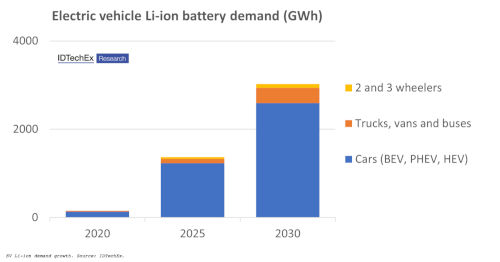
However, improvements in battery performance and cost are being sought, and although progress may be increasingly gradual, there are several avenues for the continuous improvement of lithium-ion battery technology.
Batteries:
In the short term, current trends in electric vehicle battery cells are likely to continue. For example, the average nickel content of NMC and NCA chemistries continues to increase to boost energy density and reduce cobalt content. Arguably the biggest trend is the overall shift towards LFP, a cheaper and safer option than NMC and NCA (though not inherently safe). While LFP's energy density may be 30-40% lower than that of NMC or NCA, its lower cost advantages have become unavoidable in recent years. Consequently, the percentage of LFP in electric cars has grown, although it should be noted that most of this growth has been due to readoption in China. NMC and NCA remain the preferred choice in Europe and North America, although LFP has begun to enter the market. NMC chemistries also remain the preferred choice for turnkey packages in other vehicle segments. However, the pressure of costs and the supply of materials, along with technological improvements, suggest that the LFP will increase its share in the EV market.
More transformative advances are on the horizon. Solid-state battery developments continue to be announced and are already being commercialized, for example, through Blue Solutions' polymer solid-state batteries. The use of silicon anode material is expected to increase with the development of more advanced silicon anode solutions and commercially ready products, which promise improvements in energy density and fast charging. New cathode chemistries are also being explored. For example, lithium manganese iron phosphate (LMFP) offers an interesting alternative with the potential to deliver many of the advantages of LFP while increasing energy density to approach that of NMC batteries, although its commercial deployment is still limited.
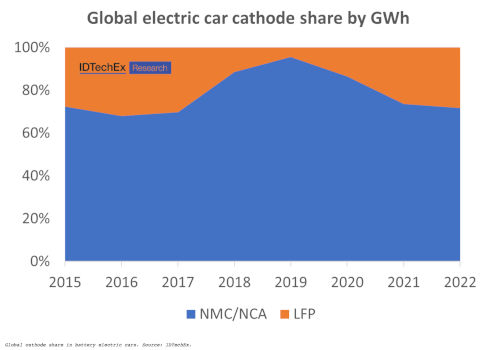 Global market share of cathodes in battery electric vehicles. Source: IDTechEx.
Battery Design:
In light of the increasing adoption of LFPs in electric vehicles, cell-to-cell battery design is gaining importance. These designs offer greater packaging efficiency, increasing energy density to help reduce one of the main disadvantages of using LFPs compared to NMC or NCA batteries. CATL and BYD have implemented CTP designs, along with Tesla, Stellantis, and other manufacturers. To improve gravimetric energy density, lightweight polymer casings are being promoted as an alternative to steel and aluminum casings.
Other companies like CATL, NIO, and Our Next Energy are exploring dual-chemistry designs. Our Next Energy presents the most extreme example, with plans to combine a high-energy-density but short-cycle chemistry as an extended-life LFP. Ultimately, combinations of different Li-ion chemistries, or even combining Li-ion with Na-ion, could help optimize the inevitable trade-offs between power, energy density, lifetime, and low-temperature performance.
Thermal Management:
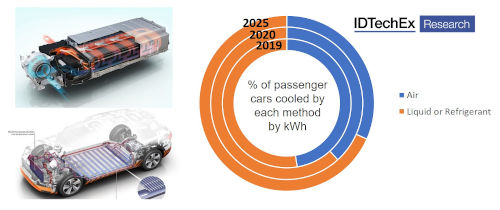
Thermal management and fire protection have become critical aspects for electric vehicle batteries in light of safety issues, high-impact fires, and battery recalls. While early electric vehicle models used passive air cooling, liquid cooling has gained prominence in several vehicle segments in recent years. According to data from IDTechEx, designs with active liquid cooling accounted for 90% of the electric car market, up from just over 50% in 2015. This trend is not limited to electric cars. Most turnkey batteries for commercial vehicle segments are also offered with liquid cooling. As cell technology advances, developments in areas such as thermal management become increasingly important, not only for maintaining safe operation but also for maximizing the available performance of lithium-ion batteries.
Battery Management Systems:
The battery management system (BMS) plays a fundamental role in the safe and reliable operation of any lithium-ion battery. While the primary function of a BMS is relatively well-defined, it also offers a way to enhance the performance of lithium-ion batteries. Safety, lifespan, fast charging, and even energy density can be improved through BMS development, and, importantly, with minimal compromises.
The development and application of more accurate battery and cell state estimation (e.g., state of charge, state of health, or state of power) are critical for improving performance, as they allow for safely extracting maximum performance from a battery. In addition to advancements in BMS software and algorithms, wireless BMS solutions are also being commercialized. Implementing wireless solutions eliminates much of the cabling, which helps reduce weight and eliminate potential failures. Although deployment is relatively slow, with GM's initial announcement of its wireless BMS in 2020, semiconductor BMS manufacturers are already offering solutions for wireless BMS designs.
The new IDTechEx report, "Li-ion Batteries and Battery Management Systems for Electric Vehicles 2024-2034," offers an analysis of key innovations, advancements, and trends in lithium-ion batteries and battery management systems (BMS) for electric vehicles, including an analysis of performance data. The report provides an overview of some of the main drivers, challenges, and battery technology options for multiple electric vehicle segments.
Author: Dr. Alex Holland, Principal Analyst at IDTechEx