




“ These materials are vital for the development of economic activity, as they are used in the production of a wide variety of goods and new technologies in sectors such as automotive or renewable energies,” highlights Miquel Rovira, Director of the Sustainability Area at Eurecat.
“These materials are considered critical because their supply is not always guaranteed, given that they are scarce materials and it is strategic for Europe to be able to have them beyond their extraction, recovering them with technologies that contribute to the circular economy and industrial autonomy,” he points out.
One example is the European project Sea4Value, where Eurecat has participated in the development of a new process for the recovery of high-value materials and minerals, such as lithium or magnesium, from the effluents generated in seawater desalination plants.
These technologies make desalination more sustainable by reducing the negative impact of the hypersaline concentrate they generate and take advantage of part of this brine as a sustainable source to extract minerals from seas and oceans, thus obtaining valuable raw materials.
Eurecat has also coordinated the European project Salema, which has worked on a circular economy model using scrap and waste as an alternative source of critical raw materials, as well as their replacement by aluminum alloy elements for electric vehicles.
He has also participated in the FREE4LIB project, which focuses on the development of sustainable and efficient technological processes for the recycling of lithium-ion batteries at the end of their useful life, in terms of their dismantling, pretreatment and recovery of materials.
Furthermore, Eurecat has tested and developed new sustainable hydrometallurgy processes, based on the use of reagents and processes with less environmental impact and a better economic return, to recover valuable products and strategic raw materials, such as lithium, manganese, nickel and cobalt, from electronic waste and batteries.
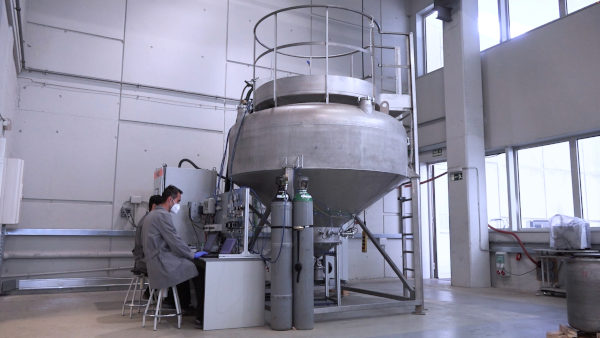
Eurecat has also developed a microwave plasma spheroidization system for recovering powdered or rejected material from manufacturing processes, for reuse in industrial activities. Furthermore, Eurecat has a pilot plant that allows it to produce customized powder on demand, either from high-purity raw materials or from metal waste for recycling.
Growth in Demand for Lithium, Cobalt, Nickel, and Other Critical Materials.
According to the International Energy Agency, between 2017 and 2022, demand for lithium tripled, cobalt demand increased by 70 percent, and nickel demand grew by 40 percent. Other studies indicate that by 2040, lithium demand will be 15 times higher than in 2020, and nickel demand 2.5 times higher, a trend expected to extend to copper, neodymium, and other minerals.
According to the latest Circularity Gap Report, the global economy is only 7.2 percent circular, a figure that is worsening due to increased extraction and use of materials. In this regard, their latest annual study estimates that more than half a trillion tons of materials have been consumed in the last six years, almost as much as in the entire 20th century.













