Driven by regulations such as Euro NCAP, driver monitoring systems (DMS) have gained significant traction, evolving from a luxury feature to a new standard. From 2024 onward, most DMS will utilize 2D near-infrared (NIR) cameras. Due to their relatively low cost, these are expected to see increasing adoption and become the dominant technology for DMS. To further differentiate themselves from competitors, automakers are expected to see advanced features such as gesture control, child presence detection, and seatbelt detection gain momentum, particularly in mid-range and high-end vehicles. Currently, 3D time-of-flight cameras stand out as the most widely used technology for DMS, while some automotive OEMs, such as Volvo and Tesla, are incorporating in-cabin radar modules.
Radar has played a vital role in advanced driver assistance systems (ADAS) for over two decades. Using radio waves with a frequency-modulated continuous wave (FMCW) coding system, radars can accurately measure the distance and relative speed of objects within their field of view. However, historically, radar modules have been primarily used for outdoor detection rather than indoor applications.
Starting in 2023, according to Tesla's website, the cabin radar operates in a frequency range of 60GHz to 64GHz, within the license-free ISM band. The detection range of these radar modules typically ranges from 0.4 to 2 meters, effectively covering the interior space. Although Tesla has not officially confirmed this, recent reports suggest that its Cybertruck is equipped with in-cab radar modules for occupant monitoring, including features such as child detection and seatbelt reminders.
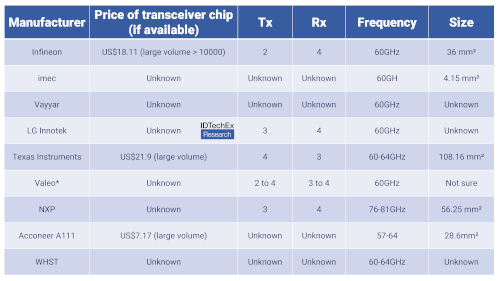
Comparison of radar manufacturers and prices. It should be noted that the NXP radar operates on a higher frequency band, and IDTechEx believes this frequency band is likely to be used for outdoor surveillance rather than indoor surveillance. Source: IDTechEx - "In-Cabin Sensing 2024-2034: Technologies, Opportunities and Markets"
Like radar modules, 3D time-of-flight (ToF) cameras also have applications in occupant surveillance. 3D ToF cameras operate using near-infrared illuminators, such as LEDs or vertical cavity surface emitting lasers (VSCELS), and image sensors. However, the use of these cameras raises privacy concerns, although some vendors claim they can address this issue by blurring people's faces or storing the data only onboard.
Another limitation of 3D ToF cameras is that, unlike in-cabin radar modules, they cannot detect people or objects through obstacles. Furthermore, due to their reliance on computer vision technology, the cameras require intricate algorithms and recalibration, which introduces technical complexity to their implementation. Despite these drawbacks, some vendors are actively working to address privacy concerns and improve the overall capabilities of 3D ToF cameras for occupant monitoring in automotive applications.
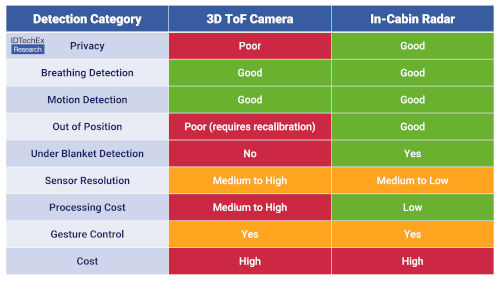
OMS technology benchmark. Source: IDTechEx - "In-Cabin Sensing 2024-2034: Technologies, opportunities and markets"
Currently, 3D ToF cameras are better suited to the OMS and offer more advanced features than radar modules. However, when comparing the costs and features of radar modules and 3D ToF cameras, IDTechEx believes there are potential opportunities for radar modules. 3D ToF cameras have been adopted in the Li Auto L9, BMW iX, and the new ARCFOX αS series, while radar modules are awaiting adoption in Tesla and Volvo. The following table, taken from IDTechEx's latest study, "In-Cabin Sensing 2024-2034: Technologies, Opportunities and Markets," estimates the costs of 3D ToF cameras.
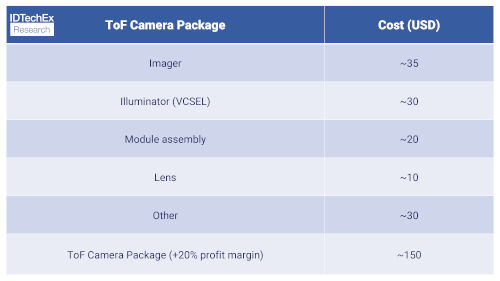
Estimated cost of a ToF camera package. Source: IDTechEx - "In-Cabin Sensing 2024-2034: Technologies, opportunities and markets"