

Traditional renewable technologies, such as solar and wind power, have generated considerable interest; however, due to their intermittent nature, additional technologies are needed that can supply energy on demand and continuously, which has led to increasing attention being paid to hydrogen fuel cells for stationary power generation.
In its new report, "Stationary Fuel Cell Markets 2025-2035: Technologies, Players & Forecasts," IDTechEx comprehensively covers the stationary fuel cell market, including key application areas, a breakdown of fuel cell (FC) power generation modes, and an assessment of the major trends anticipated within each sector. This analysis is conducted alongside an in-depth evaluation of various fuel cell technologies and a benchmarking of their key specifications. Based on this detailed market analysis, IDTechEx forecasts that the stationary fuel cell market will exceed $8 billion by 2035.
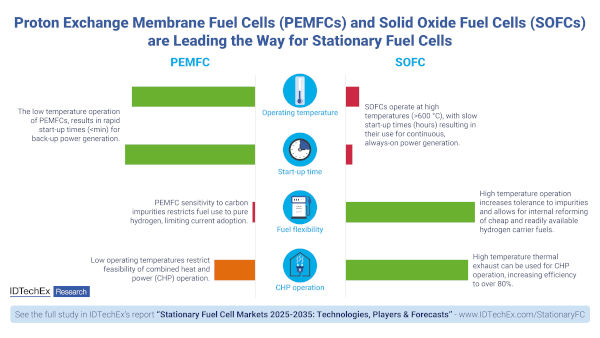
Different operating specifications of PEMFC and SOFC batteries. Source: IDTechEx
Uninterruptible power supply (UPS) systems are essential for many mission-critical applications, such as data centers, hospitals, airports, and telecommunications. Power outages in these sectors can have widespread and devastating effects on the safety of those involved, in addition to economic and operational repercussions. The U.S. Department of Energy estimates that power outages cost the U.S. economy $150 billion annually. This, compounded by growing electricity demand, which the International Energy Agency (IEA) forecasts will increase at an even faster pace over the next three years, growing at an average of 3.4% annually through 2026, means there is increasing concern about energy security. By leveraging both older and newer power generation technologies, grid operators can expect to meet rising demand and address unprecedented challenges.
Of the various types of fuel cell technologies, proton exchange membrane fuel cells (PEMFCs) have received the most commercial attention due to growing interest in their integration into automotive applications. PEMFCs operate at temperatures below 100°C, combining hydrogen and oxygen to generate electricity, and producing water and heat as byproducts. This low operating temperature allows them to respond quickly to changes in energy demand.
According to IDTechEx, standby power applications represent a significant opportunity for PEMFCs, and key companies such as Ballard and Plug Power are exploring their use in data centers to replace diesel generators.
PEMFC fuel cells, however, can only operate on pure hydrogen, a fuel that is currently expensive compared to traditional non-renewable fuels such as natural gas and diesel. PEM fuel cells are highly susceptible to carbon monoxide (CO) poisoning due to the catalyst's sensitivity to carbon impurities, leading to cell degradation. Unfortunately, limited access to green hydrogen and a lack of supply infrastructure are currently hindering the growth of the PEMFC stationary energy market. However, the development of the hydrogen economy is likely to coincide with the growth of the PEM stationary fuel cell market.
To overcome current market constraints for stationary fuel cells, primarily the cost and availability of hydrogen fuel, it is worth considering the viability of fuel cells that can operate on various fuel types, particularly solid oxide fuel cells (SOFCs). SOFCs are a high-temperature alternative to PEMFCs. Operating at temperatures above 600 °C, SOFCs have greater tolerance to fuel impurities and can internally reform cheaper and more readily available carbon-based hydrogen carrier fuels, such as natural gas.
The limitations imposed by slow start-up times due to high operating temperatures restrict SOFCs to continuous power generation applications. However, the widespread availability of natural gas, coupled with existing production and supply infrastructure, is driving current SOFC adoption. IDTechEx believes SOFCs present a unique opportunity for the stationary fuel cell market, as they help establish a secure installation base while the hydrogen economy, a technology that largely dominates market growth, develops.
Due to the different operating conditions of PEMFC and SOFC fuel cells, each is suited to a specific power generation mode. The high-temperature operation of SOFC fuel cells results in slow start-up times, hindering their ability to respond quickly to changes in power demand. Therefore, SOFCs are better suited for continuous operation. Continuous power generation refers to systems that operate 24/7 and typically power large-scale applications and systems. Traditionally, continuous power generation technologies include systems fueled by natural gas or coal, such as steam or gas turbines. These systems are used to supply power to the global grid. As global energy demand increases, so does the pressure on these existing technologies to meet higher power output. SOFCs are well-suited to operate continuously, in parallel with existing power generation technologies.
Conversely, the low-temperature operation of PEMFC fuel cells enables fast start-up times and rapid response to changes in power demand, making them better suited for standby power operation. Diesel and gasoline generators are typically installed as standby power generation technologies; however, with growing environmental concerns and government commitments to decarbonization targets, the long-term replacement of these generators is becoming necessary. Stationary fuel cells, particularly PEMFCs, can meet these power generation demands; however, as previously mentioned, leveraging the hydrogen economy is essential for widespread market adoption. In its latest report, IDTechEx analyzes the market potential of PEMFC fuel cells and alternative fuel cell technologies as standby power generation devices for various application areas.