




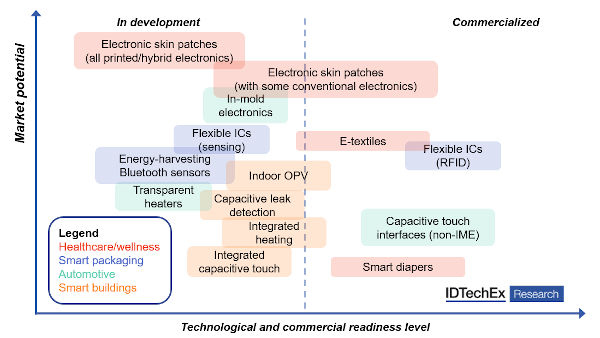
However, 2021 has been an exciting year for printed electronics, with numerous applications achieving commercial adoption and significant funding flowing into the sector. Even when technologies are not yet commercially available, companies are increasingly shifting from developing their technology and producing speculative demonstration prototypes to development and qualification projects for specific customers.
Health and well-being: Leveraging flexibility.
To successfully market printed/flexible electronics, it is necessary to identify applications where their differences from conventional electronics add significant value. Electronic skin patches are a prime example, as flexible, thin-film devices improve patient comfort while enabling continuous monitoring of biometric parameters.
Interest in electronic skin patches has truly accelerated in 2021, with dedicated materials developed by major companies like DuPont and Henkel, and the patches being used in hospitals. This increased traction is partly attributed to COVID-19, as both patients and healthcare professionals are now much more comfortable with remote consultations requiring follow-up at home. Furthermore, many healthcare systems are struggling with a backlog of patients following the cancellation of surgeries and tests, creating an additional impetus to adopt new technologies that can improve efficiency, for example, by facilitating earlier hospital discharge.
Automotive: Supporting the Transition to Electric Vehicles
While the transition to electric and autonomous vehicles attracts a lot of attention, it is accompanied by the adoption of other technologies that, to some extent, go unnoticed. The growing adoption of printed electronics is one example, with applications both inside and outside the vehicle (explored in more detail in the IDTechEx report "Printed and Flexible Electronics for Automotive Applications 2021-2031: Technologies and Markets").
Interiors are particularly promising targets for innovation that enhances the occupant experience, as it is more difficult for manufacturers to differentiate electric vehicles based on their powertrain. In this respect, printed/flexible electronics have great potential to add extra functionality to the cabin and facilitate efficient manufacturing. Examples include the integration of higher-performance displays and touch-sensitive control surfaces. In fact, backlit capacitive touch sensors comprising embedded transparent printed metal mesh films and thermoformed parts, developed by PolyIC, have been commercially available in Volkswagen models launched in 2021.
There is also growing interest in heaters for automotive applications, as electric vehicles generate significantly less waste heat. While printed electronics are already used in some seat heaters, implementing heaters made with resistive or positive temperature coefficient conductive inks on their surfaces would improve heating efficiency and thus slightly extend EV range. Transparent heaters, which can be made of metal mesh, carbon nanotubes (CNTS), or silver nanowires, are also being developed and tested, with initial applications including headlight covers and sensors.
Smart packaging: Technical innovations increase viability.
Smart packaging has received a major boost towards widespread adoption in 2021, with two startups securing $10 million in funding to increase production and expand their technical capabilities.
Defined as the integration of electronic functionalities, such as antennas and sensors, into the enclosure to track its progress and status throughout the supply chain and into the home, the smart enclosure has long been touted as a promising application for printed/flexible electronics. This is because, unlike conventional rigid electronics, printed/flexible electronics are theoretically compatible with very high-throughput roll-to-roll (R2R) production to enable the necessary extremely low production costs.
However, despite the widespread adoption of RFID tags, smart packaging with integrated sensors has so far been limited to niche applications. This is primarily because cost targets for most smart packaging applications are extremely challenging, especially since they require incorporating a power source or energy harvesting capability, one or more sensors, a processing IC, and an antenna. Furthermore, smart packaging typically only adds value when it facilitates an integrated solution along with the software. This usually requires entering a market at scale and being adopted simultaneously by multiple players in the supply chain.
In an effort to reduce the cost of smart enclosure hardware, thereby opening the technology to higher-volume applications, innovative hardware technologies are being developed. PragmatIC, a UK-based company that produces natively flexible metal-oxide integrated circuits, raised $80 million in Series C funding in October 2021. The key value proposition of PragmatIC's integrated circuits is their low cost, potentially less than one cent each. While RFID is the initial application, more complex integrated circuits for sensing applications are also under development.
Another promising innovation for smart enclosures is sensors that harvest energy from ambient electromagnetic radiation. Developed by the US company Wiliot, which raised $200 million in a Series C funding round, these battery-free, wireless sensors communicate via Bluetooth. Event-based sensing is used to communicate only when the sensor's position changes, thus reducing power consumption. Integrated circuits from PragmatIC and Wiliot will be mounted on flexible substrates, and the antennas will often be manufactured using conductive inks. This new manufacturing methodology, which combines printed and assembled components, is called "flexible hybrid electronics (FHE)" and is detailed in a dedicated IDTechEx report.
With this incoming investment facilitating the growth of technologies that address some long-standing weaknesses, 2021 could prove to be the year that smart packaging adoption begins.
Smart buildings and IoT: Combining energy sensing and harvesting
IoT devices, defined here as a network of wirelessly connected sensors for home and industrial applications, offer advantages such as predictive maintenance and condition monitoring. They represent a significant opportunity for printed/flexible electronics, as they must be affordable and have a compact form factor to fit into buildings, industrial equipment, and so on.
Despite the clear value proposition, powering IoT devices remains a challenge, as battery replacement is wasteful and costly when maintenance time is factored in. An emerging candidate to solve this problem is organic photovoltaics (OPV). Although large-scale adoption of organic photovoltaics has been difficult, this energy harvesting technology is well-suited for indoor energy harvesting, as it is more efficient than silicon photovoltaics under low-intensity diffuse radiation. The films are also inexpensive to produce using solution processing, while their flexible, thin-film form enhances durability and integration possibilities.
Indoor OPV cells for low-power IoT devices are being developed by companies such as Epishine, Dracula Technologies, and Ribes Tech. This technology gained traction in 2021, with Epishine's OPV cells being installed in commercially available facility management products.
Other applications of printed/flexible electronics for smart buildings leverage the ability to produce relatively simple, large-area devices at an affordable price. These applications include heating and leak detection, either integrated into building materials or retrofitted. In 2021, the British company Bare Conductive launched Laiier, targeting these applications: low-cost leak detection is proving particularly attractive to the insurance sector, with multiple projects under development.
Next year
This commercialization of printed/flexible electronics is expected to continue in 2022 across all the technologies and applications described above, with capacitive touch sensors made from printed metal mesh, OPV cells for indoor energy harvesting, and increasingly flexible electronic skin patches all gaining traction.













