




This makes sense because a large machine amplifies the capabilities of a skilled driver, dramatically increasing their productivity. However, this statement may be about to undergo a fundamental change. The reason is that, currently, we can remove the driver from the equation.
The IDTechEx Research report "Agricultural Robots and Drones 2016-2026: Technologies, Markets, Players" draws a detailed map of how robotic technology will enter different aspects of agriculture, how it will change the way farming is done, what the future of the agrochemical business will become, and how it will modify the way we design agricultural machinery.
This report provides detailed technology maps, ten-year market forecasts segmented by technology and region, and company profiles based on interviews. Overall, IDTechEx Research projects that the agricultural robots and drones sector will reach $12 billion by 2026.
Tractors become fully autonomous
Agricultural vehicles have been at the forefront of the development and adoption of autonomous navigation technology. In fact, more than 320,000 tractors equipped with autonomous guidance technology were sold in 2016, increasing to 660,000 per year by 2026. These tractors use RTK GPS technology to autonomously follow pre-planned paths with centimeter-level accuracy. This makes agriculture the market with the highest adoption rate of autonomous navigation.
The industry is already evolving. Major tractor manufacturers worldwide have already showcased autonomous tractors or master-slave or "follow me" tractor systems. In these arrangements, a manned operator supervises the movement of the lead tractor with others following behind.
This technological evolution will reinforce the notion that "bigger is better" because it allows for even greater productivity from the skilled driver through multiple slave or follower vehicles. This arrangement will be increasingly used in large-scale agricultural operations.
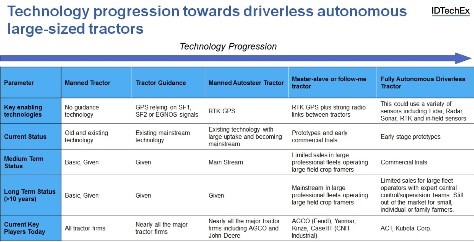 Fully autonomous, driverless tractors will be the next evolutionary step. Major semi-commercial prototypes have already been showcased by leading agricultural machinery companies.
The technical challenges are largely resolved. Here, the tractor is equipped with a variety of overlapping sensors, such as LIDAR, RADAR, and SONAR, to provide autonomous navigation in the absence of a GPS signal, while also avoiding collisions.
The costs of the technology are currently high, but the biggest obstacles lie in the lagging regulatory framework and farmers' desire to remain in control. All of this will inevitably change, particularly as the agricultural population continues to grow worldwide.
Overall, IDTechEx Research predicts in its report that sales of fully autonomous tractors will only begin in 2021/2022, reaching more than $200 million in 2026.
Are agricultural vehicles being transformed?
The arrival of mobile agricultural robots will create the notion that small, light, and slow is good. In this view, a few heavy, fast, large, and manned tractors will be replaced or supplemented by many light, slow, small, and unmanned robots.
In this case, lightness does not mean a reduction in surface area, thus increasing the usable land on each farm by up to 3%, slowness means more attention to each plant, therefore better data and a more specific action on the plant, and smallness potentially means a low cost.
Cost is, of course, a critical factor here. This is because larger, faster machines are more productive. This means that these new classes of agricultural robots will have to be 24 times cheaper to make economic sense. This requirement will limit widespread adoption in the medium term.
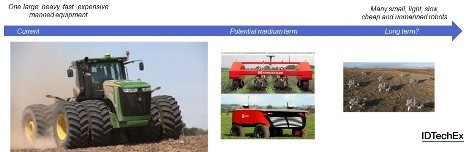 This represents a radical shift in how we conceive of agricultural vehicles. This new, alternative vision is still in its infancy, but the direction of development is clear. There are already hundreds of mobile agricultural robots. With the exception of about 50 small ones, however, most are still in the research or semi-commercial phase.
Costs are also currently high, especially since these mobile robots require multiple sensors to provide safety and autonomy even in the absence of GPS signals. The initial effect is that farmers still don't trust them and are unwilling to pay this extra cost. This means that some models are being offered with the bare minimum and seemingly basic features.
Technological immaturity shapes the business model.
Despite technological advancements, machines are still not entirely reliable, both at the component and software levels. This is reflected in the business models of many companies seeking to market similar robots. They become service providers so that farmers don't bear the entire burden of risk, and so that more experienced operators can get the machine running again in case of a technical failure that causes downtime.
Farmers Transform Revolution into Evolution.
All of this will change over the course of the next decade. Despite being known for their conservatism, farmers often embrace technology. This is evident in global statistics showing how production has grown despite declining employment in the agricultural sector, due in part to the expansion of mechanization in agriculture. The real effect of this conservatism, however, is that potentially revolutionary technologies become evolutionary. This new notion of swarms of unmanned robots will be no exception. Here, too, the change will be gradual, both technologically and commercially. In fact, as the technology improves, the value proposition will have to be proven at each step forward.
This has not yet been done, as only a few field trials have taken place, and the experimental timeline is inevitably limited by harvest seasons, further slowing the adoption process. Moreover, many agricultural robots currently operate well in specially constructed environments, suggesting that large-scale adoption may require a shift in how farms are deployed. This will continue at a meticulously slow pace, further contributing to the transformation of the revolution into an evolution.
By Dr Khasha Ghaffarzadeh, Research Director, IDTechEx Www.IDTechEx.com













