Although printed sensors have historically struggled to compete with conventional sensing solutions solely due to their cost, the tide is turning. Mass digitization demands greater and more seamless digital integration, and large-area printed sensors are poised to drive the next generation of intelligent sensing solutions.

Large-area, flexible, printed sensor technology. Source: IDTechEx
Large surface area: Sensor printing is key to detecting large areas
Mass digitization will lead to data collection across more surfaces, and large-area sensors naturally represent a solution to meet this need. Large-area sensors that map surface interactions offer more spatial information and greater data granularity than single-point sensors. To obtain sufficiently large area sensors, printing becomes necessary, offering production at much larger scales than subtractive manufacturing processes allow.
Large-area printed sensors are experiencing sustained growth in consumer electronics applications for mapping surface interactions. Major PC manufacturers have begun employing large-area printed force sensors in laptop trackpads, offering dynamic 3D touch functionality to enhance the user interface experience. Printed photodetectors are appearing in OLED displays to provide multi-touch fingerprint authentication with minimal impact on the overall device thickness. Multi-touch authentication with printed photodetectors promises up to 700 million times more security than current single-finger methods.

Large-area detection possibilities using printed and flexible sensors based on organic photodetectors (OPDs), perovskite photodetectors (PPDs), and quantum dots (QDs). Source: IDTechEx
It is no surprise that smartphones and laptops represent important market entry points for printed sensors. These devices feature large user interfaces that readily benefit from the added functionality offered by printed sensors. More importantly, the rapid development timelines and tailored nature of consumer electronics sensing requirements complement the capabilities of printed sensor technology providers, who are ideally suited to co-develop customized sensing solutions.
Multifunctionality: Printed sensors offer hybrid functionality in a compact format
In many sensing applications, it's necessary to measure more than one metric simultaneously. For example, in 3D touch trackpads on laptops, high-precision touch detection must be accompanied by input force recognition. Printing sensors in sheet form allows for stacking and combining different sensor layers with minimal impact on form factor or weight. Therefore, printed sensors offer a relatively simple way to integrate multifunctional sensing into existing products.
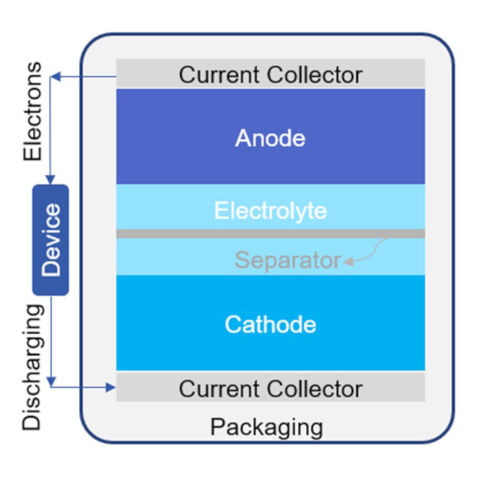
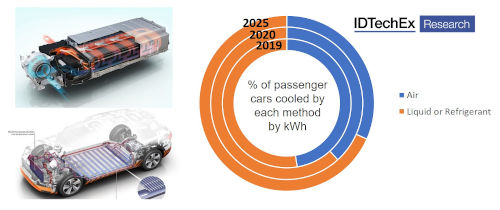
Interest from the automotive industry is driving growth opportunities for multifunctional printed sensors in applications such as electric vehicle battery thermal management. Hybrid printed temperature sensors can detect hot spots in cells, while pressure-sensing layers monitor battery swelling, indicative of cell failure. Furthermore, printed sensors complemented by printed heating layers provide additional means for addressing these measurements, offering a complete active thermal management solution. Deployment, charging, and discharging optimizations increase battery capacity and extend battery life, potentially resulting in savings of up to $3,000 per vehicle.

Multifunctional printed sensor technology for active battery health monitoring and thermal management. Source: IDTechEx
The automotive sector is undergoing a period of sustained technological redefinition, with the meta-trends of electrification and autonomy shaping the future of mobility. Automotive sensor requirements are also evolving, creating growth opportunities for printed sensors to enable multifunctional technological solutions. If key thresholds of cost, weight, and energy efficiency are met, printed sensors have the potential to define the future sensing requirements of electric vehicles before battery chemistry and design convergence lead to more standardized solutions.
Flexibility: Balance between form and function with flexible sensors
Rigid sensors and detectors are generally unsuitable for applications requiring conformal detection on non-flat surfaces, such as medical X-ray imaging, where ideally the detectors should conform to limbs. Printing sensors on flexible substrates, such as PET, polyurethane, or polyimide, offers a solution that non-printed sensors cannot replicate. The variety of elastic, thermal, and even biodegradable properties available means that sensing solutions are highly customizable and easily adapted to end-use applications.
New growth opportunities for flexible photodetectors lie in their potential to displace existing sensing technologies, which would clearly benefit from greater flexibility and non-planar measurement capabilities. Large-area photodetectors for X-ray imaging are one example. Flexible, body-conforming X-ray sensors can improve medical diagnostics, while in industrial applications, the ability to image in confined spaces promises faster and more efficient non-destructive component testing.
Flexibility is only desirable in a handful of photosensing applications, with the most promising prospects lying in printed sensor technologies, such as force, strain, and temperature detection. However, some flexible photodetectors show the rare potential to compete on cost with existing imaging solutions, for example, in X-ray and SWIR detection. Nevertheless, the growth prospects for printed photodetectors to displace current imaging sensors will depend on meeting certain well-defined and stringent performance criteria.
Conclusions and perspectives
Until now, the inability of printed sensors to meet critical thresholds for cost, performance, size, and reliability has prevented their penetration into key product markets. But with mass digitization driving the need to capture data across ever-larger surfaces, large-area sensing is rapidly becoming the most valuable market differentiator for printed sensor technology.
The saturation of consumer electronics markets is driving interest in large-area sensors that offer innovative new features, and printed sensor technology providers are well-positioned to keep pace with rapid development cycles. Multifunctional and flexible printed sensors are also increasingly desirable in the medical and electric vehicle sectors. While conventional sensors can individually achieve large-area sensing, multifunctionality, and flexible form factors, the most efficient way to combine all three is with printed sensors.
Looking ahead, IDTechEx predicts that the printed sensor market will reach $960 million by 2034. The projected growth will be driven by new opportunities offered by large-area, multifunctional flexible sensors in applications such as battery health management, biometric authentication on flexible displays, and even flexible X-ray medical and industrial imaging.
Author: Dr Jack Howley, Technology Analyst at IDTechEx