




SALSA stands for Clean Automobility System with Storage Support. The project aims to address the challenges posed by the creation of smart grids. These grids envision the generation of electricity from renewable sources at multiple points that need to communicate and coordinate with each other, overcoming the intermittency and variability of this type of energy generation through energy storage systems. These storage systems also modulate the amount of electricity flowing from one point to another, depending on generation and consumption conditions at any given time, greatly increasing efficiency and facilitating the widespread adoption of electric vehicles.
Albufera Energy Storage SL is the company responsible for the design, installation, commissioning, operation, and maintenance of the entire system. SALSA also has the support of AEDIVE, the Spanish Association for the Development and Promotion of Electric Vehicles, in disseminating and promoting awareness of the project. As Joaquín Chacón, General Manager of Albufera Energy Storage, explains, “the complete transport and charging infrastructure system is managed in two ways: through data monitoring with tracking devices and ICT information; and by ensuring the energy balance between supply, or renewable generation, and demand, or vehicle charging. This balance is achieved with battery-based energy storage systems.”.
SALSA's initial plan involves launching a series of pilot projects to test, on a small scale, all the factors that can influence the implementation of renewable energy generation systems and their application to electric mobility systems. The first pilot project will be presented at the Che Guevara Studies Center in collaboration with ICEX during the Havana International Fair.
SALSA in Havana
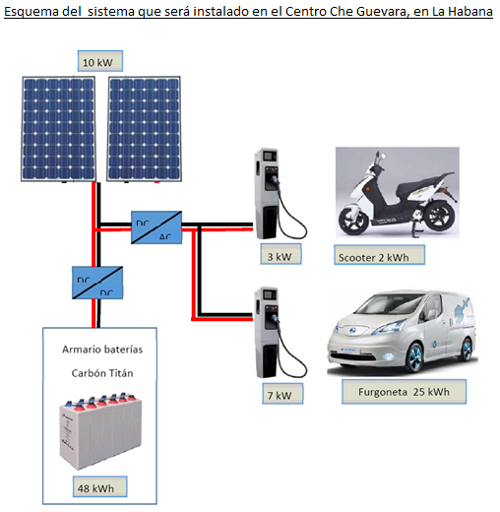
The pilot project, to be implemented at the Che Guevara Studies Center, encompasses all necessary phases: design, supply, commissioning of the transport system, and potential financing options. As explained by Albufera Energy Storage, this center was chosen for the first non-commercial pilot project because it is an emblematic institution in Cuba that plays a vital role in disseminating information, and because energy is a key element in carrying out its outreach activities. The first SALSA pilot project will be presented during the Havana International Fair, held from October 31 to November 4 at the EXPOCUBA fairgrounds, which brings together all sectors of the Cuban economy and much of Latin America.
it
has been presented, including municipalities and companies, and in every case, working groups have been created to study its possible implementation.” She adds: “Electric mobility is ideal in most large cities and especially in island environments, because the range of electric vehicles usually covers their geographical distance needs and meets the zero-emission environmental requirements that a space with these characteristics should have.” So far, the project has been presented to local authorities and companies in Madrid, Ibiza, Torrelavega, and Pernambuco.













