




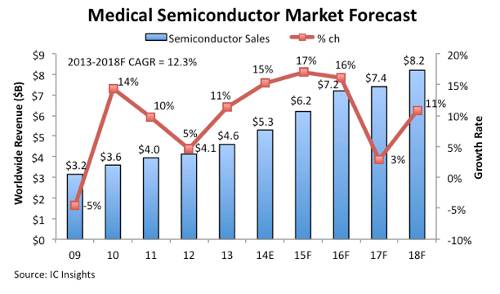
 IC Insights believes that sales growth for medical semiconductors will strengthen this year and next before declining again with the next expected economic slowdown in 2017 (Figure 1). Between 2013 and 2018, worldwide sales of medical semiconductors are projected to increase at a compound annual growth rate (CAGR) of 12.3%, reaching $8.2 billion in the final year of the forecast period. In the period 2008–2013 (which included the 2009 recession), medical semiconductor sales grew at a CAGR of 6.9%.
Figure 1
The IC portion of the semiconductor business for medicine is expected to grow at a CAGR of 10.7% to $6.6 billion in 2018, while the market share of optoelectronics, sensors/actuators, and discrete (OSD) is projected to grow at an annual rate of 20.3% to $1.6 billion that year (primarily due to strong demand for solid-state sensors and optical imaging devices).
ICs and other semiconductor technologies continue to play a key role in restructuring and redefining medical systems. With medical imaging systems being digitized and healthcare equipment operating under computer control, IC-driven advancements are happening almost as rapidly as in mobile phones and many consumer electronics. Government certification may slow some system introductions. The scaling of integrated circuit (IC) sizes, system-on-a-chip (SoC) designs, improvements in sensors, and powerful analog-to-digital converters (ADCs) are reducing the size of medical diagnostic equipment and the cost of using it.
The evolution of new medical systems for imaging, diagnosis, treatment, and surgery is moving in two different directions, as equipment responds to increasing pressures to reduce costs and increase the availability of healthcare worldwide. In one sense, new medical equipment is becoming smaller and less expensive so that systems can be used in hospital patient rooms, clinics, and doctors' offices. These systems cost between 10% and 25% of the price of equipment such as traditional large diagnostic MRI and CT scanners, which can cost $1 million and are typically installed in medical imaging centers or dedicated hospital examination rooms.
Also, lower-cost wearable medical systems and fitness monitors, which can wirelessly transmit vital signs and other readings to doctors or be used as activity trackers for health-conscious individuals, are experiencing tremendous growth. In some cases, medical and fitness monitoring applications can be performed directly by smartphones using their built-in sensors and downloaded software apps. However, medically certified mobile health devices are generally required in most countries for monitoring patients and the elderly in their homes. The information is sent to doctors via wireless connections to mobile phones or the internet.
The second major trend in medical equipment is the development of more powerful and integrated systems. These systems are expensive but promise to reduce healthcare costs by enabling the early detection of cancer and other diseases and supporting less invasive surgery for faster recovery times and shorter hospital stays. Computer-assisted surgery systems, surgical robots, and operating room automation are among the new technologies being adopted by some hospitals in developed markets.
High growth in lower-cost systems, coupled with rising prices for more sophisticated hospital equipment in developed markets, is expected to boost total medical electronics systems sales by a CAGR of 8.2% between 2013 and 2018, reaching $70.1 billion in the final forecast year.













