




Stefan Seelecke's research team at Saarland University is using thin silicone films to give surfaces novel capabilities. The technology, which can create the sensation of a touch "button" or "swipe" on flat glass screens, is literally adding a new dimension to touchscreen interactions. The polymer film can change shape at will to create the feel of a raised button or key on the screen surface, which the user can then use, for example, to navigate a page or enter data. “Thanks to this technology, we can make the user interfaces of smartphones, information displays, and home devices easier to use,” explains Professor Stefan Seelecke, who heads the Intelligent Materials Systems Laboratory at Saarland University. If the user feels a pulse or vibration under their fingers, they can respond by touching the screen. And because the user also experiences the slight resistance we feel when pressing a “real” button or switch, they know their response has been successful. For blind and visually impaired people, this kind of physical feedback isn’t a gimmick; it has enormous value in their daily lives.
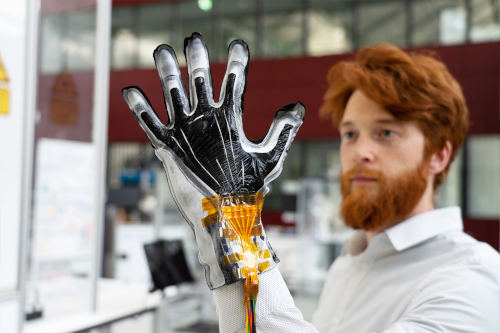
If these high-tech films are used to line clothing, they can also act as a human-machine touch interface. An example of this type of application would be to completely line the inside of an assembly worker's glove with the highly flexible, elastic polymer film and use it as a sensor so that a computer system can track the worker's hand and finger movements. “Our technology allows us to make the system smarter by introducing a complex sensor into a glove that the operator would wear anyway,” says Seelecke. And because the films are only about 50 microns thick (1 micron = one-thousandth of a millimeter), comparable to household cling film, they don’t interfere with the operator’s work. If this type of interactive glove is used in an Industry 4.0 environment, the system can recognize what action the glove wearer is trying to perform.
“The operator could, for example, control a process through the movement of their hand. When working with complex equipment in industrial plants, the system could help avoid potentially costly errors by sending a tactile signal, such as a touch, pulse, or vibration, to the operator’s hand or fingers,” explained Stefan Seelecke, who leads research groups at Saarland University and the Center for Mechatronics and Automation Technology (ZeMA).
 The specially prepared silicone films are smart material systems that can be powered simply by applying an electric current. A highly flexible, electrically conductive layer is printed onto each side of the ultrathin silicone film to create what is known as a "dielectric elastomer." When a voltage is applied to the elastomer, the two electrodes attract each other, compressing the polymer and causing it to expand laterally, increasing its surface area, which in turn alters the film's electrical capacitance," explains Paul Motzki, a research scientist on Seelecke's team.
When the operator bends a finger while wearing the glove, the film stretches like a second skin, and this distortion causes a change in capacitance. The researchers are able to precisely assign a capacitance value to each position of the film as it distorts. Thus, a specific capacitance value essentially represents a particular position of the operator's finger, and a sequence of capacitance values represents the path the finger follows as it moves. The film is, therefore, a stretchable sensor that can act as a sensory organ in engineering applications. The glove can perceive how the hand moves, and the smart touchscreen can detect if the user has pressed a virtual button.
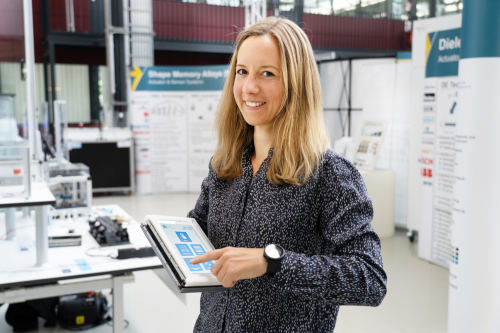
By combining measurement data and intelligent algorithms, the team has developed a control unit that can predict and program movement sequences and thus precisely control how the elastomer film deforms. “We leverage the properties of these dielectric elastomers to design drive systems,” explains Sophie Nalbach, the engineer who leads the Electroactive Polymers Group, part of Professor Seelecke’s Intelligent Materials Systems Lab. By altering the applied electric field, the researchers can make the film pulse, take on a desired shape, or oscillate or flex at a specific frequency. When combined with the electroactive polymer system, an industrial glove can interact with its wearer, or a display screen can interact with the user. “If we place the thin glass screen of a tablet on the polymer film, it can perform a very rapid flexing movement under the user’s fingertip, giving them the impression that their finger is resting on a button or key,” Nalbach explains.
Currently, the team is working on several research projects aimed at interconnecting these film-based drive systems so they can communicate and cooperate collectively. To achieve this, the researchers will need to add new capabilities to the surfaces and interfaces, which in turn requires further miniaturization of the technology.
Dielectric elastomer sheets are lightweight, flexible, quiet, energy-efficient, and cost-effective to manufacture. The work carried out by Seelecke's group is application-focused research. However, the team wants to develop this and other smart material systems for commercial and industrial applications, which is why the spin-off company "mateligent GmbH" was founded.













