




Reaching this critical milestone allows PICMG members to begin designing compliant modules, so embedded OEMs and developers will have access to a fully developed ecosystem shortly after the specification's release. The outstanding performance of the 15 member companies of the COM-HPC Mini working group reflects the strong market relevance and demand for a high-performance, credit-card-sized computer module standard. Only 12 weeks elapsed between the approval of the Statement of Work and the final definition of the mechanics and pinout by the working group.
“The definition of COM-HPC Mini is progressing at lightning speed. If the working group maintains this pace—and I see no reason to slow down, as there are no major technical challenges left to address—I am confident that we will have a release candidate available for the PICMG publication process in the first quarter of 2023, and a published specification in the second quarter of 2023. I anticipate that the first product announcements will be closely tied to the publication date,” explains Christian Eder, Chair of the COM-HPC Technical Committee and Director of Product Marketing at congatec.
“The ‘HPC’ in COM-HPC stands for ‘High-Performance Computing,’ but we now use it to refer to the ‘High-Performance Crew’ that develops the COM-HPC specification family. The team’s performance keeps pace with the rapid evolution of embedded applications and technologies,” adds Jessica Isquith, Chair of PICMG.
Details about COM-HPC Mini:
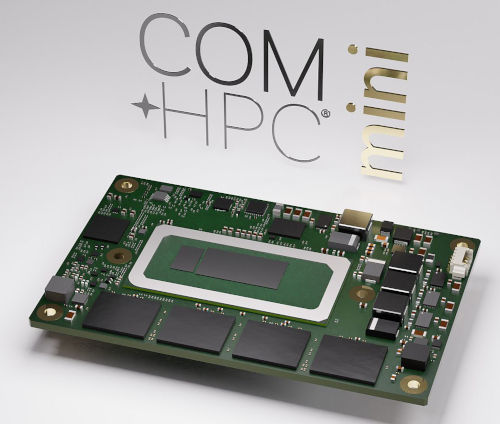
The COM-HPC Mini pin specification defines the use of a single connector instead of the two implemented for the larger COM-HPC Client and Server modules (sizes A-E), similar to COM Express Mini compared to COM Express Type 6. However, with COM-HPC, half the number of signal pins still translates to 400 signal lanes, which is 90% of the capacity offered by COM Express Type 6 modules. COM-HPC Mini is 50% smaller than COM-HPC Client Size A modules, the smallest COM-HPC form factor currently available. These tiny modules, measuring only 60 x 95 mm, are essential for high-end embedded computer logic in devices such as rail PCs for control cabinets in industrial and building automation, or portable test and measurement devices.
Furthermore, the new specification will allow engineers to integrate next-generation computing interface technologies, such as PCIe Gen4 and Gen5, into ultra-small processing units that deliver maximum performance. Because the new specification will feature a high-performance pinout and support the entire COM-HPC ecosystem, it is expected to become the high-end standard, complementing the previous PICMG COM Express Mini standard. PICMG anticipates that the COM Express specification will continue to lead the COM market for many years, as it meets numerous standard application requirements that will now be allocated to the mid-range performance sector.













