




Blue light bulbs (BLBs) also have a longer lifespan, faster charging times, and greater safety thanks to the absence of flammable liquid electrolytes. These advantages position SSBs as a cornerstone of the next generation of battery technologies, with the potential to reshape sectors that rely on solid-state batteries, as analyzed in the IDTechEx report "Solid-State and Polymer Batteries 2025-2035: Technology, Forecasts, Players.".
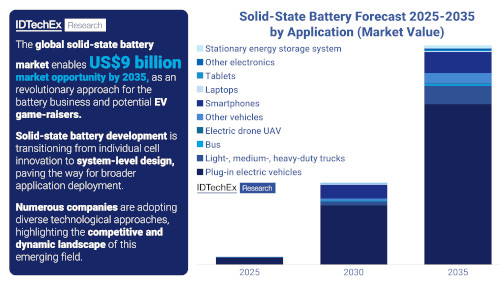
Solid-state battery forecast 2025-2035 by application (market value). Source: IDTechEx
Progress in global marketing
The path to commercializing single-bulb batteries (SFBs) has gained considerable momentum in recent years, driven by advances in materials science, strategic partnerships, and government support. Companies like QuantumScape and Solid Power have established pilot production lines to refine manufacturing processes. For example, QuantumScape has announced progress in scaling up its lithium-metal SFB technology, while Solid Power has opened a pre-pilot line to develop cells specifically for electric vehicles. Major automakers, such as Toyota and Volkswagen, are also investing heavily in low-voltage (LV) research, with Toyota planning to launch an EV powered by LV by 2027.
Around the world, governments are playing a critical role in accelerating commercialization. The U.S. National Plan fosters innovation in low-energy batteries (LUBs) through production targets, while the Inflation Reduction Act incentivizes domestic manufacturing and adoption through tax credits and supply chain support. In Japan, the Libtec consortium promotes innovation in LUB technology, while leading South Korean battery manufacturers—SK Innovation, LG Chem, and Samsung SDI—collaborate on next-generation battery research. Europe is also moving quickly, with initiatives focused on the sustainable sourcing and recycling of materials to meet the goals of the Green Deal. These efforts are complemented by private sector investment in pilot lines and gigafactories dedicated to increasing production.
For example, Blue Solutions has a long history of manufacturing polymer SSBs and offers SSB products for electric vehicles. ProLogium Technology operates the world’s first gigafactory for solid-state lithium ceramic batteries in Taoyuan, Taiwan. This facility began supplying automakers in 2024 and features innovative manufacturing technologies, such as continuous wet coating for solid electrolytes. The gigafactory has achieved 2.6 times the production efficiency of ProLogium’s previous facilities, with double the assembly speed and reduced costs. Samsung SDI has built a pilot production line, known as the “S-Line,” at its R&D center in Suwon, South Korea. This facility focuses on developing advanced solid-state battery technologies, including cathode and solid electrolyte production systems. Although still in the pilot phase, Samsung SDI plans to achieve mass production of all-solid-state batteries by 2027. ION Storage Systems launched its first pilot production line in Maryland in 2024. Initially, this facility is expected to produce 1 MWh of battery cells, expanding to 10 MWh in early 2025 and aiming for a capacity of 500 MWh by 2028. The company's anode-free technology simplifies the manufacturing process. Solid Power operates a roll-to-roll production line in Colorado, producing prototype solid-state lithium-metal batteries. Strategic partners such as BMW are currently validating these prototypes. Solid Power plans to expand its operations and reach mass production by 2030. Hyundai Motor Company is building a demonstration production line for solid-state batteries and plans to produce test electric vehicles equipped with these batteries by 2025. Partial serial production is planned for 2027, and full-scale production for 2030.
Implications for supply chain reorganization
The commercialization of lithium-ion batteries is poised to significantly impact global supply chains. Conventional lithium-ion battery manufacturing has been dominated by East Asia, with Japan, China, and South Korea playing a major role. The US and European countries are now competing, shifting the added value away from East Asia and building battery manufacturing closer to the application market. The selection of new materials and components, along with changes in manufacturing processes, indicates a reshaping of the battery supply chain, including the lithium metal anode, the silicon anode, and the solid-state electrolyte. From both a technological and business perspective, the development of solid-state batteries has become part of the next-generation battery strategy. It has become a global endeavor with regional interests and government support. Opportunities will arise for new materials, components, systems, manufacturing methods, and technical expertise.
Recycling will play a crucial role in mitigating these challenges. As the adoption of electric vehicles increases, end-of-life batteries will constitute a valuable source of recycled materials for new SSB production. Policymakers and industry leaders must collaborate to establish robust recycling infrastructure and regulations that ensure a sustainable supply chain.
Author: Dr. Xiaoxi He, Research Director at IDTechEx













