However, this trend may be partially offset by improvements in winding efficiency and copper utilization observed in recent years. In any case, the increasing electrification of the automotive market will increase copper demand for electric vehicle motors by 3.1 times in 2034 compared to 2023.
Where is copper used?
A motor consists of a stationary component (stator) and a rotating component (rotor). Generally, the stator is made of a steel frame with copper windings used to generate an electromagnetic field. Rotor materials vary depending on the technology. Permanent magnet motors have magnets in the rotor, induction motors have copper or aluminum bars, wound-rotor motors have more copper windings, and reluctance motors are predominantly made of steel.
Removing Magnets Increases Copper Content:
Induction motors have gone from being a popular drive motor to being primarily reserved for secondary drive applications. Depending on whether they have a copper or aluminum rotor, they can increase the motor's copper content compared to permanent magnet options. The wound-rotor motor is proving to be the ultimate magnet-free option, and the use of copper windings on the rotor significantly increases the motor's copper content, with some examples featuring more than twice the copper of a comparable permanent magnet motor.
There are alternative motor technologies that could maintain a similar copper content to that of permanent magnet motors; for example, the reluctance motor rotor is predominantly steel and contains no copper or aluminum. However, these have traditionally suffered from problems with power density, noise, and efficiency. Several avenues for improvement exist, with various companies working on this type of design, but it has not yet been demonstrated in a mass-produced electric vehicle. The emerging axial flux motor offers very high power density and, therefore, in terms of copper content per kW of power, has a much lower copper requirement.
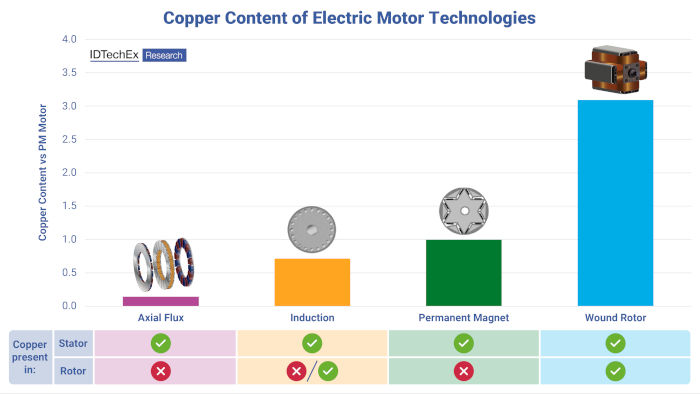
Relative copper content of electric motors used in electric cars. Source: IDTechEx
Winding Technology to Reduce Copper:
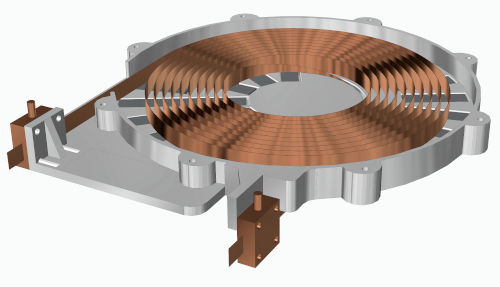
The above refers to the rotor, but efforts are underway to improve copper usage in stator windings. Traditionally, these windings consist of many small, round wires wound around the stator. In 2021, hairpin windings achieved a global market share in EVs similar to that of round wires and, in fact, surpassed them in 2022. Hairpin winding involves the use of square/rectangular wires, which increases the slot fill factor, making better use of available space and reducing the amount of excess copper windings hanging at each end of the motor. A higher fill factor can be used to increase the amount of copper mass per motor, or more efficient filling can reduce the overall length (and therefore the copper content) of the motor to achieve the same performance.
The next stage of evolution involves pre-winding these fork windings so that each bar doesn't have to be individually inserted and welded. This improves manufacturability, allows for more poles on the stator, and further reduces the protruding end windings. Companies such as Schaeffler, Lucid, and BorgWarner, which has a similar concept called "S-winding," have demonstrated this process.
It is also possible to replace copper with aluminum in the stator windings. Generally, aluminum has a lower volumetric efficiency, as it requires a larger volume of aluminum to achieve the same performance as copper. The motivation for replacing copper with aluminum is that it is lighter and less expensive than copper. Despite this, for most applications, IDTechEx expects copper to remain the primary material for the stator winding, except in some specific cases where the motor's volumetric efficiency is not critical.
Author: Dr. James Edmondson, Director of Research at IDTechEx