Specifically in industries where viable alternatives to helium are lacking, rising prices are likely to push companies to consider conservation strategies and invest in recovery technologies. Despite this, the new IDTechEx report, "Helium Market 2025-2035: Applications, Alternatives, and Recovery," forecasts that helium demand will nearly double by 2035.
Due to helium's key role in the energy transition (e.g., electric vehicles and batteries), digital transformation (electronics, AI, telecommunications, etc.), and space exploration, it is classified as a critical mineral by government bodies such as the EU and Canada. Despite its importance, a lack of production diversification and geopolitical tensions make the helium market susceptible to chronic supply shortages and price volatility.
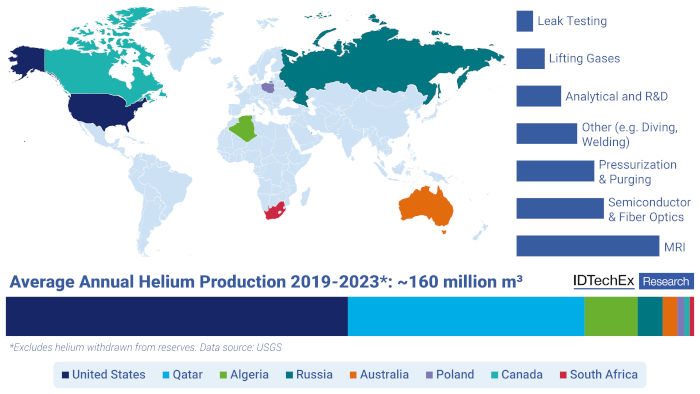
Main Sources of Helium Production and Applications. Source: IDTechEx.
Helium in the Manufacturing Industry.
Helium is widely used in manufacturing processes for its cooling and inert properties. It is essential for thermal management during semiconductor and fiber optic production and is a crucial component for quality control processes, such as leak testing of parts, including HVAC equipment, fuel tanks, battery packs, and aerospace components. It is also key for soldering processes in the production of numerous parts, including electrical and automotive components. In particular, the shift of semiconductor manufacturing processes toward smaller nodes (critical for AI, autonomous vehicles, etc.) will also increase the semiconductor industry's reliance on helium, for which there are currently no viable alternatives.
The IDTechEx report critically examines how these industries are addressing the chronic challenges of helium supply. Through interviews with key players, such as recovery technology manufacturers like Telstar and Nextrom, the report highlights market trends and activity in helium conservation (e.g., investing in recovery technologies) and the adoption of helium substitutes where possible.
Helium as a cryogen
With a normal boiling point of 4.2 K, helium is the only liquid that reaches temperatures close to absolute zero (0 K). Therefore, it is essential for superconducting devices, such as magnetic resonance imaging (MRI) and nuclear magnetic resonance imaging (NMR) machines in the medical and chemical industries, particle accelerators like the Large Hadron Collider, and some nuclear fusion reactors. For quantum computing, various types of qubits require cooling to between 10 mK and 4 K in certain aspects of the initialization, manipulation, and readout chain. To access temperatures in the mK range (1 mK = 0.001 K), the use of helium within cryostats is currently essential.
In recent decades, MRI scanners have been the primary end-use application of helium. However, improvements in hardware (e.g., sealed-for-life designs), software (e.g., AI, deep learning), and materials developments (e.g., metamaterials, high-temperature superconductors) are heralding a success story in reducing helium requirements. The IDTechEx report, "Helium Market 2025-2035: Applications, Alternatives, and Recovery," critically analyzes the technological advancements driving emerging trends in helium demand for MRI, NMR, quantum computing, and other applications.
Helium in the Aerospace Industry:
Helium plays a significant role in many aspects of the aerospace industry. It is used as an inert gas to purge hydrogen systems, pressurize ground and flight fluid systems, perform leak testing on components, and acts as a shielding gas in precision welding. It is also used as a cryogen to cool components.
Over the past five years, the frequency of orbital launches has increased, and commercial entities are becoming increasingly fundamental to the sector's expansion. This growth underscores the critical role of helium, further solidifying its status as an indispensable resource within the industry. The IDTechEx report provides a 10-year forecast detailing the projected demand for helium in the aerospace sector.
Trends in Helium Production:
While helium production capacity is expected to increase if Qatar and Russia boost their output, this does not necessarily guarantee an uninterrupted supply of helium in the future, given the geopolitical tensions in the regions where most helium is produced.
A growing number of small, independent players are exploring for primary/green helium from geological reserves where it is present in non-hydrocarbon gases. However, comprehensive data and validation are required to clarify the medium- and long-term production capacity outlook. These projects leverage low-cost separation systems, such as membrane and PSA technologies, to enhance and purify helium at wells or local processing facilities. The IDTechEx report, compiled from information obtained from helium separation technology providers such as UGS and Generon, comprehensively compares the advantages and challenges of helium separation and purification technologies.
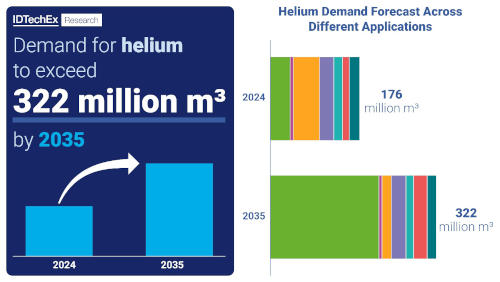
Forecast of helium demand growth. Source: IDTechEx
IDTechEx Outlook:
Historically, the price of helium has been low, making it economically unfeasible to drive innovation, exploration, and adoption of helium recovery technologies. However, the security of helium supply is hampered by geopolitical tensions and multifactorial contributions affecting the market. Specifically, in sectors where no viable alternatives to helium exist, rising prices are likely to push companies to consider conservation strategies and invest in recovery technologies.
Despite conservation strategies and substitutions, IDTechEx forecasts that helium demand will nearly double from 2024 to 2035.
Author: Dr. Shababa Selim, Technology Analyst at IDTechEx