





Since its inception in early 2019, ARVI and the Zero Waste Association have already implemented a geolocation tool to prevent the loss of fishing nets. This tool will allow them to mark areas where fishermen detect obstacles that could entangle their gear, as well as identify locations where nets have been lost for later recovery. Furthermore, thanks to chemical recycling, ECOALF has been able to transform the used nets into new raw material in the form of polyamide granules.
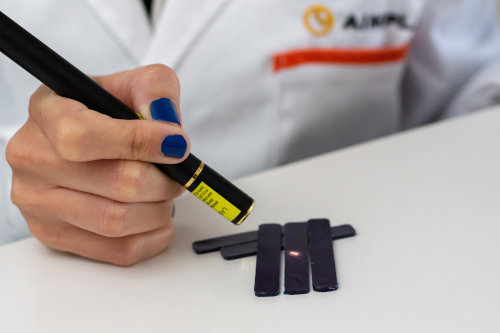 For its part, AIMPLAS, the Technological Institute of Plastics, has just completed research that has made it possible to incorporate an additive into polyamides that acts as a tracer, revealing its presence in the fabric when exposed to infrared light. This makes it possible, for the first time, to demonstrate the traceability of the raw materials used to manufacture a fabric and their origin—in this case, from fishing gear. The result has been the fabrics produced by Sintex as a demonstration product.
The next steps in the project will focus on mechanical recycling, aiming to recover value from polyester and polyethylene materials for the manufacture of new textile and non-textile products, respectively. This will also include measuring the environmental, economic, and social impact of the processes and the project as a whole, which is led by the University of Vigo.
OCEANETS is funded by the European Union and led by AIMPLAS, with the participation of the Vigo Port Fishing Vessel Owners Cooperative (ARVI), the Zero Waste Association, ECOALF, the University of Vigo, and Sintex. The project aligns with the United Nations Sustainable Development Goals due to its commitment to responsible production and consumption, as well as to marine life. The project has received funding from the European Union's EASME (European Maritime and Fisheries Fund) under agreement number EASME/EMFF/2017/1.2.1.12/52/03/552.789390 (OceaNets).













