
Virtual commissioning consists of fine-tuning the production or industrial handling system based on virtual simulations and the critical information obtained from these operations.
“We have sought to minimize the time and cost associated with setting up the machines and the measurement processes. We also aim to make it possible to make adjustments quickly and automatically based on production adaptation needs, such as having to manufacture new product lines,” explains Gorka Kortaberria, the lead researcher on the project.
Handling and manufacturing
As part of the initiative, Tekniker's research group has developed and integrated its self-calibration solutions into two different technology demonstrators: a robot for industrial handling processes and a machine tool for manufacturing.
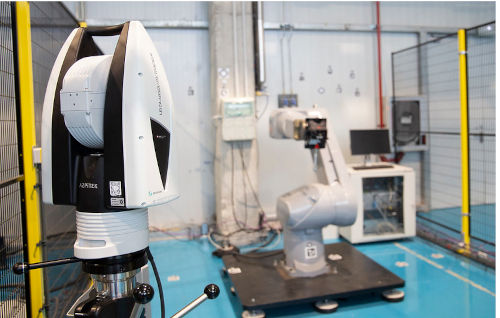
The first solution has been developed together with the Ideko technology center and allows for faster robot calibration with integrated means, which goes from having a duration of 1-2 hours (offline calibration) to 15-20 minutes, as well as improving the accuracy range by up to ten times, from 1-2 mm to 0.2-0.3 mm.
This system combines advanced photogrammetry strategies based on machine vision systems, geometric patterns, and robot kinematic models. Calibration and compensation allow the robots to be used in more demanding handling and manufacturing operations, such as insertion, measurement, or auxiliary operations where positioning is critical.
In the case of production equipment, the initiative has focused on a large machine tool, a type of equipment in which improving precision and maintaining this condition over time is a critical and enabling aspect for complex production processes.
In this case, calibration was achieved by integrating a laser tracker into the machine head and automatically measuring the equipment's volume and geometry. All of this is managed through a user interface that allows the procedure to be completed quickly, in less than 30 minutes, and the results to be collected.
Tekniker's work has focused on modeling and characterizing the machine's behavior so that it can be used for both demanding manufacturing processes and traceable measurement operations; that is, so that the machine itself evolves in such a way that, in addition to managing the manufacturing process, it has the ability to control the quality of the parts in an integrated manner.
The Precitek initiative, funded by the Basque Government's Elkartek program (2021-2022), has been led by Tekniker and has included the participation of Ideko, Vicomtech, Tecnalia, IMH Campus and the UPV/EHU.