




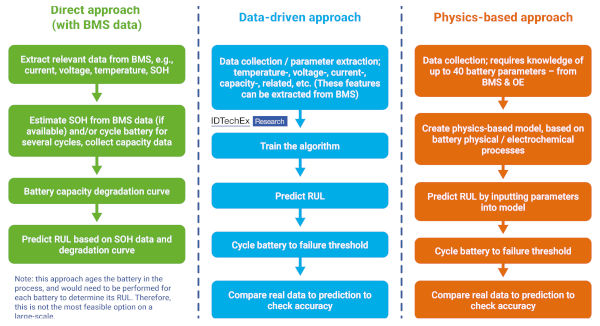
This is because it will influence the performance of the final second-life battery once it is reused. In its latest report on the topic, "Second-Life Batteries for Electric Vehicles 2023-2033," IDTechEx analyzes the various methods used by stakeholders to model and estimate important performance parameters of retired EV batteries.
The main battery tests typically performed are state of health (SOH), internal impedance, and remaining useful life (RUL). RUL is an estimate of the time remaining before a battery falls below a failure threshold. For most first-life EV batteries, this equates to 70-80% capacity at the end of their useful life. Batteries with high SOH and RUL and low internal impedance are best suited for second-life applications.
Key stakeholders who would conduct these tests include second-life battery recyclers and battery diagnosticians developing performance models. Startups developing these models could provide battery performance data to existing recyclers. In the future, automotive OEMs could use these technologies to comply with regulations such as the EU Battery Passport, which will require OEMs to provide battery condition information to recyclers.
To calculate the RUL (Recovery Limit), a battery would have to be subjected to cycles and its capacity degradation curve extrapolated to the failure threshold. Prolonged cycling is time-consuming and ages the battery. Furthermore, after a certain number of cycles, the degradation ceases to be linear, reducing the test's accuracy. Therefore, more accurate and faster alternative methods are needed to estimate the RUL.
These approaches include data-driven techniques such as machine learning (ML), adaptive filtering, and stochastic process methods, as well as physics-based modeling. For example, the California-based startup ReJoule develops battery management and classification solutions and offers technology that combines ML with electrochemical impedance spectroscopy and statistical modeling techniques. An Indian startup, Oorja Energy, combines both physics-based and data-driven techniques. Limited experimental data is added to its applied physics model, and ML algorithms are used to obtain an accurate result. The advantage is the time savings compared to developing a model based solely on physics.
Both data-driven and physics-based methods have their pros and cons, representing a trade-off between modeling speed and accuracy. Machine learning (ML) methods can be fast at modeling the performance of a large batch of batteries, though they can be prone to overfitting and limited to specific battery architectures. In the future, pure physics-based models may aspire to be battery chemistry-agnostic. This would benefit multiple stakeholders in the streamlined sorting of large volumes of retired EV batteries, regardless of their design. However, physics-based battery modeling is incredibly complex, as it requires knowledge of all conventional materials and properties to fully model the various aspects of a battery. Many of the materials used in a battery are engineered, making it difficult to know factors such as anode porosity without the battery manufacturer providing those specifications to an automotive OEM or a downstream modeler. Therefore, developing physics-based models can be time-consuming, as modelers may need to calculate and understand these battery-specific metrics themselves.
For remanufacturers, it is important to quickly and accurately measure the performance and RUL (Return on Use) of retired EV batteries. Currently, most diagnostic tools develop data-driven models, sometimes supplemented with other techniques using a hybrid modeling approach. This is a short-term solution for reusers who want to know the suitability of retired EV batteries for second-life applications. However, data-driven modeling remains limited to specific battery architectures, restricting its commercial viability if it is not compatible with a remanufacturer's retired EV batteries. Clearly, greater standardization of EV batteries and/or the development of battery-independent models are needed to help overcome this obstacle and facilitate better technological compatibility at scale.
For more information on testing and performance modeling considerations for retired EV batteries, see IDTechEx's new report, "Second-life Electric Vehicle Batteries 2023-2033." The report includes further information on the following: the regulatory landscape for second-life batteries, battery technology developments, techno-economic analysis of second-life batteries, key player activity, and 10-year forecasts for the second-life battery market (GWh installed) and EV battery availability.
Author: Conrad Nichols, technology analyst at IDTechEx













