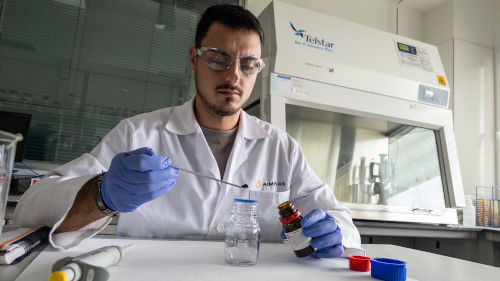
This challenge is the focus of the RECRITIC project, being developed by AIMPLAS, the Technological Institute of Plastics, with the support of ACTECO and GBP Metal Group. This research, funded by the Valencian Institute of Business Competitiveness (IVACE), emphasizes the importance of recovering and recycling Critical Raw Materials (CRMs), the critical raw materials identified by the European Commission due to their high economic importance, scarcity, and strategic relevance, as they are essential for the production of technological products and applications.
As explained by Eva Verdejo, lead researcher in Chemical Recycling at AIMPLAS, “These critical raw materials, such as lithium, gold, and silicon, along with other valuable waste, are found in everyday electrical and electronic devices like mobile phones and computers. They also play a particularly important role in the construction of alternative energy infrastructure, such as wind, photovoltaic, and concentrated solar power, making them vital in the energy transition towards clean and sustainable sources. Therefore, it is even more important to promote research into sustainable and viable recycling processes that allow us to recover these materials and treat complex waste appropriately to obtain recycled plastic that can be reused.”
The advances brought about by the RECRITIC project, Verdejo emphasized, “will allow us to move towards total recycling, with zero waste to landfill—a transformation that is aligned with European, national, and regional legislation on the circular economy, waste management, and plastics strategy, among other areas.”
To achieve this ambitious goal, the project will focus on developing and implementing various processes and technologies for mechanical, chemical, and biological recycling. In addition to the participating recycling companies, the project also benefits from the collaboration of the Design Engineering Group at Universitat Jaume I (UJI) to assess the environmental impact of CRM's chemical and biological recovery processes; Ingeniería Analítica SL, which will complement the substance analyses, specifically chromatographic analyses; and the Servei Central de Suport a la Investigació Experimental (SCSIE) – Universitat de València, which will contribute to additional analyses.
This project is included in the IVACE grant program for technology centers in the Valencian Community for non-economic R&D projects carried out in collaboration with companies for the 2023 fiscal year, funded by the European Regional Development Fund (ERDF) of the European Union within the framework of the 2021-2027 Operational Program.