




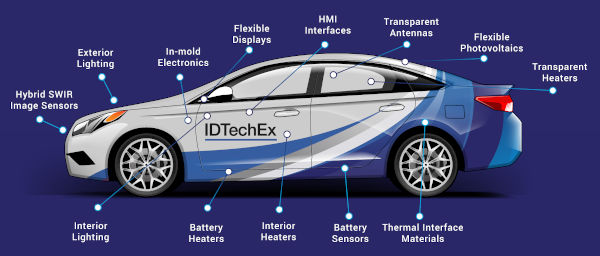
It's an exciting time for the automotive industry, with technological transitions toward electric vehicles and greater range occurring simultaneously. This, of course, creates vast opportunities for many new technologies, including printed/flexible electronics. For example, the ability to manufacture electronic components on thin, flexible substrates allows for weight reduction, which is crucial for electric vehicles. Furthermore, the shaping capabilities associated with flexible electronics are well-suited to the new trends in automotive interior design, where organic curves are replacing flat surfaces.
Electric vehicles. The accelerating transition to electric vehicles is well documented, and several countries have announced that the sale of new gasoline/diesel cars will be illegal at various points during the 2030s. It is clearly desirable for electric vehicle batteries to operate at the highest possible efficiency to maximize vehicle range for a given weight. However, battery capacity is highly temperature-dependent. This presents an opportunity for printed temperature sensor arrays to provide local control and for printed heaters to be integrated within the same functional film.
Greater levels of autonomy. Vehicles across the price range now feature sophisticated advanced driver assistance systems (ADAS). Over time, the level of autonomy will increase, with some vehicles expected to achieve Level 5 autonomy within a decade. This creates opportunities for multiple sensor technologies and associated features, such as transparent heaters, integrated antennas, and even flexible, low-resolution displays for the exterior to interact with pedestrians.
Differentiation is shifting from the powertrain to the interior/cabin. Automakers are increasingly turning to interior design and features to differentiate their products. Given their lightness and adaptability, this transition means that in-vehicle applications are undoubtedly the biggest opportunity for printed/flexible electronics. This trend is already evident in the rapid increase in display adoption, which will continue and extend to curved and flexible displays.
Human-machine interface (HMI) technologies, more simply described as pressure or touch sensors, are particularly promising. Printed pressure sensors, already widely used in seat occupancy sensors, are likely to be introduced into control panels to provide a wider range of inputs than purely capacitive touch sensors without the expense of mechanical switches.
Many of these touch sensors will likely be produced using in-mold electronics. Combining electronics with thermoformed plastic allows embedded systems like center consoles and overhead control panels to be much lighter, simpler, and easier to manufacture. In fact, IDTechEx forecasts that in-mold electronics will be a market worth approximately $1.3 billion by 2031.
Other opportunities for printed/flexible electronics in vehicle interiors include printed heaters, which allow heaters to be integrated into contact points. This is far more efficient than heating the space through the ventilation system, and much more sensitive—printed flexible heaters can even be transparent!
Summary
In summary, the transition to electric and autonomous vehicles is creating vast opportunities for printed and flexible electronics. These technologies include sensors within vehicle batteries, interior HMI components and displays, new manufacturing methodologies such as in-mold electronics (IME), and even exterior heating and lighting.













