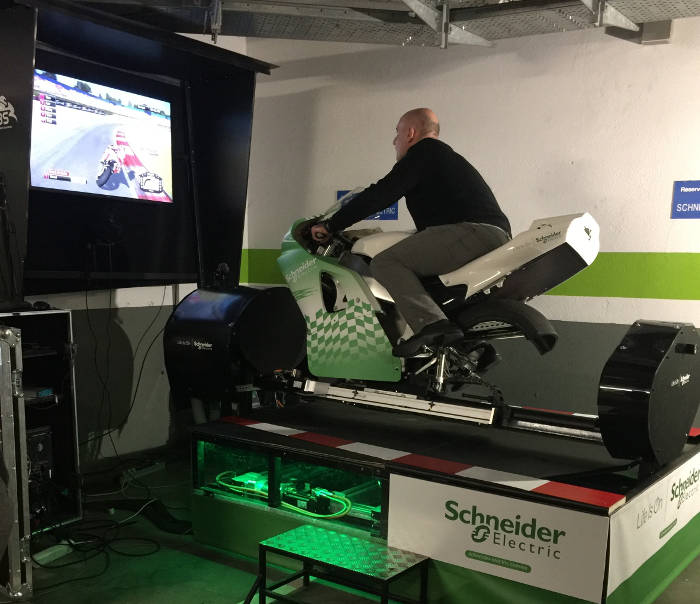
XBS is a startup founded by two Catalan entrepreneurs who began working from their garage on creating MotoGP simulators for training professional and semi-professional riders. Their product is also aimed at those who have always dreamed of experiencing the thrill of riding a real MotoGP bike on a racetrack.
The result is a fully electric MotoGP simulator with faster response times, more efficient power consumption, and single-phase power connection. This solution utilizes electric servo drive technology and Schneider Electric's control system.
According to José Miguel Solans Nerín, Business Development & Training Director of Schneider Electric, “For some time now, at the Schneider Electric Training Institute, ISEF, we have wanted to embark on a challenge like the one proposed by XBS: to put Schneider Electric's automation technology at the service of emotions so that people can experience what it is like to ride a MotoGP bike in a sustainable and safe way.”
 Simulator description
The new MotoGP simulator consists of three main elements. The mechanical component features the fairing of a real 1000cc motorcycle, mounted on a 5-axis mechanical system. This allows the simulator to replicate any movement a real motorcycle can perform: acceleration/braking, wheelies/inverted wheels, front/rear slides, and leaning up to 60%. These movements are achieved through the mechanical interconnection of various servomotors and electric axes, designed to support users weighing up to 100 kg.
The user's interaction with the handlebars, throttle, and brake, as well as the bike's lean angle and the other buttons, is sent to the PC and, consequently, to the MotoGP game via an electronic card. Using software, the PC breaks down the movement values of the MotoGP game for each of the simulator's electrical axes and sends them via Ethernet/OPC, with a very short cycle time (<10ms) to be imperceptible to the user, to the PLC that controls each axis.
This technology allows the user to live a realistic experience and feel the excitement of truly driving a high-displacement motorcycle on a race track.
The Schneider Electric solution
Among the challenges of the project was to go from the usual three axes to five, which would allow the real experience of driving an authentic Moto GP in a simulation process.
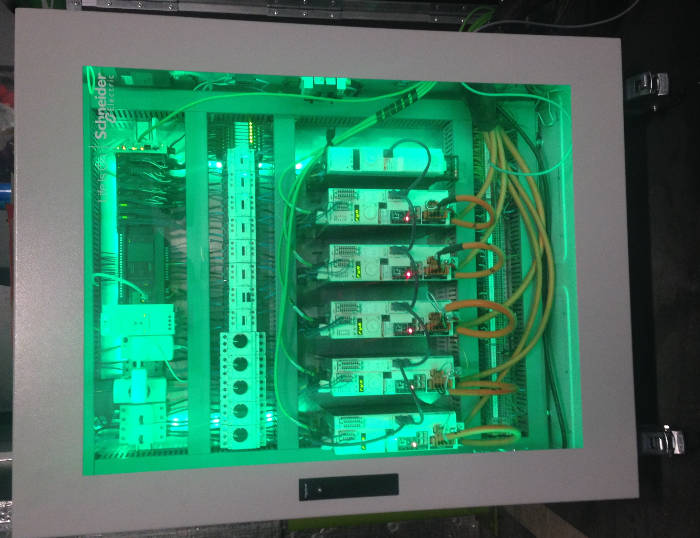
For the mechanical components, Schneider Electric's Lexium 32 range of servomotors and servodrivers (with single-phase power supply) were chosen. Five Lexium 32 units can control the movement of five Schneider Electric PAS4x or MAXR linear axes.
The control panel has all the necessary Schneider Electric electrical protections for each axis. Movement commands for each axis are provided by a Schneider Electric Modicon M241 programmable logic controller (PLC) via a CANopen bus. The PLC collects the position of each axis and sends it to the PC via Ethernet and OPC-DA, and receives movement commands from the computer.
The control interface for the different game modes can be accessed via an HMI screen installed on the control panel or via a web server, connected to the PLC via Wi-Fi. Using data received from the PLC and data from the motorcycle's handlebars, the PC interacts with the game through a software application. This allows for different operating modes, or the ability to load real-world telemetry data for rider improvement on a specific track.
Finally, VR technology has been introduced for greater player immersion in the simulation environment. All of this makes the experience more realistic and conveys the thrill of riding a real high-displacement motorcycle on a racetrack.