




In key regions, government initiatives have been established to accelerate the development of industrial decarbonization technologies, such as carbon capture and storage (CCUS), heat pumps, and thermal energy storage (TES), among other more direct electrification technologies. In its new market report, "Thermal Energy Storage 2024-2034: Technologies, Players, Markets, and Forecasts," IDTechEx forecasts that more than 40 GWh of TES capacity will be installed across the industry by 2034.
An emerging market for thermal energy storage
Heat exchanger (TES) technologies have been widely deployed in various applications and markets, such as pairing with concentrated solar power (CSP) plants, district heating, cold chain, and space heating for buildings. Their penetration in the industrial sector is much lower, with only 1% of global TES capacity represented by systems installed in industrial environments. As governments seek to reduce industrial emissions to help achieve broader net-zero emissions targets, the proportion of global TES capacity represented by industrial deployments is expected to increase. Given the wide variety of industrial heating processes, it is important to examine the different TES technologies being developed by key players and how system designs and commercialization levels will influence their adoption in industry.
Main players and technologies in industrial thermal energy storage
Most of the industrial players in the thermal energy storage sector are located across Europe, the United States, and Australia. As shown in the IDTechEx market report, these players are developing and commercializing both sensible and latent heat TES systems for industrial applications, and most have deployed pilot or commercial demonstration projects.
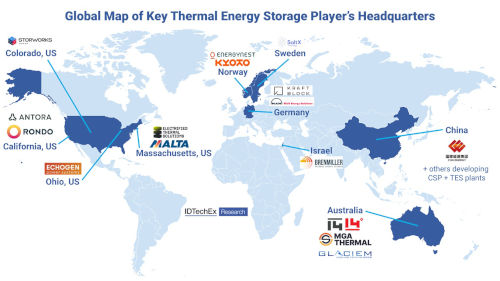
World map of the headquarters of the main players in thermal energy storage. Source: IDTechEx
In a sensible heat TES system, a thermal storage medium, such as molten salt, concrete, or refractory bricks, is heated to a higher temperature, stores this heat until needed, and transfers it to an industrial process upon discharge. The heat can be transferred to a heat transfer fluid (HTF), such as water, air, or thermal oil. In latent heat systems, a phase-change material (PCM), such as a metal alloy or silicon, is heated at a constant temperature to change its phase from solid to liquid.
Thermal energy storage by latent heat
Latent heat systems can offer higher energy storage densities than sensible heat systems because a large amount of heat is required to change the phase of a material from solid to liquid. This could be useful in industry, where existing manufacturing environments may already be space-constrained. Another advantage of latent heat systems is their ability to supply heat at a constant temperature, as they can operate under isothermal conditions. This is important for industrial processes that require heat supply at constant operating parameters, such as temperature, pressure, and/or flow rate.
However, PCM containment and the variation of material properties over extended cycles are factors that require further development if latent heat systems are to have a longer lifespan or require fewer material replacements throughout the system's lifetime. Furthermore, the number of key players developing latent heat systems is lower than that of sensible heat systems. One example is the Australian company 1414 Degrees, which is developing a silicon-based latent heat storage technology (TES). It is likely that, in the medium term, these factors will result in fewer commercial-scale deployments of latent heat storage systems.
Thermal energy storage by sensible heat
Molten salt thermal energy storage (TES) technologies have been widely implemented in heat transfer circuitry (HTC) applications, which has likely driven their commercial adoption in industry ahead of other TES technologies. However, upon discharge, the temperature of the thermal storage media used in sensible heat systems decreases, which, without additional system design, would result in fluctuating temperatures being supplied to an industrial process—a situation that would be impractical or, at least, undesirable.
Molten salt systems, such as those developed by the Norwegian company Kyoto Group, can solve this problem by incorporating continuous recirculation loops, which keep the salt within its operating temperature range while continuously supplying heat at a constant temperature to an industrial process. One of the main drawbacks of molten salt heat exchangers is that these systems cannot store heat at temperatures above 600 °C due to salt decomposition. This limits the application of this technology, although it will continue to be in demand for low- and medium-temperature industrial processes, such as drying and heating process fluids.
Solid-state sensible heat systems utilize materials such as concrete and refractory brick and are being developed by leading companies like EnergyNest and Rondo Energy. A solid-state system supplying hot air to a process could be mixed with an ambient or cooler air stream at the time of discharge, with proportions varying over time so that the air is supplied to the process at a constant temperature. However, this would increase the system's complexity and cost. More importantly, solid-state systems can deliver heat at temperatures exceeding 1,000 °C, which will be crucial for decarbonizing certain glass, metal, and cement manufacturing processes.
Future prospects for thermal energy storage technology
Many of the solid-state TES technologies under development still struggle to deliver heat at temperatures above 1,300°C due to limitations in the mechanical and thermal stability of the materials. To deliver heat at constant temperatures, it may be necessary to mix cooler fluids with hotter fluids that leave the system at the time of discharge. Therefore, it will be necessary to develop new materials or alter existing compositions to decarbonize some of the highest-temperature industrial heating applications, including certain heat treatment and metal smelting processes. One key company, US-based Electrified Thermal Solutions, is developing a TES technology that utilizes electrically conductive ceramic bricks. The chemical composition of these bricks has been modified so that they can absorb electricity as an energy source and function as a heating element, storing the heat generated by the electricity. A furnace could be constructed using these bricks to provide radiant heat directly to a process, potentially up to 1,800°C. This would enable the decarbonization of the atmosphere. This would allow the decarbonization of some of the most extreme industrial heating processes that occur in the metal and glass industries.
Furthermore, thermochemical energy storage (TCES) technologies may penetrate the market in the future. These technologies can utilize sorption (adsorption or absorption) between two materials or chemical reactions to store energy in the form of chemical potential. These systems have higher theoretical energy densities and lower heat losses over time than latent heat and sensible heat systems. This could make them suitable for future residential and seasonal storage applications. Several TCES prototypes have been created, although the large number of material combinations that could hypothetically be used in these systems may be an obstacle to the commercial development of any TCES technology. Fine-tuning, increased awareness, and funding for these technologies are needed to bring them to market.
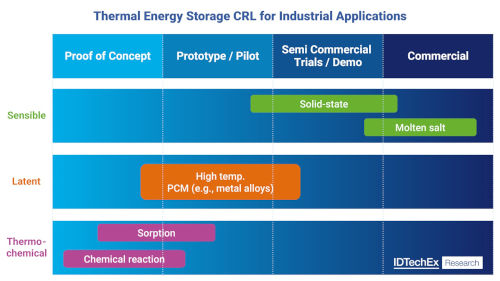
Thermal energy storage LCR for industrial applications. Source: IDTechEx
In the next decade, as the IDTechEx market report suggests, sensible heat systems are expected to dominate the industrial TES market. Their use of abundant and low-cost materials, coupled with their ability to deliver heat at over 1,000°C in the case of solid-state systems, makes them suitable technologies for a wide range of industrial heating applications. Further development of latent heat and TCES technologies for decarbonized industrial heating is anticipated, although broader markets and applications could benefit from the use of these systems, which offer higher energy densities.
Author: Conrad Nichols, Senior Technology Analyst at IDTechEx













