




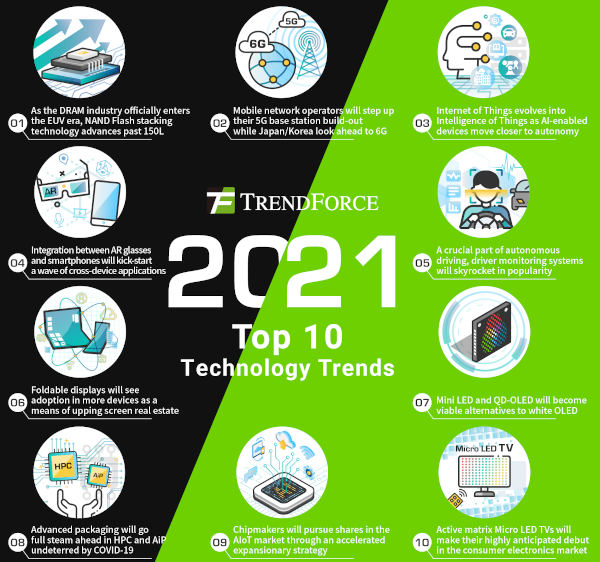
The three leading DRAM vendors, Samsung, SK Hynix, and Micron, will not only continue their transition to 1Znm and 1alpha nm process technologies, but will also formally usher in the era of VUE (Virtual Unified Edge) technology, with Samsung leading the way, in 2021. DRAM vendors will gradually replace their current dual-pattern technologies to optimize their cost structure and manufacturing efficiency.
After NAND Flash vendors achieved memory stacking technology exceeding 100 layers in 2020, they aim to reach 150 layers and more in 2021 and increase single-chip capacity from 256/512Gb to 512Gb/1Tb. Consumers will be able to adopt higher-density NAND Flash products thanks to vendors' efforts to optimize chip costs. While PCIe Gen 3 is currently the dominant bus interface for SSDs, PCIe Gen 4 will begin to gain a larger market share in 2021 thanks to its integration into the PS5, Xbox Series X/S, and motherboards with Intel's new microarchitecture. The new interface is essential to meet the massive data transfer demands of high-end PCs, servers, and HPC data centers.
Mobile network operators will ramp up construction of their 5G base stations as Japan/Korea look towards 6G.
The 5G Implementation Guidelines: SA Option 2, published by the GSMA in June 2020, delve into significant technical details regarding 5G deployment, both for mobile network operators and from a global perspective. Operators are expected to deploy 5G Autonomous (SA) architectures on a large scale in 2021. In addition to providing high-speed, high-bandwidth connections, 5G SA architectures will allow operators to customize their networks based on user applications and adapt to workloads requiring ultra-low latency. However, even as 5G deployment is underway, Japan-based NTT DoCoMo and Korea-based SK Telecom are already focusing on 6G deployment, as 6G enables various emerging applications in RX (including VR, AR, MR, and 8K and higher resolutions), realistic holographic communications, WFH, remote access, telemedicine, and distance learning.
The Internet of Things (IoT) is evolving into the Intelligence of Things as AI-enabled devices move closer to autonomy.
In 2021, deep AI integration will be the main value-add to the IoT, whose definition will evolve from the Internet of Things to the Intelligence of Things. Innovations in tools such as deep learning and computer vision will bring about a complete upgrade for IoT software and hardware applications. Considering industry dynamics, economic stimulus, and the demand for remote access, the IoT is expected to see widespread adoption in some key vertical sectors, such as smart manufacturing and smart healthcare. Regarding smart manufacturing, the introduction of contactless technology is expected to accelerate the arrival of Industry 4.0. As smart factories pursue resilience, flexibility, and efficiency, IoT integration will equip edge devices, such as cobots and drones, with even greater accuracy and inspection capabilities, transforming automation into autonomy. In smart healthcare, AI adoption can transform existing medical datasets into enablers of process optimization and expanded service reach. For example, AI integration offers faster thermal image recognition that can support clinical decision-making, telemedicine, and surgical assistance applications. These applications are expected to serve as crucial functions for AI-enabled medical IoT in diverse environments, from smart clinics to telemedicine centers.
The integration of AI glasses and smartphones will usher in a wave of cross-platform applications.
AR glasses will move toward a smartphone-connected design in 2021, where the smartphone serves as the computing platform for the glasses. This design allows for a significant reduction in the cost and weight of AR glasses. In particular, as the 5G network environment matures in 2021, the integration of 5G smartphones and AR glasses will allow the latter not only to run AR applications more seamlessly but also to fulfill advanced personal audiovisual entertainment functions by leveraging the added computing power of smartphones. As a result, smartphone brands and mobile network operators are expected to venture into the AR glasses market on a large scale in 2021.
A crucial component of autonomous driving, driver monitoring systems (DMS) are set to skyrocket in popularity.
Automotive safety technology has evolved from exterior applications to interior ones, while sensing technology is moving toward a future that integrates driver condition monitoring with external environmental readings. Similarly, automotive AI integration is evolving beyond its current entertainment and user assistance functions to become an indispensable element of automotive safety. In light of the series of traffic accidents where drivers ignored road conditions due to their over-reliance on advanced driver assistance systems (ADAS), whose adoption rate has recently surged, the market is once again paying close attention to driver monitoring functions. In the future, the primary impetus for driver monitoring functions will focus on the development of more active, reliable, and accurate camera systems. By detecting driver drowsiness and attention through iris tracking and behavioral monitoring, these systems can identify in real time whether the driver is tired, distracted, or driving improperly. As such, Driver Monitoring Systems (DMS) have become an absolute necessity in the development of Autonomous Driving Systems (ADS), since DMS must serve multiple functions simultaneously, including real-time detection and notification, driver capability assessment, and taking over driving controls when necessary. Vehicles with integrated DMS are expected to enter mass production in the near future.
Foldable displays will be adopted in more devices as a means of increasing screen size.
As foldable phones transitioned from a concept to a product in 2019, several smartphone brands successively launched their own foldable phones to test the waters. Although the sales performance of these phones has been mediocre so far due to their relatively high costs—and, by extension, their retail prices—they are still capable of generating considerable buzz in the mature and saturated smartphone market. In the coming years, as panel manufacturers gradually expand their flexible AMOLED production capabilities, smartphone brands will continue to focus on their foldable phone development. Furthermore, foldable functionality has been seeing increasing penetration in other devices as well, specifically laptops. With Intel and Microsoft leading the way, several manufacturers have each launched their own dual-screen laptop offerings. Similarly, foldable products with flexible AMOLED displays will become the next big thing. Laptops with foldable screens will likely enter the market in 2021. As an innovative application of flexible displays and as a product category featuring much larger flexible screens than previous applications, the integration of foldable displays into laptops is expected to increase the flexible production capacity of AMOLED manufacturers to some extent.
Mini LED and QD-OLED will become viable alternatives to white OLEDs.
Competition among display technologies is expected to heat up in the high-end TV market in 2021. In particular, Mini LED backlighting allows LCD TVs to have finer control over their backlight zones and, therefore, greater screen contrast compared to current conventional TVs. Led by Samsung, LCD TVs with Mini LED backlighting compete with their white OLED counterparts, offering similar specifications and performance. Moreover, given its superior cost-effectiveness, Mini LED is expected to emerge as a strong alternative to white OLEDs as a display technology. On the other hand, Samsung Display (SDC) is betting on its new QD-OLED technology as a technological differentiator from its competitors, as SDC is winding down its LCD manufacturing operations. SDC will seek to set the new gold standard in TV specifications with its QD OLED technology, which is superior to white OLED in terms of color saturation. TrendForce expects the high-end TV market to exhibit a new and ruthless competitive landscape in the second half of 2021.
Advanced Packaging Evolves at Full Speed in HPC and AiP.
The development of advanced packaging technology has not slowed this year despite the impact of the COVID-19 pandemic. As several manufacturers launch HPC chips and AiP (antenna-in-package) modules, semiconductor companies such as TSMC, Intel, ASE, and Amkor are eager to participate in the burgeoning advanced packaging industry. Regarding HPC chip packaging, due to the increased demand for these chips in terms of I/O lead density, the demand for interposers, which are used in chip packaging, has also increased accordingly. TSMC and Intel have each launched their new chip package architectures, branded 3D fabric and Hybrid Bonding, respectively, while gradually evolving their third-generation packaging technologies (CoWoS for TSMC and EMIB for Intel) to fourth-generation CoWoS and Co-EMIB technologies.
In 2021, the two foundries will seek to capitalize on the demand for high-end 2.5D and 3D chip packages. Regarding AiP module packages, after Qualcomm launched its first QTM products in 2018, MediaTek and Apple subsequently collaborated with OSAT-related companies, including ASE and Amkor. Through these collaborations, MediaTek and Apple hoped to advance research and development of leading flip-chip packages, a relatively low-cost technology. AiP is expected to see gradual integration into 5G mmWave devices starting in 2021. Driven by the demand for 5G network communications and connectivity, AiP modules are expected to first reach the smartphone market and subsequently the automotive and tablet markets.
Chipmakers will seek market share in the AIoT sector through an accelerated expansion strategy.
With the rapid development of IoT, 5G, AI, and cloud/edge computing, chipmakers' strategies have evolved from single products to product lines and, finally, to product solutions, thus creating a complete and granular chip ecosystem. Looking at the development of major chipmakers in recent years from a broad perspective, their continued vertical integration has resulted in an oligopolistic industry where localized competition is more intense than ever. Furthermore, as the commercialization of 5G generates diverse application demands for various use cases, chipmakers are now offering full-service vertical solutions, ranging from chip design to software/hardware platform integration, in response to the significant business opportunities presented by the rapidly developing AIoT industry. On the other hand, chip manufacturers that were unable to position themselves in time according to market needs will likely be exposed to the risk of over-reliance on a single market.
Active matrix micro LED TVs will make their long-awaited debut in the consumer electronics market.
The launch of large-format micro LED displays by Samsung, LG, Sony, and Lumens in recent years marked the beginning of the integration of micro LEDs into large-format display development. As the application of micro LEDs in large displays gradually matures, Samsung is expected to be the first in the industry to launch its active matrix micro LED TVs, thus solidifying 2021 as the first year of micro LED integration in televisions. The active matrix addresses pixels using the display's TFT glass backplane, and since the active matrix IC design is relatively simple, this addressing scheme therefore requires a relatively low amount of routing. In particular, active matrix integrated circuits require PWM functionality and MOSFET switches to stabilize the electrical current that drives the micro LED displays, which necessitates a new and extremely expensive research and development process for such integrated circuits. Therefore, for Micro LED manufacturers, their biggest challenges at the moment in pushing Micro LED into the end-user device market lie in technology and cost.













