




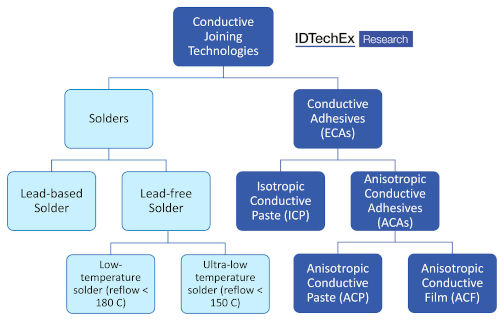
Component fastening materials can be divided into two categories, as shown in the chart.
Soldering, formerly lead-based but now primarily lead-free, offers the dual advantage of being low-cost and well-established. Furthermore, the reflow process aids in component alignment, reorienting the components to minimize the surface energy of the solder droplet. This self-alignment significantly reduces the resolution requirements of the pick-and-place process, enabling faster component placement.
However, soldering has a key drawback. The reflow process typically requires high temperatures, around 250°C, for the widely used SAC (tin/silver/copper) solders, and also requires time-consuming thermal ramp-ups. Therefore, it is not applicable to thermally brittle substrates such as PET, nor is it compatible with high-speed roll-to-roll (R2R) manufacturing or 3D additive electronics. It should be noted that ultra-low temperature solders have recently been developed to improve compatibility with polymer substrates, but they have not yet achieved widespread acceptance.
The time-consuming, high-temperature reflow process leaves room for electrically conductive adhesives (ECAs), which are analyzed in detail in the new IDTechEx report, "Electrically Conductive Adhesives 2022-2032: Technologies, Markets, and Forecasts." Instead of being a metallic alloy like solder, ECAs are composed of a metallic powder embedded in a polymer resin.
Although more expensive and lacking the self-aligning advantage, ECAs allow components to be bonded directly to the substrate and require neither high reflow temperatures nor long thermal ramps. Therefore, they are unlikely to replace soldering on conventional printed circuit boards, but their market share is expected to increase with the transition to integrated and flexible electronics.
Furthermore, anisotropic conductive adhesives (ACAs) offer lower conductivity than the more common isotropic conductive adhesives (ICAs). Currently, ACAs (supplied as films or pastes) require the application of high temperatures and pressures during component placement, increasing both manufacturing costs and the risk of damage. However, the emerging technology of "field-aligned conductive adhesives" eliminates this limitation, as anisotropic conductivity is induced prior to bonding.
Emerging applications of ECAs
ECAs are well suited to applications that require mounting electronic components on anything other than a conventional FR4 substrate, especially when the substrate material is thermally brittle.
A very promising emerging application of ECAs is in-mold electronics (IME), used to manufacture decorative surfaces with integrated capacitive touch sensing and lighting. Automotive interiors are the primary use case, and the total IME market is projected to reach approximately $1.5 billion by 2032. IME components are manufactured by screen-printing conductive ink onto a flat substrate (typically polycarbonate), after which the electronic components are mounted. ECAs are used because polycarbonate would not withstand the high reflow temperatures of soldering.
Another promising application of ECAs is flexible hybrid electronics (FHE), a developing approach that can be seen as combining the best of both conventional and printed electronics. This requires mounting components on flexible substrates with printed conductive traces, and ECAs (or, alternatively, very low-temperature soldering) are needed to avoid damaging the low-cost PET substrates.
A very specific use case for ECAs is stretchable electronics, necessary for electronic textiles and some electronic skin patches. This will require solutions for attaching slightly stretchable components. Since the mechanical properties of ECAs depend heavily on the properties of the polymer resin, slight elasticity can be introduced using an elastomeric material













