

While EVs rely on high-voltage batteries (800V, 400V) and a 48V distribution system, a 48V battery can instantly supply the required power, but any intermediate battery in EV architectures will negatively impact weight, space, and cost.
|
|
 Figure 1: Comparison of power distribution and energy storage in the architectures of internal combustion engines, hybrid vehicles, and electric vehicles (EVs). EV power architectures are complex compared to previous architectures due to the various subsystems with dynamic and static power levels, using older 12V and newer 48V inputs. To avoid the added cost and weight of an intermediate energy storage stage, a converter with fast transient response and high efficiency is needed to convert the high-voltage battery to voltages that can be safely distributed throughout the vehicle.
The opportunity to introduce innovations in EV power architectures lies in using a high-voltage battery to leverage the advantages of high-voltage energy storage and eliminate the need for an intermediate battery. This is achieved by using a DC/DC converter to power the system within a SELV (Safely Low Voltage) range. While a conventional converter can handle the voltage conversion, it lacks the response speed required to meet the power demands of the various subsystems.
Vicor's BCM (Battery Control Module) is characterized by its low impedance and fast response time, enabling it to transform the high-voltage battery into what appears to be a 48V battery for grid connection, thus eliminating the need for a separate 48V intermediate battery.
This article explains in detail the characteristics of Vicor's BCM converter, its operation and capabilities, compares it with a conventional DC/DC converter, and suggests an implementation of its architecture when used in the power architecture for an EV.
The BCM converter
|
Factor K |
1/32 |
1/4 |
1/1 |
4/1 |
|
VPRI |
384 |
48 |
48 |
12 |
|
VSEC |
12 |
12 |
48 |
48 |
|
IPRI |
1 |
1 |
1 |
4 |
|
ISEC |
32 |
4 |
1 |
1 |
|
Table 1: Examples of voltage to current conversion |
The BCM converter functions as a fixed-ratio converter whose output voltage (also called the secondary voltage) is a fixed fraction of the input voltage (also called the primary voltage). This fixed fraction, called the K-factor, can be greater than, equal to, or less than one and is defined as the input voltage divided by the output voltage (V<sub>PRI</sub> /V<sub>SEC</sub>). When the K-factor is less than one, input voltages decrease but input currents increase. When the K-factor is greater than one, input voltages increase and input currents
decrease.
The internal operation of the BCM converter consists of three stages:
- A switching stage in the primary that converts the DC input of the primary into a sinusoidal signal.
- An ideal transformer that converts AC to AC and varies the voltage depending on the turns ratio between the primary and secondary (the K factor).
|
|
 Figure 2: Block diagram of the BCM converter. Although it converts DC to DC, the BCM uses a transformer for high-efficiency AC-to-AC conversion, varying the magnitude by the K factor and using switching blocks to convert between AC and DC. The switching occurs at high frequency, and because the energy transfer is similar to that of a transformer, the conversion is characterized by its fast response to transient load changes and exhibits low input-output impedance.
A switching stage on the secondary side converts the sinusoidal signal from the ideal transformer into a DC output. The switching stages switch when the sinusoidal signal passes through zero current and zero voltage in the transformer, thus minimizing losses caused by switching.
Symmetry, along with appropriate sequencing and control, allows the BCM to function as either a buck or boost converter. This inherent bidirectional capability enables the BCM to convert power with equal efficiency in either direction. This opens up the possibility of power conversion in applications characterized by rapid charging and discharging from a storage element, for example, although this article will focus on buck conversion.
Thanks to zero current/zero voltage (ZCS/ZVS) switching, BCM converters operate at higher frequencies than conventional converters. For example, the BCM6135 operates at 1.2 MHz, and unlike a conventional ZV/ZC resonant converter, the BCM operates within a narrow frequency band. The BCM's high operating frequency provides a fast response to changes in load currents and low input-to-output impedance. Fixed-ratio conversion, bidirectional operation, fast transient response, and low impedance are the qualities that allow the BCM to make a 384V battery appear as if it were a 48V battery—a process we call transformation. This ability to transform a power supply is the primary advantage and the biggest difference compared to conventional converters.
Power supply transformation
|
|
 Figure 3: High-voltage battery conversion. When a K-factor 1/8 BCM converts the output of a 384 V battery, a virtual 48 V battery is created. This conversion preserves the energy density of the 384 V battery and its transient supply capacity, but with a SELV voltage compatible with its subsequent distribution.
The BCM transforms an input voltage into an output voltage according to a fixed relationship, which can be mathematically expressed as VOUT = K ∙ VIN. Consider a 48V distributed power system connected to a high-voltage battery charged to 384V. The loads on the 48V bus have an input voltage range that is a fixed fraction of the battery output. An isolated (1/8) BSM converts the high-voltage DC battery output into a set of voltages compatible with the 48V distribution. The BCM's fast response time makes the 384V battery appear, from the perspective of any load on the low side, to discharge to 48V. In practice, the BCM converter has transformed the high-voltage battery, thus allowing the system to enjoy all the advantages of a higher voltage battery for energy storage, such as faster charging time and improved energy density when compared to a 48V battery with equivalent energy storage.
Let's now consider the same application with a conventional converter, which regulates the input voltage to a specific output voltage independent of input fluctuations. Input voltage fluctuations are not propagated to the regulated output. The narrow bandwidth of the regulated converter prevents the distribution system from supplying power as quickly as a direct battery connection. From the low-potential side, there is only one ideal supply voltage of 48V. While this conversion is useful, it has two weaknesses. First, the narrow bandwidth necessitates some additional energy storage (either capacitive or another battery) to supply current during a discharge with a high dI/dt. Second, a regulation stage is unnecessary because the input voltage of the loads on the low-potential side is a fixed fraction of the battery voltage on the high-potential side. The conventional converter regulates unnecessarily, thus wasting energy, increasing costs, and reducing system efficiency. Furthermore, the limited bandwidth of the regulated converter worsens the reaction time to rapid power demands in the distribution system.
|
|
 Figure 4: 48V power supply disconnected from a high-voltage battery. When a conventional converter generates 48V from a battery, the converter's narrower bandwidth means it cannot deliver power as quickly and also wastes energy in an unnecessary regulation stage.
 By designing a power supply's voltage range to be a fixed fraction of the load's input range in the power distribution system, the high voltages (with their corresponding advantage of low losses) can be used to distribute power without the unnecessary regulation stages used in systems equipped with conventional converters. Taking this a step further, designing a system where all voltage ranges—for sources, loads, and various distribution paths—are fixed ratios to each other allows for optimal selection of the best technology for power storage and distribution, as well as for subsystem capabilities. This is achieved through high-performance EV power architectures. These systems use Li-ion batteries (arranged according to capacity and high voltage for fast charging), distribute power at 48V (according to the LV148V specification for SELV distribution), and utilize various legacy, cost-effective 12V subsystems alongside state-of-the-art 48V AI technology. The BCMs then integrate all these voltages into a single, highly efficient system.
A 48V virtual battery architecture
|
|
 Figure 5: EV power architecture. With a much lighter weight but the same energy storage capacity, a 384V battery can be used as a virtual 48V battery with a BCM. EV power architectures can distribute 48V and use NBM to integrate legacy 12V systems into more efficient and lightweight architectures.
Power architectures for EVs can utilize battery modules (BCMs) to create a high-efficiency, lightweight power system. High-voltage battery banks, which constitute the primary energy storage unit, reduce the voltage to the most efficient value for distribution. This configuration offers advantages (energy density and charging time) over lower-voltage solutions, but also drawbacks (non-SELV) that make it advisable for EV applications but unsafe for distributed power delivery across the vehicle. Instead, implementing a distributed power system according to the LV148 specification allows power to be distributed at a safe voltage (SELV), which is easier to maintain than the high battery voltage and requires less copper for the lower current than if distributed at 12V as before.
The BCM converter reflects the discharge characteristics of the high-voltage battery based on a K-factor of 1/8. This virtual battery powers the compatible LV148 distribution system as effectively as any physical 48V battery, but with the energy density and advantages associated with a high-voltage battery in the system.
The Vicor BCM6135 converter is isolated, providing the necessary protection when connecting a high-voltage source to a SELV distribution system. It achieves an efficiency exceeding 97%, and over 96% when operating above 30% of its rated current. Capable of delivering up to 65A (over 3000W) continuously, the BCM6135 converters can create high-power conversion stages between high-voltage DC and SELV ranges. The BCM6135 has an input range of 260 to 410V and a fixed conversion ratio of 1/8 to provide an output compatible with a 48V distribution system.
The BCM6135 measures 61x35x7.5mm, is available in chassis-mount and insert-mount versions, and weighs 68g. Its high power density (3400 W/in³)facilitates optimal placement within the vehicle's power architecture and weight distribution. The package is designed for use in both conduction and liquid-cooled systems, and its heat dissipation is similar on the top and bottom of the package to increase mounting and cooling flexibility.
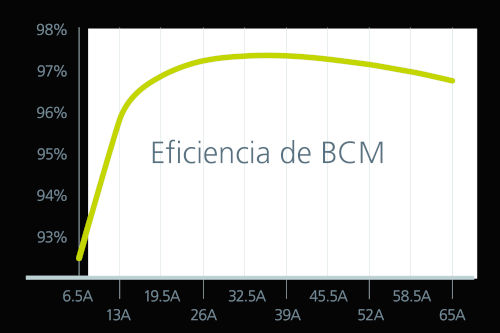 Figure 6: Efficiency of the BCM6153 with respect to the output load current.
Figure 7: Image of the BCM6135 for chassis mounting.
Extend the 48V distribution
While the system's power can be derived from a virtual 48V battery, it must still be distributed throughout the vehicle to a large number of loads in subsystems with varying power requirements and 48V and 12V inputs. While the advantages of 48V over 12V power (higher efficiencies and lighter cables) are clear, how this setup will evolve over time is less so. As 12V becomes less prevalent, the vehicle's power architecture must be flexible enough to accommodate new subsystems while continuing to optimize the weight and cost of all the required wiring.
The ideal solution is to extend the 48V distribution as much as physically possible and convert to 12V only when absolutely necessary. Since the operating range of the LV148 specification can be transformed into a 12V distribution-compatible input with a K-factor conversion of 1/4, a BCM converter is the ideal solution for achieving maximum efficiency. Furthermore, because both voltages are SELV-compatible, isolation is not required, and a non-isolated converter can be used to convert from 48V to 12V throughout the system. A non-isolated BCM is called an NBM, and its other characteristics are identical, thus offering the same advantages described above: fast transient response, low impedance, and bidirectional operation.
 Figure 8: Efficiency of the NBM2317 with respect to the output load current.
This distributed power architecture offers all the advantages of 48V distribution while maintaining the flexibility for the platform to accommodate new subsystems with both 48V and 12V inputs. The NBM transforms the 48V input into what appears to be a 12V source for legacy 12V systems. The NBM can be integrated anywhere in the vehicle, as it is small enough to power the legacy subsystems wherever they are located. It also facilitates its removal should the system be retrofitted in the future with the installation of 48V subsystems.
The Vicor NBM2317, measuring 23 x 17 x 7.4 mm and weighing 12 g, can be placed anywhere in the optimal location to extend the 48V distribution. Its maximum efficiency exceeds 97.5% when operating above 30% of its rated current. Capable of delivering up to 60 A (800 W) continuously, the NBM2317 is designed for optimal cooling flexibility, either top or bottom, and its surface-mount package allows for easy integration into existing layouts. Its high power density (4500 W/in³)far surpasses competing modules, and it can also be integrated more effectively than any discrete solution of equivalent power level.
 Figure 9: Image of the NBM2317 for surface mounting.
When used together, the BCM6135 and NBM2317 offer EV power architecture flexibility to adopt the optimal combination of 48V and 12V subsystems, as well as to take full advantage of 48V SELV distribution and high-voltage DC storage, thereby meeting the high-performance goals of EV designs.
Conclusion
The ability of Battery Converter Modules (BCMs) to transform power sources, especially batteries, is their primary advantage and key difference compared to conventional converters. Since the output voltage of the primary power supply in the power architecture is a fixed ratio to any input voltage of a downstream subsystem, the power can be distributed at the highest optimal voltage and then converted as needed by the BCMs without the losses caused by unnecessary regulation stages. The advantage leveraged by EV architectures is the elimination of any intermediate batteries, as the high-voltage energy storage battery is transformed into a SELV-compatible range for supplying power throughout the vehicle. While both BCMs and Non-Battery Converters (NBCs) are being implemented in EV power systems, any other battery-powered system—from ultralight unmanned aerial vehicles to autonomous industrial robots and distributed AI computing platforms—can benefit from their transformative capabilities.
For more information visit www.vicorpower.com or call the Vicor representative in your country.