In its latest report on redox flow batteries, "Redox Flow Batteries 2021-2031," IDTechEx assessed the role of medium-duration energy storage in the context of increased variable renewable energy penetration. To date, variable renewable energy has achieved a low-to-medium penetration rate, between 10% and 40%. As researched in academia, energy storage will be a key tool for enabling greater integration of renewable energy; the question is: what storage will be needed to meet the growing penetration of renewable energy?
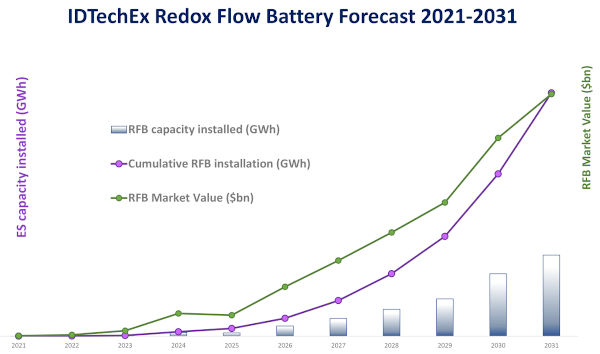
Lithium-ion battery technologies have dominated the field of stationary energy storage, but will they continue to do so? Based on a study conducted by IDTechEx, which analyzed profiles of several companies in the redox flow battery sector and additional secondary research, IDTechEx has projected the potential future market penetration of redox flow batteries.
The results of IDTechEx's research show that RFB technology could begin to gain ground on lithium-ion batteries over the next decade, surpassing the energy capacity of installed lithium-ion batteries before the end of 2030.
The widespread adoption of variable renewable energy (VRE) is substantially impacting grid infrastructure, and with more renewables being installed, the need to adjust and upgrade the electricity grid will only increase. In fact, variability is one of the challenges facing the electricity grid.
The arrival of renewable energy implies a change in the existing grid infrastructure, due to the nature of renewable energies, both wind and solar. The variability and uncertainty of these renewable energy sources exacerbate the problem of the existing electricity grid's flexibility.
Although grid flexibility is a feature that has existed in electrical systems since long before the advent of low-cost VRE, the evolution of its definitions has undoubtedly been driven by the increasing adoption of VRE.
In 2017, the IEA defined flexibility as: "the ability of the electricity system to cope with a greater degree of uncertainty and variability in the balance between supply and demand.".
In IDTechEx's latest report on redox flow batteries, "Redox Flow Batteries 2021-2031", the role of more than 4 hours of storage has been highlighted, showing the comparison between the redox flow battery and the lithium-ion battery in terms of levelized cost of storage.
The author of the report believes, based on scientific studies, that the redox flow battery could occupy a larger share of energy storage capacity by the end of 2030, based on the anticipated greater penetration of renewable energies.
In fact, energy storage capacity could surpass that of lithium-ion batteries by 2031.