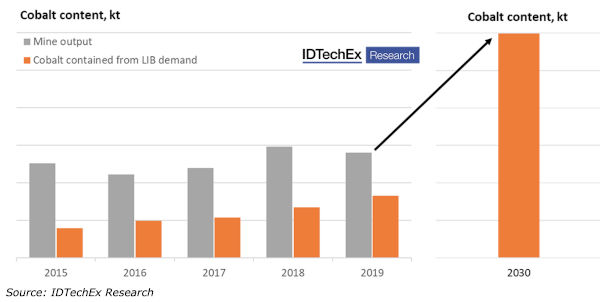
To improve these materials, many have tried incorporating more nickel into these cathodes, which increases their reversible capacity and can replace some of the expensive cobalt required. Increased capacity, and therefore energy density, is of course very important for battery electric vehicles, and IDTechEx anticipates that the proportion of "high-nickel" NMCs (>60% nickel) will increase significantly over the next decade; see the IDTechEx report "Li-ion Batteries 2020-2030" for more information. Recently, the focus has shifted toward reducing the cobalt content itself to minimize reliance on the controversial material. IDTechEx estimates that the amount of cobalt contained in Li-ion batteries by 2030 will be nearly 300 kt. This will be more than twice the amount estimated to be mined in 2019, according to USGS data. The 5- to 10-year lead times required to build new mines suggest that the electrification of transport and the integration of renewables may be at risk of material shortages. Further information can be found in the IDTechEx report, "The Li-ion Supply Chain 2020-2030." Therefore, moving away from cobalt is desirable from several perspectives, and numerous companies and news outlets are reporting on the arrival of low-cobalt and cobalt-free batteries. However, the metal is generally considered essential for stabilizing NMC/NCA materials and reducing cobalt content below 10% without severely degrading cycle life and safety. So, what are the options for moving away from cobalt-containing cathodes?
NMC/NCA – First, there is a general trend toward decreasing the cobalt content of NMC and NCA batteries, and while they are unlikely to become cobalt-free, many are still striving to minimize cobalt and increase nickel content. As noted earlier, the challenge lies in preserving lifetime and cycle stability, and numerous material and design options are being employed to improve these factors. NMC 811 (80% nickel) is reportedly being used in several Chinese electric vehicles, and the trend toward increased nickel content will continue, with patent literature showing major players using and exploring materials with nickel content exceeding 80%; see the IDTechEx report "Li-ion Battery Patent Landscape 2020." Reducing cobalt and increasing nickel content in layered oxides will likely be the solution for increasing capacity and reducing cobalt dependence, even if they are never truly cobalt-free.
NMA – A recent paper from the University of Texas (DOI: 10.1002/adma.202002718) showed promising results for a cobalt zero-layer oxide cathode. Although there was a decrease in capacity (and therefore energy density), the material's stability during cycling at both 25 °C and 45 °C was surprisingly high. Higher temperatures can be achieved in demanding applications such as electric vehicles (EVs), and it will be necessary to demonstrate the stability of their NMA material given the generally higher dissolution rate of manganese, especially at higher temperatures. A possible long-term solution is to exclude cobalt, but the limited capacity improvement restricts the performance benefit compared to the current state of the art.
LFP – A widely commercialized technology that can demonstrate a long cycle life, greater safety, and can be engineered for high capacity. Furthermore, it is a relatively low-cost material (based on $/kg). As a result of these factors, it is well-suited for applications such as electric buses, two-wheelers, certain stationary applications, and has received renewed interest in electric cars as well. However, it is a cathode with an inherently lower energy density, and while there are ways to improve energy density at both the cell and pack levels, LFP batteries are unlikely to be sufficient for long-range electric vehicles.
LMP/LMFP – Lithium-manganese phosphate (LMP) shares the same crystal structure as LFP but operates at a more positive voltage, overcoming one of LFP's major disadvantages. However, cycle life tends to be low due to the high manganese content, while poor electronic and ionic conductivity means that reasonable capacities are generally measured only at low charge/discharge rates, making them unsuitable for EVs. Incorporating iron to form LMFP can improve conductivity and cycle life but reduces the average voltage. Ultimately, LMFP can bridge the gap between LFP and NMC/NCA, but the reversible capacities of LMP and LFP are too low to achieve the cell-level energy densities of cells using NMC or NCA.
LNMO – Lithium-manganese-nickel oxide (LNMO), separated from the oxides of NMC/NCA/NMA layers, is a cathode that operates at a high voltage of 4.7 V vs. Li/Li+, up to 25% higher than NMC, and has also shown promise as a high-rate material. Unfortunately, improvements in energy density are effectively lost because NMC has a comparatively low capacity of around 120 mAh/g, while the high operating voltage will require developments in the electrolyte to ensure stability and safe operation. Improvements in energy density at the cell level are unlikely, but the high voltage could allow for cost and performance benefits at the battery level, provided that electrolyte stability can be demonstrated.
Rich Lithium-Manganese Cathodes (LMR-NMC) – A cathode that is not necessarily cobalt-free but can reduce cobalt content compared to current NMCs and also lower cost through a comparatively high manganese content. This material is one of the few options for significantly improving the capacity of lithium-ion cathodes. LMR-NMC can show a 20–30% capacity improvement over current next-generation NCAs, but it is plagued by lifetime and stability issues. It is another long-term project and an example of the often-seen trade-off between high energy density and cycle life.
The lithium-ion market is constantly pushing for the development of new technologies, with the drive to reduce the cobalt content of NMC and NCA cathodes having recently received considerable attention. However, doing so without negatively impacting overall performance is a major challenge, and cost benefits are not guaranteed, given the relatively low percentages of cobalt already used in next-generation cathode formulations and the increased difficulty of synthesizing low- and high-density cobalt/high-density nickel oxides. Other classes of cathode materials have their own set of advantages and disadvantages. Of course, the ethical implications of cobalt mining should not be underestimated, and companies will likely need to minimize their reliance on this metal in the medium to long term to mitigate supply risks.
As this article is expected to make clear, there is no "silver bullet" cathode technology, and as such, there will continue to be differentiation in the solutions adopted, depending on the market, application, and customer preference.
Author: Dr. Alex Holland, Technology Analyst at IDTechEx