

(batteries, electrolyzers, supercapacitors, and fuel cells). AIMPLAS is focused on developing electrically, ionicly, and thermally conductive plastic materials for use in separators, current collectors, electrodes, and sensors. [VVBA1]
Energy storage systems are key to ensuring the transition to a carbon-neutral economy and the effective integration of renewable energies. They are also crucial for boosting markets based on electric mobility, both for vehicles and portable devices.
The different energy storage systems can be organized into five classes: chemical, electrochemical, electrical, mechanical, and thermal.
Figure 1 details some of the electrochemical storage technologies.
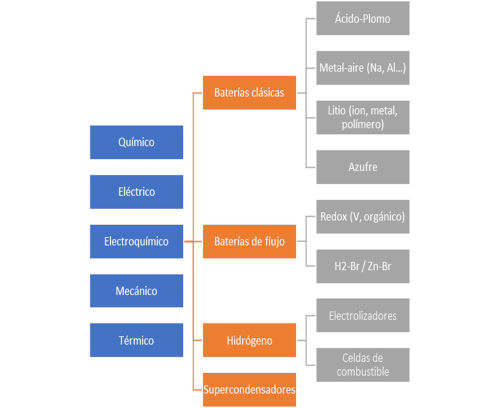 Figure 1. Energy storage technologies and breakdown of some electrochemical technologies. Adapted from EASE 1]
In the field of electrochemical storage, secondary (rechargeable) batteries stand out, with lithium batteries having a long track record and very favorable growth. However, other technologies based on other metals and elements, such as sodium, aluminum, or sulfur, or those that include redox electrolyte pairs, vanadium, or organic compounds, offer very interesting growth potential.
Hydrogen electrolyzers and fuel cells are also destined to become predominant in the electrochemical storage sector, understood as those devices that make electrons and chemical compounds interact to store energy in one another.
Within this range of possibilities, electrochemical devices cover a very broad part of the storage capacity spectrum (Figure 2) of these energy systems.
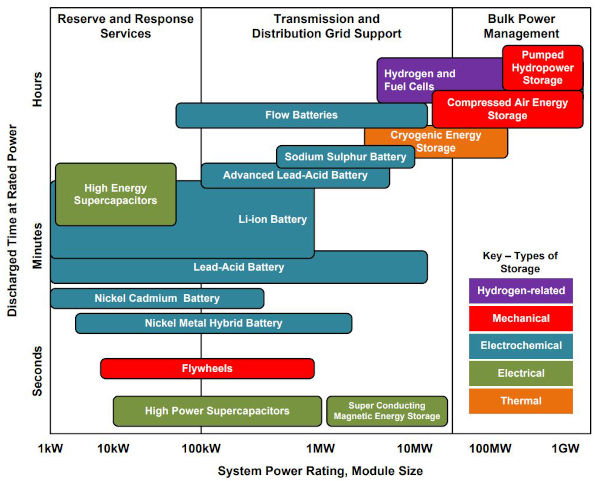 Figure 2. Relationship between storage capacity in terms of power and time for different technologies[2].
In any of these electrochemical devices, there is a similar internal structure in which different components combine to form these devices, capable of transforming electricity into chemical species that subsequently react to generate electricity.
As detailed schematically in Figure 3, these components are:
- Separators (membranes, electrolytes)
- Electrodes (cathodes, anodes)
- Current collectors (connectors, bipolar plates, traces, cables)
- Sensors (temperature, state of charge and health, leakage…)
Figure 3. Components of an electrochemical device.
The names of these components depend on the type of device in which they are installed, but their functions are similar.
The following details the advances and proposals of AIMPLAS for each of the components (or materials) described above, which are the subject of research and development in the AcumularEQ project.
Electrically conductive plastic materials.
Thermoplastic materials play a major role in the energy and electrical-electronic sectors due to their availability in numerous commercial grades, their low cost, their physical-mechanical and chemical properties, their lightness, and the versatility of their processing technologies.
Although polymers are generally insulators by nature (> 10⁻⁷ S/cm), in recent years conductive polymers (~10² S/cm) have been developed, achieving optimal properties for a multitude of applications (Figure 4).
 Figure 4. Conductivity scale (in S/cm) for various types of materials, including some plastics[3].
Possible applications for electrically conductive plastics include bipolar plates, electrodes, photovoltaic cells, diodes, (super)capacitors, transistors, and sensors. To achieve acceptable electrical conductivity values, conventional polymers are often enhanced with carbon materials such as graphene, graphite, carbon nanotubes, carbon fibers, or carbon black. Metallic particles such as steel fibers, copper, or silver or tin particles are also used. Intrinsically conductive polymers could even be used (Figure 5).
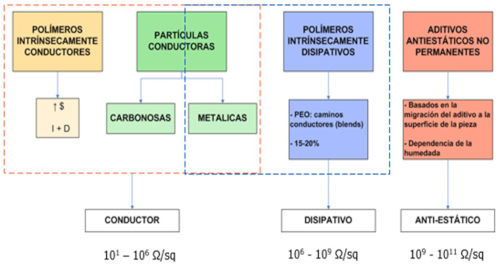 Figure 5. Schematic representation of the conductivity of some plastics, expressed as surface resistivity (inverse of conductivity).
Graphite is an excellent solution for making polymers electrically conductive. This is due to its layered structure, particle morphology, and lower abrasion resistance. However, high quantities of graphite must be used to achieve high electrical conductivities. This makes processing by conventional methods difficult and also reduces mechanical properties such as elasticity and plasticity of the plastic composite[4], [5]. Alternatively, carbon nanotubes offer the advantage of high conductivity values with low loadings, although they are more expensive.
The conductivity of plastic materials is also determined by the nature of the polymer matrix itself.
AIMPLAS is working on several projects to produce plastic composites with electrical conductivity properties. Table 1 details some conductivity ranges obtained with polymer matrices and carbon nanotubes (CNTs).
 Table 1. Conductivities of different polymer and carbon nanotube formulations.
The AcumularEQ project builds upon this prior experience in the development of conductive materials to obtain a panel of conductivities that will offer solutions to various market demands: connectors, heat sinks, and shielding applications. Different combinations of carbonaceous compounds (carbon nanotubes, graphite), metallic compounds (fibers and steel or tin powder), and conductive polymers have been formulated with different polymer matrices to obtain conductive plastics that can be processed using conventional methods. The results will be available in the second half of 2022.
Separators.
On the other hand, plastic materials also have a place as components in electrochemical energy devices due to their electrical insulating properties: separators, membranes, and even solid electrolytes are among these applications.
In this case, the electrical insulating capacity must be complemented by ionic conductivity, that is, the ability to allow ions to pass through it. This step can occur either through chemical affinity or through the polymer's microstructure.
Additionally, these separators must be mechanically resistant to the pressures and flow rates present during operation, as well as the harsh chemical environments within electrochemical devices, intense oxidation conditions, and often extreme pH, which can lead to chemical degradation of the membrane.[6] In some types of batteries, for example, the reduction of ions to their metallic state can lead to the formation of dendrites capable of perforating the membranes and rendering the battery unusable by short-circuiting the electrodes.
Different types of electrochemical energy storage devices exist, depending on the electrochemical reactions that take place, the species involved, the reaction media, the conditions, and so on. This great diversity is linked to the need to design specific separators for each type of device.
Thus, in metal-air batteries, porous organic polymer membranes, inorganic membranes,[7] hybrid membranes,[8] anion exchange membranes[9] and cation exchange membranes are used.[10]
For example, perfluorosulfonic acid (PFSA) membranes have excellent conductivity under the acidic conditions present in vanadium redox flow batteries, but exhibit lower conductivity in other types of redox flow batteries that require alkaline media.[11]
In the case of proton exchange membrane (PEM) fuel cells, polymeric membranes are used through which proton transport takes place. This membrane is a sulfonated polytetrafluoroethylene fluoropolymer introduced by DuPont in the mid-1960s and marketed as Nafion®.
This material is considered the benchmark and basis for comparison in the development of new separators for other applications, due to its excellent properties that complement its high proton conductivity, but not electron conductivity.
These new membranes can be classified into three categories: (i) fluorinated and non-fluorinated polymer membranes (such as polyimides, polysulfones, poly(ethersulfone), and poly(phenylsulfone)), (ii) ceramics, and (iii) hybrid membranes. Figure 6 summarizes some examples of these alternative separators.
 Figure 6. Classification of examples of proton exchange membranes studied.[12]
On the other hand, the use of more sustainable materials than those traditionally used is becoming increasingly important. Specifically, biopolymers such as cellulose, chitosan, starch, gelatin, and agar have been considered as possible options for membrane fabrication [13]. However, these bio-based materials must also meet the high durability, conductivity, and selectivity standards required for most separators.
This is the objective of the AcumularEQ project for separators: to develop materials capable of being used as membranes, separators, and even solid electrolytes using bio-based polymers (and derivatives) with lower environmental impacts.
Printed Electrodes.
Both for their active participation (as a catalyst or catalyst support) and for their function of connecting electrochemical species (for example, porosity), the electrode is a key element in the functionality of electrochemical devices. One of the main challenges is developing printable materials that maintain the required functionality as electrodes.
Developing new materials, and especially new functional inks, presents a clear challenge in obtaining printable materials with high porosity, high electrical conductivity, and greater environmental friendliness, enabling a leap forward in the performance and functionality of the devices developed.
Achieving materials with these characteristics is the objective and innovation that the AcumularEQ project aims to achieve in the field of electrodes.
Printed Temperature Sensors:
Printed electronics, or flexible electronics, is a technology that, while established for some time and with certain commercial applications, is constantly expanding with the emergence of new materials and research into their combinations, opening up a continuous range of new applications and the development of electronic devices. This is the case with new printed temperature sensors.
Temperature is a key variable in a significant number of processes, and there is considerable interest in its monitoring and control as a tool for supervising processes and/or the operation of parts and equipment, as well as predicting their lifespan.
Furthermore, the large number of applications, especially in the increasingly smaller and more complex devices being demanded, creates a need for lightweight, thin, flexible, and versatile flat sensors for integration into complex-shaped parts, providing high added value. Printed sensors, therefore, emerge as the most promising candidates.
The closest developments to printed temperature sensors currently on the market are surface sensors. However, these devices have several limitations or disadvantages. One of the most significant is that, due to their structure, integration into the part being measured is often not direct; instead, they must be installed externally, making them susceptible to interference from the part's thermal insulation and/or external thermal disturbances that can affect the measurement.
The technical development of temperature sensors has been a key objective in sectors such as energy, automotive, aerospace, and healthcare, where monitoring and measuring this variable allows for better process control, reduced energy consumption, and extended product lifespan.
Likewise, a significant amount of research focuses on the use of intrinsically conductive polymers based on inkjet printing technology. While inkjet offers a higher level of definition than other printing techniques, its scalability and production capacity at an industrial level are limited.
Therefore, the application and integration of temperature sensors in energy storage devices, the use of screen printing as a manufacturing technology, and the application of new Positive Temperature Coefficient (PTC) materials proposed in the AcumularEQ project represent an advance and innovation in temperature sensor development and a clear difference from those currently available on the market.
 Figure 7. Examples of some temperature sensors developed by AIMPLAS.
AIMPLAS is developing several temperature sensors for defined ranges (20-80 °C, with a resolution of 0.5 °C and a response time of less than 2 s), according to application needs, which can be directly integrated into electrochemical devices (Figure 7).
The AcumularEQ project is funded by the Valencian Regional Government's Ministry of Sustainable Economy, Productive Sectors, Trade and Labor through grants from IVACE, with co-financing from the EU's ERDF funds, within the ERDF Operational Programme of the Valencian Community 2014-2020. These grants are aimed at technology centers in the Valencian Community for the development of non-economic R&D projects carried out in cooperation with companies for the 2021 fiscal year.
[1] https://ease-storage.eu/energy-storage/technologies/
[2] https://www.researchgate.net/publication/320273548_Housing_Estate_Energy_Storage_Feasibility_for_a_2050_Scenario
[3] González-Velasco, Jaime. (2012). Conducting Polymers.
[4] Müller.MT, KK (2011). Influence of feeding conditions on the electrical and mechanical properties of PP/MWCNT composites in the two-screw extrusion of PP/MWCNT. Compos.71, 1535-1542
[5] Socher.R, KM (2012). The influence of matric viscosity on the MWCNT dispersion and electrical properties of different thermoplastic nanocomposites. Polymer 53, 495-504
[6] Yuan, XZ; Song, C.; Platt, A.; Zhao, N.; Wang, H.; Li, H.; Fatih, K.; Jang, D. A Review of All-Vanadium Redox Flow Battery Durability: Degradation Mechanisms and Mitigation Strategies. Int. J. Energy Res. 2019, 43 (13), 6599−6638
[7] Saputra, H.; Othman, R.; Sutjipto, AGE; Muhida, R. MCM-41 as a new separator material for electrochemical cell: Application in zinc–air system. J. Membr. Sci. 2011, 367, 152–157.
[8] Kiros, Y. Separation and permeability of zincate ions through membranes. J. Power Sources 1996, 62, 117–119.
[9] Kim, H.W.; Lim, J.M.; Lee, H.J.; Eom, SW; Hong, Y.T.; Lee, SY Artificially engineered, bicontinuous anion-conducting/-repelling polymeric phases as a selective ion transport channel for rechargeable zinc-air battery separator membranes. J. Mater. Chem A 2016, 4, 3711–3720.
[10] Dewi, EL; Oyaizu, K.; Nishide, H.; Tsuchida, E. Cationic polysulfonium membrane as separator in zinc–air cells. J. Power Sources 2003, 115, 149–152.
[11] Yuan, Z.; Yin, Y.; Xie, C.; Zhang, H.; Yao, Y.; Li, X. Advanced Materials for Zinc-Based Flow Batteries: Development and Challenge. Adv. Mater. 2019, 31 (50), No. 1902025.
[12] T. Maiyalagan, S. Pasupathi, Components for PEM Fuel cells: An Overview, Materials Science Forum Vol. 657 (2010) pp 143-189.
[13] Alday, PP; Barros, SC; Alves, R.; Esperança, JMSS; Navarro-Segarra, M.; Sabaté, N.; Silva, MM; Esquivel, JP Biopolymer Electrolyte Membranes (Biopems) for Sustainable Primary Redox Batteries. Adv. Sustain. Syst. 2020, 4 (2), 1900110.
[VVBA1]This is what would go below the names
Author: Vicente Vert, Construction and Renewable Energy Researcher at AIMPLAS