

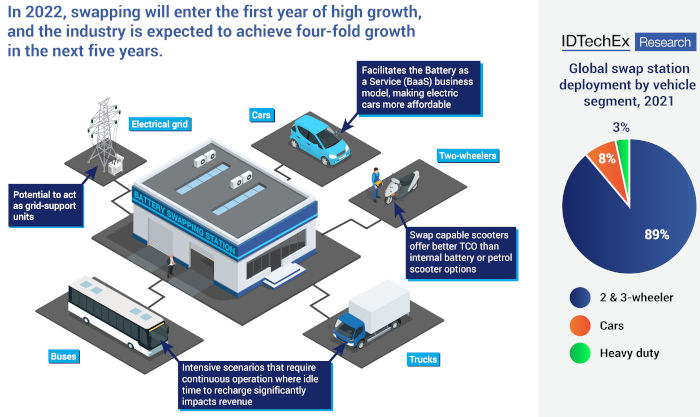
Battery swapping is an emerging technology that aims to address all these shortcomings. In addition to easily upgrading battery technology, reducing the purchase price of electric vehicles (by decoupling the battery cost from the vehicle), and drastically reducing charging times, it's also important to note that battery swapping stations themselves can become independent energy storage facilities capable of balancing the grid. As we electrify various vehicle segments, can battery swapping be considered a viable charging strategy for all of them?
Battery swapping will first come to two- and three-wheeled vehicles
Battery swapping is considered an ideal solution for the burgeoning two- and three-wheeler electric vehicle segment due to its self-service business model, which requires low capital investment. Swapping stations in this segment resemble vending machines, occupying little space and requiring no robotic machinery like that needed for cars or trucks. The high utilization of commercial fleets in this segment means that swapping can directly increase revenue. There is no downtime, no waiting, no power surges, and no need to swipe a card or enter a PIN. It only takes a few seconds to swap and drive away. This makes the two- and three-wheeler segment a promising candidate for adopting swapping technologies. The new IDTechEx report, "Battery Swapping for Electric Vehicles 2022-2032: Technology, Players and Forecasts," covers the various players in this field and compares their swappable battery modules by weight and power capacity.
The cars are showing their potential, but are currently limited to China
Fleet vehicles with high daily mileage are better suited for battery swapping because they are more sensitive to downtime costs. Swapping stations offer a much faster response time for electric vehicles with low charge levels. Furthermore, fleet vehicles are typically of a single model. This eliminates the difficulty of standardizing the different battery connection/locking mechanisms across various EV manufacturers and promotes the use of shared swapping stations, as demonstrated by the partnership between BAIC BJEV and Aulton in China. It also addresses the issue of limited range, improves work efficiency, and increases revenue for fleet operators. Moreover, it has the potential to reduce the initial cost of the EV. Since batteries can be leased, the EV can be purchased without its most expensive component. On average, IDTechEx research suggests that decoupling battery costs can reduce the purchase price of EVs by 20%. The IDTechEx report on battery swapping examines the battery-as-a-service business model and explains why fleets will benefit from using a swapping architecture.
Battery swapping for heavy vehicles is in the pilot phase
The heavy commercial vehicle segment includes buses, trucks, and construction equipment. Nearly all major Chinese heavy truck manufacturers have already launched a battery-swapping model for their electric trucks, including FAW, CAMC, Dongfeng, JMC, Shanxi Automobile, and Shanghai Automotive Industry Corporation (SAIC). IDTechEx forecasts that sales of new energy/electric heavy trucks with battery swapping capabilities will capture more than 30% of the total market share of purely electric heavy trucks in China by the end of 2022. The IDTechEx report includes information on the major Chinese players in the battery-swapping supply chain and the technical specifications of various battery-swapping truck models.
The Korean government has proposed the use of "quick-charging machines" (QCMs), a device installed at a bus station that transforms a suitable bus station into a battery swapping station. This involves using cranes mounted on top of the station to swap batteries between buses that use top-mounted batteries while waiting for passengers. Side-by-side battery swapping on buses is also being successfully implemented in China. The swap is performed from both sides using robotic arms on swap tracks that can screw or unscrew the bus's battery packs. In India, Sun Mobility has also launched its "Quick Swap Station," which facilitates the swapping, charging, and maintenance of electric bus battery packs. IDTechEx believes that heavy-duty trucks and buses, as well as electric construction machinery, are particularly well-suited for battery swapping technology because their fixed operating patterns require minimal downtime, justifying the cost of installing battery swapping stations.
The current state of swapping
Currently, fuel swapping technology appears to be the winner in the two- and three-wheeler markets of the Asia-Pacific region. In China, private cars and taxi fleets are also adopting this technology, with companies setting ambitious targets to deploy their own networks of swapping stations. Swapping trials are also underway in the heavy-duty vehicle segment, largely supported by local governments. The question that remains is whether this technology will reach Europe or the United States. While it is still unlikely to take off in the US, many Chinese OEMs are entering the European market. It is quite possible that they will introduce swapping there as an alternative charging strategy. However, the deployment of swapping stations will remain very limited unless consumers, OEMs, and government agencies demonstrate significant support or interest. The new IDTechEx report, "Battery Swapping for Electric Vehicles 2022-2032: Technology, Players and Forecasts", includes a global overview of swapping across all segments with supporting case studies and offers a balanced perspective on the likelihood of adoption.