Globally, battery demand has reached levels of several terawatt-hours (more than 2.4 TWh in 2023, according to the International Energy Agency), with billions of lithium-ion batteries sold each year. More than 90% of these batteries end up in landfills. The IDTechEx report, "Flexible Batteries Market 2025-2035: Technologies, Forecasts, and Players," includes details on thin and flexible batteries for microenergy applications and the gradual shift toward sustainable alternatives.
Lithium is the primary material used in modern battery technologies. However, its availability depends on lithium extraction. The largest commercial source of lithium is extraction from underground deposits (known as salt flats due to their naturally occurring saline solution), which has a relatively low environmental impact. However, lithium mines are an important secondary source. Currently, lithium mines are not sustainable, as they contribute to water depletion and habitat destruction.
PFAS, or perfluoroalkyl and polyfluoroalkyl substances, are used in multiple stages of battery construction. First, PFAS are used in cathode binders to fix the active material to the electrode and connect the current collector to the electrode. Specifically, PTFE and PVDF are used in rechargeable and non-rechargeable lithium batteries, as well as in other battery chemistries. PFAS are well-suited for this application because they have good adhesive and dispersive properties. Some lithium-ion batteries also use PFAS in liquid electrolytes, for example, Li-triflate, LiTFSI, and LiBETI. Depending on the battery, PFAS can also be used in separator and membrane coatings. They could serve as binders in ceramic separator coatings, for example. Generally, these PFAS have a low environmental impact and are non-toxic. However, as PFAS attract increasing interest from government agencies, they may face increasingly stringent regulation in the future, particularly in Europe, where new standards are expected to be phased in by 2025. The exact scope of these new regulations is yet to be determined, which is a significant motivating factor for innovative new methods of battery production.
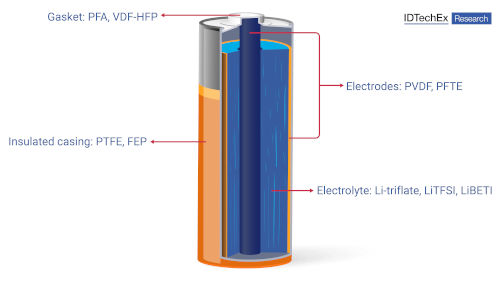
Illustration of some battery components in which PFAS substances may be used. Source: IDTechE
As a result of these factors, many companies have become interested in more sustainable materials and manufacturing methods. IDTechEx has specifically analyzed companies in the thin-film and microenergy sectors in the report "Flexible Batteries Market 2025-2035: Technologies, Forecasts, and Players." Two general trends emerge from this analysis. First, the development of new manufacturing methods and binder materials for traditional lithium chemistries. Second, the development of new chemicals that replace the need for lithium and, in some cases, eliminate the need for PFAS-based binders.
The first approach involves developing dry-curing and energy-curing technologies. Ateios is an example of a company that uses this type of method. Ateios' Raicure™ technology is an energy-curing process for battery electrodes that does not require the use of PFAS. This technology was originally developed by Oak Ridge National Laboratory. Ateios combines energy-curing polymers with battery powder to manufacture its electrodes. During the mixing process, the binder is introduced in fragments, which helps improve blending and dispersion. After coating the sheet, it undergoes a platform process that converts the polymer fragments into an interconnected network, making the electrode more robust. The use of fragmented binders in the mixing process eliminates the need for solvents.
The second approach involves lithium-free chemistries. Among these, printed zinc-carbon and silver-zinc are the most significant in the thin microbattery field. Zinc is more abundant than lithium, its extraction is cheaper, and it is considered environmentally friendly. Zinc is extracted from abundant zinc concentrates, usually zinc sulfide. This sulfide is then oxidized to produce zinc oxide, which is leached to form sulfate. The sulfate is purified, and finally, metallic zinc is extracted by electrolysis. Printed zinc-carbon and zinc-silver are valued for their thinness and flexibility and are used for IoT and logistics applications, especially smart labels. Key players include Zinergy and CCL Design. Their main competition is wallet batteries, most of which are lithium-based, although some zinc-based (zinc-air) chemistries are also used. Differentiation through sustainability is becoming increasingly relevant in this application space, particularly in Europe.
Another example is the development of an alternative fuel cell to traditional batteries. BeFC is a French company developing bioenzymatic fuel cells to replace thin batteries in microenergy applications. These fuel cells are printed on paper and use biocatalytic reactions with glucose to generate energy. They are made of organic materials, making them relatively sustainable. The cells are designed to be easily disposable and single-use. The fuel cell is used in the same way as a battery, although a catalyst is required to initiate energy generation. This catalyst takes two general forms: external stimuli (e.g., biological or environmental) such as sweat, urine, blood, and saliva, which can be used in medical or cosmetic applications, or rainwater or river water for remote sensing applications; and artificial stimuli, namely the company's patented blister reservoir, which can be broken for activation, similar to a mechanical ignition switch. The company focuses on Internet of Things applications, skin patches, and smart tags, especially in cases where non-toxicity and ease of disposal are important.
As concerns grow about material extraction and battery manufacturing processes, and regulations continue to loom on the horizon, battery suppliers that can offer sustainable alternatives to traditional technologies will see increased interest, provided they can maintain functionality.
Author: Daniel Parr, Technology Analyst at IDTechEx