


This article explores the power requirements of these systems, highlights the importance of medical-grade DC/DC converters, and introduces the P-DUKE MPU01 series, distributed in Spain and Portugal by Electrónica OLFER, emphasizing its unique features and contribution to system performance.
Power requirements in medical devices
1. Electrocardiographs.
Electrocardiographs monitor the heart's electrical activity, requiring precise signal processing and low noise. Typical power requirements for these devices include:
• Analog input circuits: Require low-noise ±5V or ±12V power supplies for amplifiers and filters.
• Digital processing units: Operate on 3.3V or 5V for microcontrollers and data processors.
• Display and user interface: Typically require 12V or 24V for backlighting or touchscreens.
• Power consumption varies, but analog circuits demand high stability to avoid signal distortion.
2. Endoscopes.
Endoscopic systems integrate imaging, lighting, and control components:
• Camera modules: Require 3.3V or 5V for image sensors.
• Lighting systems: Use 12V or more for LED or fiber optic light sources.
• Motorized controls: Operate at 24V for precise endoscope movement.
• These systems require isolated power supplies to prevent leakage currents from reaching the patient.
3. Blood Analyzers
Blood analyzers perform chemical and biological tests using sophisticated subsystems:
• Measurement circuits: Require ±12V or ±15V for amplifiers and precision sensors.
• Microcontrollers and communication modules: Typically operate at 3.3V or 5V.
• Pumps and actuators: Use 24V for fluid handling mechanisms.
• A reliable power supply is essential to ensure accurate test results under varying load conditions.
Why use medical-grade DC/DC converters?
Medical-grade DC/DC converters are essential in these devices for the following reasons:
1. Patient safety: Medical-grade converters meet stringent safety standards (e.g., IEC 60601-1) with reinforced insulation, low leakage current, and high isolation voltage. This prevents dangerous electric shocks to patients and operators.
2. Electromagnetic compatibility (EMC): These converters minimize electromagnetic interference (EMI), ensuring that the device does not interfere with other medical equipment or suffer external interference.
3. Isolation requirements: Different voltage domains in medical devices must be electrically isolated to prevent signal cross-contamination and ensure patient safety.
4. Regulatory compliance: Medical devices must comply with global standards, and using certified medical-grade converters simplifies the certification process.
5. Greater reliability: Medical-grade converters are designed for continuous operation in critical environments, providing consistent performance under varying loads.
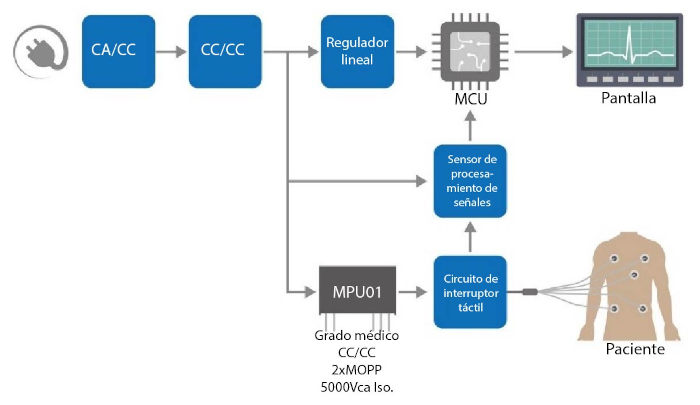
ECG diagram
How Advanced DC/DC Converter Features Improve Medical Device Reliability
1. Enhanced Regulation
Precise voltage regulation ensures stable output even with fluctuations in input voltage or varying loads. In electrocardiographs, for example, poor regulation could distort low-amplitude signals, leading to inaccurate diagnoses. Advanced regulation improves signal integrity in all medical devices.
2. Output Short-Circuit Protection
Short-circuit protection prevents damage to the converter and connected circuits during faults. In critical systems such as blood analyzers, this feature ensures uninterrupted operation by isolating faults without compromising the entire system.
3. Enhanced System Reliability
Features such as thermal shutdown, overcurrent protection, and low ripple contribute to the longevity and reliability of medical equipment. This reduces maintenance costs and improves patient safety by minimizing device downtime. The P-DUKE MPU01 series is a powerful power solution specifically designed for medical applications.
The MPU01 series, included in the OLFER Electronics catalog, is specifically designed for medical applications and offers high safety, reliability and efficiency to meet the diverse demands of modern medical devices.

MPU01 Series
The MPU01 series supports 5V, 12V, 15V, and 24VDC inputs, ensuring seamless integration into various medical devices. Its exceptional isolation performance guarantees patient safety, with an isolation voltage of up to 5kVac and compliance with the 8mm creepage distance requirement of IEC 60601-1, providing reinforced 2xMOPP insulation.
To minimize the risk of electric shock, the MPU01 series is designed with an ultra-low leakage current (>10μA), making it ideal for medical devices in direct contact with patients, such as electrocardiographs. Furthermore, the series offers a variety of single output voltage options, including 3.3V, 5V, 12V, 15V, ±5V, ±12V, and ±15VDC, meeting diverse voltage requirements and simplifying power distribution in medical systems.
The MPU01 series also features an ultra-low isolation capacity of just 15pF, significantly reducing noise and optimizing electromagnetic compatibility. This is ideal for devices such as endoscopes that require high signal integrity. Furthermore, its compact SIP-9 design facilitates integration into space-constrained medical equipment.
In short, the P-DUKE MPU01 series is a comprehensive solution for medical power applications thanks to its safety, diverse output options, and advanced technical specifications, meeting the ever-evolving demands of the industry.

Key features of the MPU01 series
Key Differences of the MPU01
The MPU01 series stands out for its combination of high isolation voltage, ultra-low leakage current, and compact size. These features make it the ideal choice for medical applications where safety, reliability, and space efficiency are critical priorities.
1. Safety Standards
The MPU01 complies with IEC/EN/UL 60601-1 standards for medical devices, ensuring global acceptance and simplifying regulatory approval processes.
2. High Efficiency
With efficiency levels exceeding 85%, the MPU01 minimizes power losses and heat generation, contributing to overall system efficiency and reliability.
3. Competitive Advantage
While many competitors offer similar products, the MPU01's unique combination of low leakage current, high isolation voltage, and compact size delivers unmatched value in critical applications.
Importance of the MPU01 in Medical Systems
The MPU01 series enhances system performance by addressing key challenges in medical device design:
• Its high isolation voltage and low leakage current ensure patient safety in direct contact applications.
• The wide input voltage range simplifies power supply design in diverse geographical environments.
• Advanced features such as short-circuit protection and low ripple improve reliability and signal integrity in sensitive circuits.
By integrating the MPU01 into electrocardiographs, endoscopes, or blood analyzers, manufacturers can achieve superior performance while meeting stringent regulatory requirements.
Future-proof Medical Devices with Safe and Certified Power Solutions
Medical devices demand highly reliable power solutions that prioritize safety, accuracy, and efficiency. The use of medical-grade DC/DC converters is crucial to meeting these requirements while also complying with global standards. The P-DUKE MPU01 series exemplifies excellence in medical-grade power conversion thanks to its advanced features, compact design, and robust safety measures. By incorporating the MPU01 into their designs, manufacturers can ensure the highest levels of performance and safety for life-saving applications.
Author: P-DUKE Technical Department
Translation: OLFER Electronics Marketing Department
Moreinformation