The converters support a nominal input of 12 to 48 V, with a maximum range of 10.8 to 52.8 V, and a programmable nominal output of 5 to 55 V, which can range from 4.7 to 57 V.
These features allow the devices to be used in both step-up configurations and applications requiring specific supply voltages. Considered uses include installations with long cable runs and the provision of an independent, isolated voltage for Power-over-Ethernet (PoE) applications.
The DDSM series enables remote control and real-time monitoring via Modbus through a USB connection. PowerCMC software is used for these operations.
The converters also feature a digital display on the front panel that provides information on settings, device status, and system alarms. Three pushbuttons allow for the configuration and operation of certain functions directly from the unit.
The 120W model provides a nominal output current of 5A, while the 240W version reaches 10A. Efficiency can reach 93% under the operating conditions specified by the manufacturer.
Both models measure 40 × 116.6 × 115 mm (width × depth × height) and weigh 500 grams. They also feature a 24 V/1 A DC-OK signal accessible from the front panel and use push-in connection terminals.
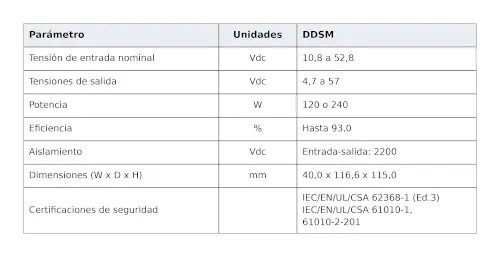
In terms of insulation, the specification between input and output is 2,200 Vdc. The converters comply with the safety standards IEC/EN/UL/CSA 61010-1, 61010-2-201 and IEC/EN/UL/CSA 62368-1 Ed. 3.
The series also bears CE and UKCA markings and, according to the manufacturer, complies with the relevant low-voltage, electromagnetic compatibility (EMC), and RoHS requirements. The models also meet EN 55032-B standards for radiated and conducted emissions and EN 61000-6 standards for electromagnetic immunity.
Due to its electrical characteristics and programming possibilities, the DDSM series is aimed at applications in industrial automation, semiconductor manufacturing, renewable energy generation, telecommunications and test and measurement equipment.