In recent years, the electrification of vehicle systems has increased steadily. This trend, combined with the limited amount of available energy, highlights the need to reduce energy consumption. At the same time, the output voltage of batteries and generators can vary widely, requiring a versatile power supply solution.
With conventional integrated power supply circuits, it is difficult to achieve both fast charging responses to ensure stable operation and high energy conversion efficiency, which would contribute to greater energy savings. The new product, which adopts the advanced original Nano Pulse Control™* power supply technology, enables high-speed operation at 2.2 MHz without interfering with the AM radio band (1.84 MHz max.), while achieving a high reduction ratio. It is an optimal technology for automotive applications.
The BD9P series ensures stable operation during fluctuating battery input voltage, reducing output overshoot to less than one-tenth compared to conventional products. This eliminates the need for the additional output capacitors typically required to mitigate overshoot voltages. Furthermore, the adoption of a novel control method enables both high efficiency and rapid load response (which are in a compensating relationship). The DC/DC converters offer 92% power conversion efficiency at heavy loads (with an output current of 1 A) and 85% at light loads (1 mA), thus achieving class-leading efficiency across the entire load range. This reduces energy consumption, leading to lower CO2 emissions and reduced parasitic battery discharge.
Furthermore, combining the new product with the BD9S series of secondary DC/DC converters cascaded to the next stage allows users to configure faster and more efficient automotive power supply circuits. Reference designs are also available on the official ROHM website. Using reference boards, tools, and ROHM's free web simulation tool, "ROHM Solution Simulator," it is possible to perform simulations closely resembling real-world conditions, significantly reducing design resources for the application.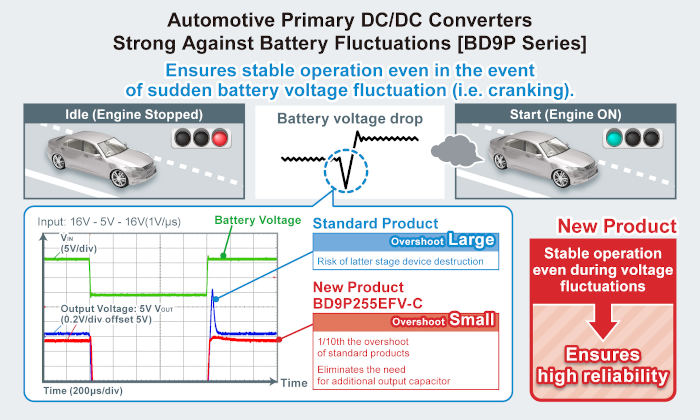
ROHM is committed to supporting the evolution of vehicles by developing products that contribute to lower energy consumption and greater system reliability.
*Nano Pulse Control™ is a trademark or registered trademark of ROHM Co., Ltd.
 ROHM tools significantly reduce the application development burden.
Using ROHM reference designs together with the ROHM Solution Simulator minimizes the working hours for application development at each design stage (i.e., circuit/board/noise/thermal design, simulation).
Reference Designs:
The reference designs (including the BD9P series), which have undergone thermal and electromagnetic compatibility testing in addition to standard electrical characteristic measurements, cover the power supply systems required for ADAS and infotainment functions. Furthermore, in addition to evaluation reports, various tools such as design data, on-board simulation models, and printed circuit board CAD symbols are provided to facilitate evaluation when used with reference board REFRPT001-EVK-001.
Reference design URL: https://www.rohm.com/support/power-managment-evk/solution
Available tools
- Design data (i.e., circuit diagrams, bill of materials, printed circuit board data)
- Simulation models (e.g., SPICE, thermal)
- Printed circuit board library (i.e., CAD tool symbols, footprints)
ROHM
Solution Simulator is a web-based simulation tool that enables comprehensive verification of power device circuits (power semiconductors), controller ICs, and power management ICs within solution circuits. ROHM supports development by offering reference circuits that include new products in the form of trimmed reference designs, along with various tools.
ROHM Solution Simulator URL: https://www.rohm.com/solution-simulator
BD9P Series Product Range:
This new series is offered in 3.3V/5.0V/variable output voltages to suit a wide range of circuits.
(Table)
Application examples include
ECUs (Electronic Control Units), sensors, cameras and radars, ADAS systems
, in-vehicle infotainment, instrument clusters, body control modules (BCMs), etc. These are
automotive applications requiring high efficiency, superior reliability, and smaller form factors.