
Furthermore, the steady decline in grid feed-in tariffs has led to a growing number of facility owners using the energy they produce instead of feeding it into the grid. To maximize self-consumption, storage systems are frequently used in conjunction with energy management systems. These PV storage systems require inverters to have more complex control systems and energy flows than those previously available, as they focus not only on maximizing self-consumption but also on additional functions such as:
- Optimized inverter scheduling to take advantage of off-peak loads
- Improved grid quality
- Emergency power outage function
This article details the new technical characteristics required of current inverters to fulfill these functions.
Energy Flow in Storage Systems
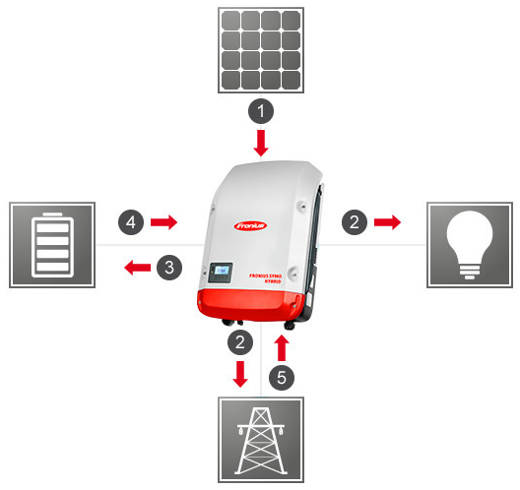
In general, a PV storage system can operate with the following five load flows (Figure 1):
1. PV Generator → Inverter: PV energy
2. Inverter → Consumer or grid injection
3. Inverter → Battery: Battery charging
4. Battery → Inverter: Battery discharging
5. AC Grid → Inverter: Battery charging with AC grid energy
The first two energy flows are typical of PV systems without a storage function.
However, systems with storage must be able to handle energy flows 3 and 4 to charge and discharge the battery.
Energy flow 5, which charges the battery from the AC grid, is not a mandatory requirement for a system with storage, and therefore not all storage systems offer this option.
This latter mode of operation enables many additional applications, some already important today and others that will be in the future, as shown in the examples below:
AC Charging Function.
Although the AC charging function is not the most relevant for optimizing self-consumption, a more detailed analysis shows that many applications are not possible without this function. Charging via AC current can take place using either private or self-generated energy sources (households) or public grids (grid supplies). Examples of AC charging applications can be analyzed from the perspective of the following three stakeholder groups:
From the system operator's perspective
– Coupling with other energy sources (AC coupling):
In recent years, there has been a growing increase in small combined heat and power (micro CHP) installations and even low-power wind farms on the market. In these systems, electricity is available even when PV output is low, i.e., in winter, and the PV storage system is operating below capacity. The AC charging function allows for the temporary storage of excess energy from auxiliary sources for later use.
Furthermore, AC coupling allows for the installation of the storage system within an existing PV system.
Charge conservation:
If for long periods little or no PV energy is available (whether caused by faulty modules, snow-covered PV generators, or other factors), the AC charging function prevents the complete discharge of the storage system and the resulting premature battery deterioration.
Minimum load in emergency situations
: Many PV storage systems include an emergency power supply function in case of a grid outage or failure. Regardless of insulation conditions, the AC load ensures a minimum capacity in the storage system. This also allows for planning to determine if there will be enough time to fully charge the system in the event of a grid outage or failure.
From the perspective of electricity market users:
Time-of-use electricity tariffs.
The introduction of smart meters has allowed electricity distribution companies to offer their customers time-of-use electricity tariffs. This enables energy storage systems to be supplied with electricity from the grid during off-peak periods, and then use this energy during peak periods. This is especially useful during times of low sunlight.
Use of Flexible Storage Systems for Grid Optimization and Balancing:
The role of electricity markets (kWh markets), and their respective participants, is to achieve the greatest possible balance between supply (production) and demand (consumption) before electricity is needed. For the optimal integration of these energy sources into the market, especially PV and wind power due to their natural fluctuations, forecasting tools with a variety of options are required. One such option is decentralized battery storage (which combines to form a “virtual power plant”).
From the perspective of the electricity grid operator:
Improved grid quality.
The significant increase in PV systems connected to the grid translates into greater responsibility for these systems in providing service and ensuring quality across the grid. The use of energy storage systems means that PV systems can play a crucial role in maintaining the necessary voltage and frequency levels in the distribution network. The additional function of charging batteries with AC grid electricity (after passing through the DC inverter) provides the PV system with greater versatility.
Participation in the electricity balancing market:
The electricity grid operator compensates for electrical imbalances by managing electricity production when production and instantaneous demand do not coincide. Electricity management is therefore carried out according to the grid's needs to achieve a balance between electricity demand and production. Just as the electricity system operator uses this grid capacity (see below), decentralized battery storage offers a flexible electricity management option based on the needs of both the user and the grid.
Multi-Flow Technology
The energy flows described in the previous section are necessary to ensure the optimal performance of the PV storage system. Not only is the inverter required for these operating modes, but it is also relevant to know if the current flows can occur in parallel (simultaneously). The Multi-Flow technology used in the Fronius Symo Hybrid series represents a comprehensive approach to energy flow control, in which the inverter becomes the intelligent control center for all current flows. The following examples illustrate the advantages of storage systems with Multi-Flow technology.
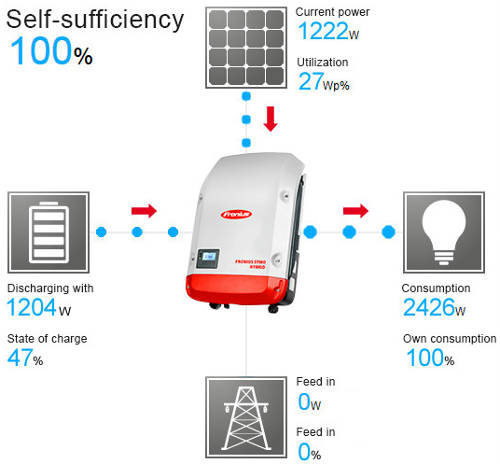 Simultaneous supply of energy from the PV system and battery to the home
To meet the home's energy needs, the PV system supplies power, with any shortfall covered by the battery.
Without Multi-Flow technology, meaning if energy flows cannot occur in parallel, the PV system would not be able to meet the household's needs, even with stored battery power. Furthermore, the PV system would have to shut down, resulting in energy loss.
'
 Battery charging and home power supply with PV:
If the PV system's power output exceeds the home's consumption, the excess energy is stored in the battery. This excess energy is not fed into the grid until the battery is fully charged.
Without Multi Flow technology, the inverter would have to reduce its power, resulting in energy loss.
'
 Simultaneous home power supply and battery charging with PV and other energy sources:
To meet home energy needs, energy produced by the PV system and other energy sources (e.g., a small wind turbine or CHP) is used, with surplus energy simultaneously stored in the battery. This achieves a much greater level of autonomy, even during the winter months.
Systems without Multi Flow technology are not capable of using the battery to temporarily store energy from other sources.
'
 Covering energy consumption in emergency situations using PV power and a battery.
In emergency situations, household energy consumption can be covered simultaneously by a PV system and a battery. Therefore, emergency operation continues even when the battery is discharged, assuming that the power produced is greater than the power consumed.
In the case of a system without Multi Flow technology, the PV system energy often cannot be used for emergency operations and is therefore lost.
'
6 Summary
The demands placed on inverters in an energy storage system are greater than those of a conventional PV system without storage. The inverter in a modern storage system must perform intelligent control for each energy flow, as well as maximize self-consumption. To ensure no energy loss and achieve the highest energy efficiency levels, all energy flows must be able to be supplied simultaneously. For certain applications, this is only possible with the AC charging function, thus making this function even more critical.
The Fronius Energy Package and Multi Flow technology meet the stringent control system requirements of a modern energy storage system. Multi Flow technology enables the storage system to be used with a wide variety of applications, both now and in the future.