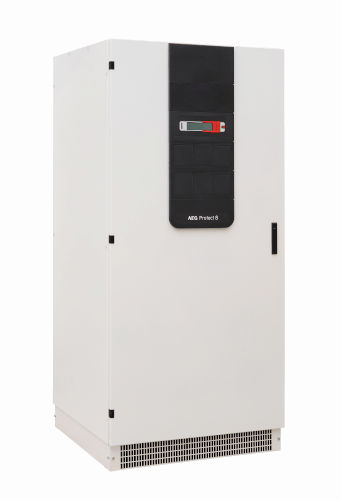
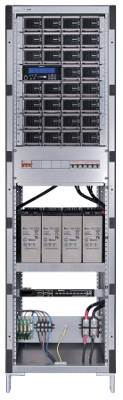
 Salicru's new DC POWER-S energy systems include DC-S rectifier modules, available in power ratings of 1,000, 2,000 and 2,700 W and in output voltages of 48, 110 or 125 Vdc. Its modular design allows up to four modules to be installed in a 2U 19” subrack, achieving very high power density and enabling expansion as needed, thus optimizing investment. It also features a control and monitoring system for
managing the entire system: input and output measurements, battery charging currents, control of priority and non-priority loads, and external communication channels.
The maximum number of rectifiers controlled by a single control system is 30, enabling systems up to 81 kW, with the option of N+n redundant configurations. The basic version of its communication module includes three programmable relays, a battery temperature sensor, and an RS-232/485 channel. The extended version adds an Ethernet/SNMP adapter slot, an electrolyte level detection input for Ni-Cd batteries, and six additional relays. All of this is housed in a
fully enclosed cabinet with the option to include batteries.
Features
Maximum power per system up to 81 kW
Flexible, scalable, and redundant N+n systems, configurable for current demand and future expansions
High power density in modules, up to 27 W/in³
High efficiency, up to 95%, even with low load
Single-phase or three-phase power supply option
Power systems with output voltages of 48, 110, or 125 Vdc
Wide operating temperature range, from -20°C to +55°C
Wide input voltage range, from 90 Vac to 290 Vac
Unity input power factor for improved performance
Modular design of rectifiers and control system
Output current sharing among rectifiers
Front access for easier installation and maintenance
Hot-swap function Hot-plug with automatic adjustment for module connection/disconnection
LLVD & BLVD – disconnection of non-priority loads and low battery voltage
Complete local control and monitoring system with LCD (4x40 characters)
Communication unit for remote monitoring
Monitoring software via Ethernet/SNMP
Smart-mode to maximize MTBF (Mean Time Between Failures)