

A significant technological evolution
The first UPS systems marketed in the 1960s were designed to stabilize the output voltage and continue supporting the load, without interruption, in the event of a failure of the main network supply, and with limited reliability.
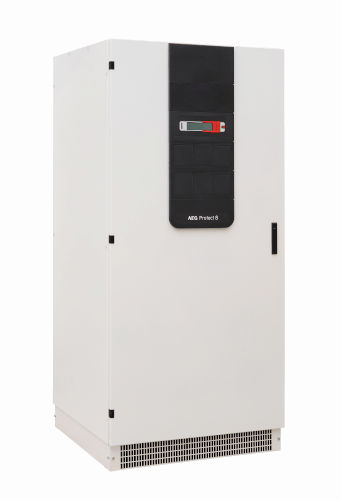
The evolutionary chain of UPS systems continued in the 1970s with the introduction of the Static Bypass, which allowed for uninterrupted load transfer to the backup power grid in the event of an inverter failure or overload, with an architecture that substantially improved overall reliability.
And in recent years, the rise of cloud has enabled significant technological advancements in UPS systems. The absolute necessity of keeping large amounts of data secure in large server infrastructures like data centershas led to a demand for much higher levels of reliability in security systems. And the latest generation of UPS systems has delivered.
These critical loads cannot rely on a single UPS power configuration with Static Bypass, but they can rely on a UPS with a high number of modules in parallel, redundantly arranged in a rack.
In response to evolving market demands, UPS manufacturers like Salicru have been developing their architecture in recent years to improve efficiency and performance. The reliability of a redundant parallel UPS depends heavily on the failure rate of the parallel bus, which is the most critical point of failure. However, in redundant parallel UPS chains, the static bypass and their control electronics, as well as the mains voltage, are all redundant components and therefore have a negligible impact on overall reliability.
Modular technology and its advantages
Modular UPS systems consist of a large number of modules connected in redundant parallel configuration and represent the logical evolution of parallel UPS systems. But what are their advantages?
Among other advantages, the high reliability of the repetitive, assembly-line manufacturing of identical modules stands out, allowing for the selection of redundancy levels based on criticality. High availability is also noteworthy; with the same reliability as a conventional UPS, availabilities (A) of 5 or 6 nines can be achieved simply by selecting the appropriate redundancy level.
To optimize system efficiency, improving module performance and intelligent management are the two main approaches. In the first case, the single-module design facilitates the optimization of power converters for maximum performance by selecting the appropriate topology and components. In the second case, considering that a module achieves maximum performance at around 75% of the load, that the system is redundant, and that the load may not be constant, system management criteria can be applied to ensure that only the necessary modules operate, maximizing their performance. Furthermore, cycling can be implemented to equalize the operating time of all system modules, thereby optimizing their reliability.
In the specific case of Data Centers, a redundant parallel modular system offers a particularly important advantage, as it facilitates obtaining a high rating (Tier III or IV), guaranteeing better levels of reliability and availability, not only due to the strict specification of the UPSs used but also due to the complete design of the DC environment, the cooling system and the electrical distribution to critical loads.
Furthermore, the modular structure allows for greater scalability, making it easy to adapt to any type of installation and its future evolution. It also allows for greater flexibility by combining Power Modules with Battery Charger Modules for extended runtimes without needing to oversize the UPS system.
 Other parameters of interest
Other advantages offered by a modular UPS are the following:
- Low MTTR: The redundant modular structure can offer high system availability depending on several factors such as: hardware reliability, redundancy against the failure of some element and speed with which the failure is repaired, that is, achieving a low "Mean Time To Repair" (MTTR).
- Improved TCO (Total Cost of Ownership): This will be achieved by improving OPEX (Operating Expenses) thanks to the fact that with modular systems, maximum energy performance of the module and the overall system is achieved with proper management.
- Reduction of CAPEX (Capital Expenditures): mainly because the manufacture of a large number of identical modules allows the development of economies of scale that improves the manufacturing costs of UPSs and guarantees high price competitiveness.
Of course, there is still a long way to go in the overall improvement of the performance of each module, as well as in the efficiency of managing the complete modular system, but it will undoubtedly be in the field of modular systems where the development of the UPSs of the future will be concentrated.
Salicru's SLC ADAPT, an example of modularity
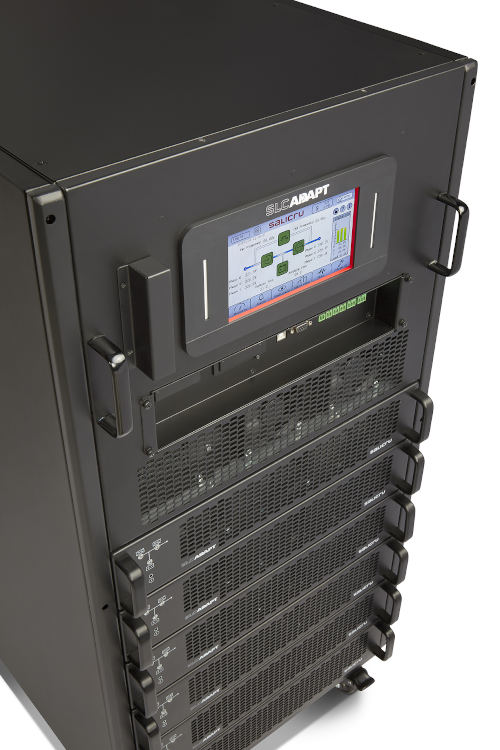
An example of modularity in uninterruptible power supplies for equipment and systems is the SLC ADAPT. This is a range of UPS systems from Salicru that offer redundant protection for critical applications such as data centers of all capacities, IT infrastructures, modular and virtualized data centers, and services that require high-level electrical protection to ensure reliable, continuous, and high-quality operation.
The SLC ADAPT series is made up of modular online double conversion technology solutions , with DSP control technology and a three-level IGBT inverter, and with a wide range of power module levels, which enables very high flexibility/scalability.
One of the main features of the SLC ADAPT series is its adaptability, as it allows configurable solutions from 10 kVA to 1500 kVA, thanks to the wide range of available modules (10, 15, 25, 30 and 50 kVA), the different configurable systems (2, 3, 4, 6, 8 or 10 modules) and the parallel/redundant option of up to 3 systems of 500 kVA.
Another feature is their availability, since hot-swap can be added or replaced during operation, improving mean time to repair and maintenance costs.
Furthermore, the system's remote management, which can be integrated into any platform, simplifies its operation. And the extensive backup available, along with intelligent battery charging, ensure the continuous operation of the protected critical loads.
Finally, to conclude the description of this innovative Salicru UPS, it's worth highlighting its high reliability. The DSP control, combined with three-level PWM technology, enhances response efficiency and, together with load redundancy, significantly increases mean time between failures (MTBF). Furthermore, both the control display and the bypass module can be replaced without affecting the unit's operation.
Albert Carrera, Marketing Director of Salicru.
More information:
SLC ADAPT technical specifications
White Paper Salicru – Modular UPSs: Are they really more reliable?