High-voltage silicon carbide (SiC) MOSFETs are the key designers need to break free from the limitations of silicon. Figure 1. An entire fleet of electrified commercial vehicles will benefit from high-voltage SiC MOSFETs.
For nearly two decades, SiC power devices with nominal voltages from 650 to 1200V have been commercially available. This has finally allowed designers to introduce disruptive advancements in technologies and end-use equipment, simultaneously improving performance, reliability, size, weight, and even cost. The recent announcement of a 1700V SiC product family extends the numerous advantages of SiC across the supply chain to change the power conversion paradigm in new end-use segments, such as the electrification of commercial and heavy-duty vehicles, traction and auxiliary power for light rail, renewable energy, and industrial drives.
This article details the advantages that 1700V SiC MOSFETs offer over silicon solutions at various power levels, from watts to megawatts.
From tens to hundreds of watts.
For such a low power level, what need is there for a 1700V transistor? Although there is only one, it is ubiquitous: the auxiliary power supply, found in all power electronics systems, is essential for the operation of industrial motor drives, electric vehicles, data centers and backup power, solar inverters and charging infrastructure, among other applications. The auxiliary power supply is critical to the system because it powers gate drivers, sensing and control circuits, and cooling fans; therefore, the auxiliary power supply cannot fail, and the associated risks must be mitigated.
Since these isolated, low-power switched-mode power supplies are used in a variety of applications worldwide, they must support a wide range of high DC input voltages (300 to 1000V) and deliver a low output voltage (5 to 48V). Perhaps the most effective method for minimizing failures is the design of a simplified circuit. As shown in Figure 2, the most reliable circuit design is the single-switch flyback topology (Fig. 2, right), which is notable for its simplicity and lower component count, offering the added advantage of reduced overall cost.
The advent of 1700V SiC MOSFETs provides an ideal solution for auxiliary power supplies. These devices, characterized by their high breakdown voltage, lower on-resistance, and fast switching speed, are well-suited for the single-switch flyback topology. In contrast, silicon-based solutions are characterized by a voltage rating that is too low, requiring a two-switch architecture (as shown in Figure 2, left) and doubling the potential for failure, or they have a suitable voltage rating but low efficiency. Furthermore, there are few suppliers, and their price is higher compared to SiC.
Along with their improved reliability, simpler control technique, fewer components, and lower cost, a 1700V auxiliary power supply using SiC MOSFETs can also be smaller. The normalized on-resistance (Ron,sp) of SiC MOSFETs is much lower than that of silicon MOSFETs. This means smaller packages can be used because the semiconductor material die is also smaller. Conduction losses are also lower, which can ultimately reduce the size of the heat sinks, or even eliminate them. Furthermore, SiC MOSFETs have lower switching losses, which simplifies reducing the size, weight, and cost of the transformer, as the switching frequency increases.
 Figure 2. The two-switch topology (left) using silicon transistors can be replaced by a flyback topology (right) with a single switch, which is much simpler, improves performance and is less costly thanks to the 1700V SiC MOSFETs.
From tens to hundreds of kilowatts
: Moving to higher power levels, 1700V SiC MOSFETs also offer many advantages over silicon MOSFETs and IGBTs in applications ranging from tens to hundreds of kilowatts. Examples include string inverters and solar power plants, auxiliary power supplies in commercial vehicles, induction heating and welding machines, industrial drives, and wind turbine converters, among others.
As the processed power increases, so do the effects of SiC's faster speed and more efficient switching. Compared to silicon IGBTs, SiC MOSFETs reduce switching losses by an average of 80%, allowing converters to increase switching frequency and reduce the size, weight, and cost of bulky and expensive transformers. And although the conduction losses of SiC MOSFETs and silicon IGBTs are similar under heavy loads, many applications spend most of their lifespan operating under light loads. Examples include solar inverters operating on cloudy days or in shaded areas; wind turbine converters on windless days; and train doors (opened/closed by auxiliary transport sources) that are closed most of the time. With these common light loads, SiC MOSFETs offer lower conduction losses to complement their reduced switching losses, thus enabling reduced heat dissipation and other thermal management measures.
From a reliability standpoint, SiC MOSFETs allow designers to simplify circuit topology and control techniques, as well as reduce the number of components, all of which naturally contribute to lower costs. The higher power requirements of these medium-power converters necessitate the use of a higher DC bus voltage, typically between 1000 and 1300V. When selecting silicon transistors for these high DC link voltages, the required efficiency forces designers to choose from a few complex three-level circuit architectures. Figure 3 shows the neutral-point blocked (NPC) diode circuit, the active NPC circuit (ANPC), and the T-type circuit. In contrast, 1700V SiC MOSFETs allow designers to overcome these limitations and return to the more elegant two-level circuit shown on the right side of Figure 3. This effectively halves the number of devices and optimizes control.
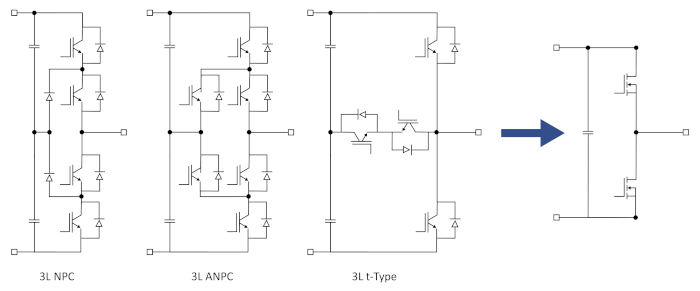 Figure 3. The complicated three-level circuit topologies (left) using silicon IGBTs can be simplified to the more elegant and reliable two-level topology (right) using half (or less) 1700V SiC MOSFET modules.
It is worth mentioning the importance of power packaging and proper gate control in SiC MOSFETs. Since SiCs can switch high power levels at very high speeds, care must be taken to avoid voltage spikes and reduce noise emissions. Medium-power converters in these applications often switch hundreds of amperes on a 1000–1300V bus in less than a microsecond and require the lowest possible package inductance, intelligent, fast-triggering gate drivers, and optimal system layout.
The combination of the SP6LI power package and Microchip Technology's AgileSwitch® family of digital gate drivers provides designers with ready-made solutions to easily get the most out of 1700V SiC MOSFETs.
Megawatts
For multi-megawatt power applications, the main design factors are ease of scalability and minimal maintenance, which encourage the use of modular solutions based on a basic unit cell. As shown in Figure 4, these cells, sometimes called power electronic blocks or submodules, are configured as cascaded half-bridge converters or multi-level modular converters (MMCs). Megawatt-scale applications include solid-state transformers (SSTs), distributed medium-voltage DC systems, traction power systems in commercial and heavy-duty vehicles, central solar inverters and offshore wind turbine converters, as well as power conversion systems on ships.
Historically, the power semiconductor devices used in these unit cells have been 1200–1700V silicon IGBTs. Much like in lower-power applications, using 1700V SiC MOSFETs at the cell level expands their power handling capacity and electrical performance. As noted earlier, 1700V SiC MOSFETs have much lower conduction losses, allowing for higher switching frequencies and a significant reduction in the size of each unit cell. Furthermore, the high blocking voltage of 1700V decreases the number of unit cells required for the same DC link voltage, increasing system reliability and reducing cost.
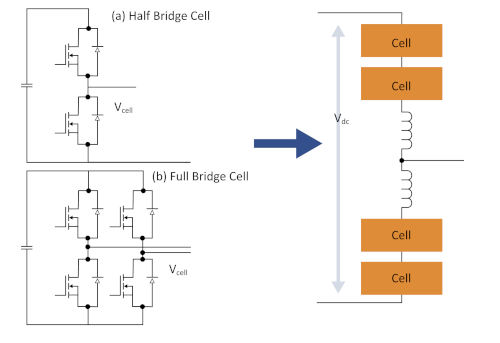 Figure 4. (Left) Multilevel modular converter with multiple cells to achieve the required power, and (right) two examples of how a simple two-level unit cell configuration can be used with 1700V SiC MOSFETs.
Summary:
The arrival of 1700V SiC MOSFETs is beneficial for a variety of applications and end-user equipment, offering increased reliability at a reduced cost, while simultaneously enabling smaller, lighter, and more efficient converters. From watts to megawatts, high-voltage SiC MOSFETs allow designers to overcome silicon's limitations and introduce significant improvements to power conversion systems. Along with the most robust SiC power devices on the market, advanced power packaging with ultra-low parasitic inductance and digital gate drivers help designers fully leverage SiC and accelerate time to market.
Microchip Technology has expanded its SiC portfolio with the introduction of 3.3 kV SiC MOSFETs
with the lowest on-resistance [RDS(on)] on the market and SiC SBDs (Schottky Barrier Diodes) with the highest current rating, allowing designers to take full advantage of their robustness, reliability, and performance. Microchip's 3.3 kV MOSFETs and SBDs complement the company's extensive SiC product range, consisting of unpackaged, discrete devices, modules, and 700V, 1200V, and 1700V digital gate drivers.
AUTHOR: Xuning Zhang and Kevin Speer, Microchip Technology