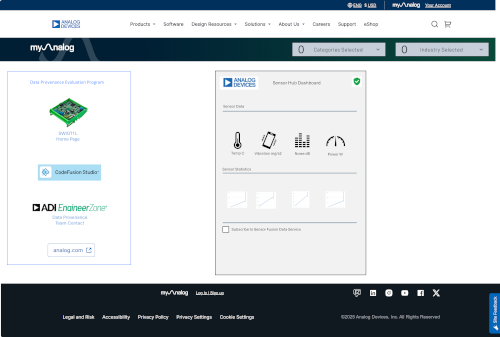
The new Data Provenance Software Development solution establishes a framework of trust for data created at the Intelligent Edge, ensuring that data remains reliable and maintains its integrity from creation to consumption or storage. Early access kits and software downloads for the solution will be available through the ADI Developer Portal on April 25.
“The workload for embedded systems developers is more complex than ever, from increasingly sophisticated processors to the new challenges of multiple development teams and a more demanding security environment,” said Rob Oshana, Senior Vice President of ADI’s Software and Digital Platforms group. “We’ve heard from customers time and again that they want to be able to more quickly and easily manage their systems design, allocate resources, rapidly demonstrate proofs of concept, and do so with data integrity at the edge—all of which inspired this expanded offering of CodeFusion Studio™ System Planner and Data Provenance Software Development solutions.”
In recent years, embedded devices have seen exponential increases in processing speed, number of cores, functionality, and complexity, resulting in reduced costs and space requirements, but also increased complexity in software development processes. Legacy development tools often lack the flexibility and customization needed to integrate seamlessly into these processes and established codebases, which are fundamental to effective modern system design. ADI's CodeFusion Studio™ System Planner addresses many of these challenges in project creation and resource partitioning across complex and heterogeneous devices.
Utilizing a licensed, open-source architecture, ADI's CodeFusion Studio™ System Planner enables flexible project creation across multiple cores and graphical allocation of memory and peripheral resources. The offering also includes configuration tools that are aware of the real-time operating system or firmware platform used by a given core, exposing context-aware configuration settings for a peripheral or memory block allocated to a core. With greater insight into system performance and accessible, open-source tools for improving resource allocation, developers are better equipped to effectively optimize their designs.
In addition, System Planner allows developers to generate the code they need through a plugin-based project creation system. This system offers developers maximum flexibility while providing a common set of configuration tools. A suite of plugins for common firmware platforms—Zephyr RTOS, ADI SDK, etc.—is included, but customers are free to duplicate and modify these project creation and configuration plugins to suit their needs. The plugin system utilizes a template engine under the hood. Static files are modified by replacing strings in specific locations, and the code generation logic can be augmented with JavaScript or TypeScript functions.

Finally, System Planner provides a graphical utility for partitioning memory resources, assigning partitions to one or more cores. This utility is intended to help customers generate linker scripts or Device Tree memory overlay files. Peripheral blocks can also be graphically assigned to a core, with RTOS-compatible configuration settings.
In addition to the CodeFusion Studio™ System Planner, ADI is also announcing an update to ADI Assure™ Trusted Edge Security Architecture with the early access release of the company's first Data Provenance software development solution that ensures data trust and traceability for customers throughout its lifecycle.
Now available in early access, ADI's new Data Provenance solution establishes a framework of trust for signal chain data, ensuring that data created at the Intelligent Edge retains its integrity, authenticity, and fidelity as it moves through the system. The Data Provenance solution enables the addition of secure metadata, enhancing the trust and fidelity of the generated data. Fidelity is achieved by adding information about the data's history throughout its journey. Trust is established through robust cryptographic proof, allowing users to more easily assess the authenticity and integrity of their data across complex networks, whether used for simple dashboard visualizations or sophisticated machine learning models.
By establishing end-to-end trust and improving data fidelity, Data Provenance enables more accurate and reliable model outputs and greater precision in decision-making. Immediate applications include building more reliable AI algorithms or models that run on authentic, high-quality data; extracting verified information from sensors to improve understanding of signal chain outcomes and operational reliability; simply reducing data waste; and facilitating integrity and authenticity testing.
“We’re not only meeting customers’ needs for simplified development tools and data trust today, but we’re also working on additional solutions to support the integration of artificial intelligence and machine learning models into embedded systems,” said Oshana. “Stay tuned in the coming months for further extensions to the CodeFusion Studio™ platform as we empower customers to more easily deliver products with embedded intelligence.”