Immersion silver is a high-quality surface finish with excellent characteristics, offering high coplanarity and making it suitable for application on the most demanding PCBs on the market with BGA components and fine-pitch pads. However, it's important to note that, like everything, it has its drawbacks. From the manufacturing stage, it must be handled with gloves due to its sensitivity to light, humidity, and temperature. Therefore, it must be stored in an appropriate environment and for no longer than six months, as this is its estimated lifespan.
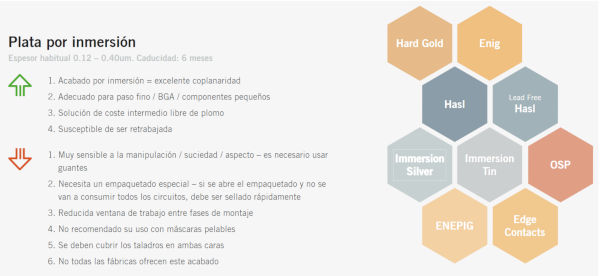 The following details the care required for this finish, from the factory process to component assembly: In the factory, handling is performed with sulfur-free gloves to avoid contaminating the product. Prolonged exposure to light, air, and humidity is minimized. It is vacuum-packed as quickly as possible with pH-neutral, sulfur-free paper separators between the PCBs, and each package includes a silica gel desiccant packet. Until shipment, the material should be stored in a location free from sunlight and strong acidic, alkaline, or organic solvents, at a temperature of 25°C and humidity below 50% RH. Once the material arrives at its destination, it is also recommended to keep it in a location free from sunlight and strong acidic, alkaline, or organic solvents, at a temperature of 23 ± 3°C and humidity below 50% RH. If any of the vacuum-sealed packages are damaged during transport, or if it becomes necessary to open any of these vacuum-sealed bags at the destination, they should be re-vacuum-sealed with their separator papers and silica gel desiccant packet inside, and stored again in a location as described above. It is recommended to handle the material with sulfide-free gloves, avoiding contact with the metallized areas of the PCB. When assembling components onto these PCBs, the selection of components to be mounted must always follow the FIFO (First In, First Out) rule by date code. The first component assembly process must be carried out within 8 hours of opening the package, and the second assembly process within 24 hours of unpacking. Furthermore, after unpacking, the temperature and humidity in the work area must be maintained at 25°C.
It is recommended to begin the component assembly process by performing a test with a few components to verify solderability before starting production of the first batch. The optimal usage time is within 3 months of the date code printed on the PCB, with a shelf life of 6 months from the date of manufacture. One advantage of this surface finish is the possibility of reprocessing it, thus extending its shelf life by another 6 months. NCAB could advise the client during the design phase both in the choice of surface finish and in other fields related to the design and manufacture of printed circuits.
Author: Enrique García-Rico